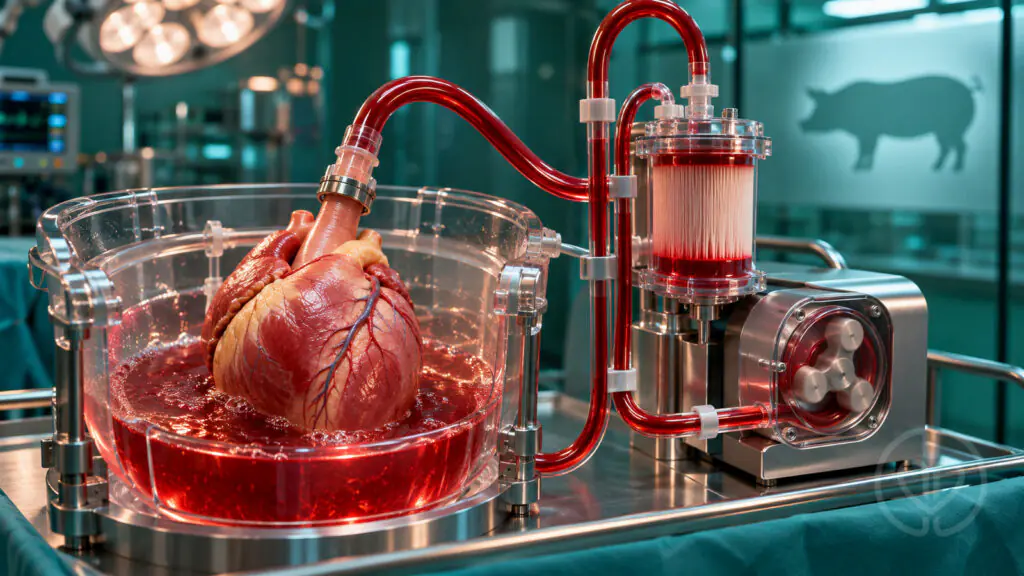
Beating-heart xenotransplantation may offer a way to avoid the planned ischemic intervals that occur during conventional donor-heart procurement and implantation. Wolbrom and colleagues describe continuous normothermic coronary perfusion in a pig-to-baboon model, including one non-survival experiment and one recipient that survived 55 days. The report establishes technical feasibility, but it does not demonstrate that the method prevents early graft dysfunction or improves survival.
Why Maintain Perfusion Throughout Transplantation?
Porcine cardiac xenografts face both preservation injury and major immunologic barriers. Conventional arrest, storage, and implantation interrupt coronary blood flow; ex vivo perfusion can shorten these interruptions but may still require ischemic periods at connection and implantation. The investigators developed a circuit intended to maintain oxygenated coronary perfusion while the donor heart remained warm and beating through procurement, transport, and implantation.
Their proposed benefit is less ischemia-reperfusion injury and, potentially, less perioperative cardiac xenograft dysfunction. These are hypotheses requiring comparative testing. Continuous perfusion does not by itself establish adequate tissue oxygen delivery or the absence of myocardial injury.
Study Design and Donor Selection
The initial proof-of-concept experiment used a 16-kg GGTA1-knockout pig donor and a 24-kg baboon recipient, with planned euthanasia one hour after separation from cardiopulmonary bypass. That recipient had high pretransplant anti-pig antibody activity and received no induction immunosuppression.
The survival experiment used a 5.0-kg donor pig with a single GGTA1 gene knockout and a 5.3-kg baboon selected for relatively low preformed anti-pig antibody activity. The donor was negative for porcine cytomegalovirus. The recipient received intensive immunosuppression, including costimulation and complement blockade. This was an uncontrolled animal feasibility study, not a human trial or a comparison of preservation strategies.
Beating-Heart Xenotransplantation: The Perfusion Approach
A Separate Coronary Perfusion Circuit
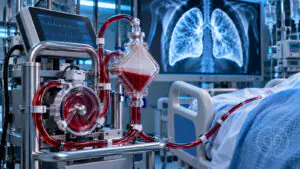
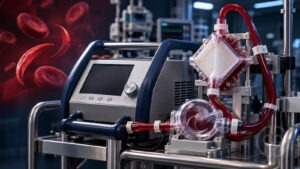
The donor-heart circuit used a Spectrum Quantum Charlotte frame, a LivaNova D100 oxygenator, a reservoir, and small-bore tubing. Antegrade inflow entered the proximal ascending aorta. Right atrial drainage and a left ventricular apical vent joined a common return line. A pump sucker recovered spilled blood for recirculation.
The circuit was primed with donor pig heparinized blood and a reported 135-mL additional priming mixture. Coronary flow was maintained at 60–100 mL/min in this experimental setting. The heart was removed while perfusion continued, placed in a sterile basin, and transported to an adjoining operating room with the circuit. These values describe the reported animal technique and are not human operating targets.
Recipient Bypass and the Transition to Recipient Perfusion
A separate cardiopulmonary bypass circuit supported the recipient during implantation. After completing the left atrial and aortic anastomoses and deairing the left heart, the team stopped the coronary circuit and removed the cross-clamp to establish recipient-derived coronary perfusion. The remaining anastomoses were then completed.
This handover is central to the technique: the preservation circuit must support coronary flow until the recipient circulation can take over. Cannula security, avoidance of kinking, temperature control, ventricular decompression, blood conservation, and deairing all remain relevant perfusion concerns.
What the Experiments Showed
| Finding | Reported result |
|---|---|
| Non-survival experiment | 34 minutes on the donor-heart circuit; separation from bypass without inotropes or vasopressors |
| Survival experiment | 41 minutes on the donor-heart circuit; recipient bypass time 2 hours 25 minutes |
| Early survival-case ventricular function | LVEF 15.8% initially, improving to approximately 50% at 12–14 hours |
| Later ventricular function | LVEF 55.9% on day 8, 43.9% on day 29, and 38% on day 42 |
| Survival endpoint | Death on postoperative day 55, attributed by the authors to probable antibody-mediated rejection in the setting of suspected infection and reduced immunosuppression |
The first recipient maintained sinus rhythm and life-supporting cardiac output during the planned observation period. Histology did not show morphologic evidence of hyperacute rejection, ischemic injury, or edema at that early endpoint.
The survival recipient had a more complicated initial course. Dobutamine was required after chest closure, lactate peaked around 12 mmol/L, and early echocardiography showed severe left ventricular dysfunction with valve regurgitation. Function improved over the next several hours, and the recipient was extubated within 24 hours. These findings prevent interpreting continuous perfusion as proof that early dysfunction was eliminated.
Blood Management and Later Complications
Initial bypass hematocrit in the survival experiment was 18%. The investigators removed 250 mL of circuit volume through hemoconcentration. Subsequent bleeding after antithrombotic therapy prompted interruption of heparin and transfusion of additional irradiated baboon blood. These observations highlight how small-recipient circuit volume, oxygen delivery, bleeding, and anticoagulation interact.
The report contains an important blood-prime inconsistency: the Methods specify 100 mL of irradiated, washed third-party baboon whole blood in the recipient circuit, whereas the Results describe 100 mL of donor pig blood. The actual recipient-circuit blood source therefore needs clarification. Separately, the authors acknowledge an unquantified transfer of porcine blood with the donor heart and identify its immunologic consequences as an unresolved question.
A left ventricular apical mass appeared near the prior vent-cannula site on day 21. Cannulation injury was suspected, but histologic assessment was inconclusive. Later, suspected central-line infection led to interruption and reduction of mycophenolate. Ventricular function subsequently deteriorated; terminal pathology was interpreted as antibody-mediated vascular injury. The proposed relationship among infection, reduced immunosuppression, and rejection remains an interpretation of a single case.
What This Means for Perfusion Practice
The report presents perfusion as a continuous preservation process extending into implantation. It also demonstrates that a small donor heart can be supported with a dedicated coronary circuit assembled from existing components. Whether this approach can be reproduced reliably, scaled, transported over longer distances, or integrated safely into clinical transplantation remains unknown.
Future evaluation should compare the method with established preservation strategies and document coronary pressure, myocardial oxygen delivery, metabolic trends, ventricular distension, blood exposure, and cannulation complications. A beating heart and maintained circuit flow are encouraging observations, but they are incomplete measures of graft protection.
Limitations and Disclosures
Only two procedures are described, and only one was intended for survival. There was no randomized allocation, matched comparator, or basis for estimating complication rates or survival benefit. Donor genetics, recipient selection, intensive immunosuppression, and postoperative care cannot be separated from the effect of preservation. Survival of one single-gene-edited graft does not establish that additional genetic modifications are unnecessary.
The animal work received Columbia University institutional approval. Funding included an American Heart Association Collaborative Sciences Award and NIH support; the authors declared no commercial or financial conflicts of interest. This summary addresses preclinical research and does not establish a clinical treatment protocol.
Original Article
Wolbrom DH, Matsumura N, Moroi MK, et al. Nonischemic and normothermic beating cardiac xenotransplantation. Frontiers in Transplantation. 2026;5:1984456. Published October 30, 2026. doi:10.3389/frtra.2026.1984456.
The source PDF is unchanged and is available under its original CC BY license. The cover is an AI-generated editorial illustration, not an exact representation of the study circuit.