Heater-cooler infection control remains an important part of perfusion safety long after the Mycobacterium chimaera outbreak prompted changes in cardiac operating rooms. A 2026 German survey reports that environmental monitoring has eased in many responding departments, while some technical precautions have expanded. The findings describe local practice; they do not demonstrate that less frequent sampling is safe or that heater-cooler contamination has been eliminated.
What the Survey Examined
Sebastian Schulz-Stübner distributed an anonymous online questionnaire to directors of German cardiac surgery departments through the German Society for Thoracic and Cardiovascular Surgery. Twelve of 78 departments responded, approximately 15%. Their annual cardiopulmonary bypass volumes ranged from about 300 to 2,800 procedures, and the responses included equipment from major heater-cooler manufacturers used in Germany.
The survey collected information about device types and location, cleaning and disinfection practices, and microbiological surveillance of water and operating-room air. It collected no patient-level data and did not measure postoperative infection rates or compare outcomes between surveillance strategies.
How Monitoring Practices Changed
| Practice or finding | Earlier outbreak response | Current survey report |
|---|---|---|
| Routine water sampling for nontuberculous mycobacteria | 12 of 12 departments | Two departments discontinued sampling; intervals were reduced in several others |
| Routine operating-room air sampling | 4 of 12 departments | 3 of 12 continued |
| Heater-coolers outside the operating room | 4 of 12 departments | 5 of 12 departments |
| Positive environmental samples | NTM detected in water and, less often, air | No positive water or air samples reported in the most recent 12 months |
Water-sampling intervals during the initial response ranged from monthly to yearly. Air sampling, when used, initially occurred every three to six months. The paper describes a general move toward less intensive surveillance, although the small dataset and differences between its abstract and Results wording limit precise interpretation of the extent of that change.
Negative Samples Do Not Establish Absence of Risk
No positive samples in a reporting period is reassuring, but its meaning depends on how often and where samples were taken, the laboratory methods used, and the number of devices tested. Reducing sampling can also reduce opportunities to detect contamination. This survey cannot distinguish a true fall in contamination from changes in surveillance intensity.
The paper reviews separate microbiological studies showing persistent NTM colonization in heater-cooler water systems despite disinfection, and reports involving manufacturers beyond LivaNova. Those studies provide context; their contamination rates should not be treated as findings from these 12 German departments or as current infection risks for a particular device model.
The report also discusses M. chelonae aerosolization in another center. M. chelonae and M. chimaera are distinct organisms within the broader NTM group. Detecting an organism in water or air does not by itself establish transmission to a patient.
Heater-Cooler Infection Control in Perfusion Practice
The author proposes continued water surveillance, with intervals of three to six months in centers with consistently negative results, and targeted air sampling when NTM are detected in water. These are the author’s practice recommendations, rather than intervals validated by a clinical trial or an infection-outcome comparison.
For U.S. teams, the survey should be interpreted alongside current manufacturer instructions, institutional infection-prevention policy, and applicable regulatory advice. The FDA’s recommendations for water-based heater-cooler devices emphasize adherence to current cleaning and disinfection instructions, documented maintenance, and directing exhaust away from the sterile field. The FDA advises considering environmental sampling when contamination is suspected; it does not establish the survey author’s three-to-six-month interval as a universal schedule.
Device location and exhaust management deserve attention alongside microbiology. Moving a unit outside the operating room requires planning consistent with its instructions and the facility’s engineering and perfusion requirements. The survey does not establish that relocation alone eliminates exposure, or that air sampling alone can certify a device as safe.
Limitations and Reporting Inconsistencies
The low response rate and small sample create substantial selection bias: responding departments may have different resources or surveillance practices from nonrespondents. Historical practices were recalled retrospectively, and the study did not independently verify microbiological results, adherence to disinfection procedures, or patient outcomes. Its descriptive design cannot identify the most effective monitoring strategy.
The abstract and Results report historical water positivity in four departments, while a Discussion paragraph gives three. The paper also uses inconsistent date wording for the outbreak-response period. This summary avoids choosing between the conflicting historical water counts. Neither discrepancy changes the central finding that responding departments reported less surveillance, but both warrant caution when interpreting exact figures.
Funding and Disclosures
The work was funded by the German Consulting Center for Infection Prevention and Control, which is also an author affiliation. The author declares no competing interests and acknowledges use of DeepL for English-language assistance. Participation was voluntary and anonymous; no patient data were collected.
Original Article
Schulz-Stübner S. Current infection control measures regarding Heater Cooler Units (HCU) in Germany after the mycobacteria chimaera outbreak 2014–2026. GMS Hygiene and Infection Control. 2026;21:Doc72. Published October 7, 2026. doi:10.3205/dgkh000681.
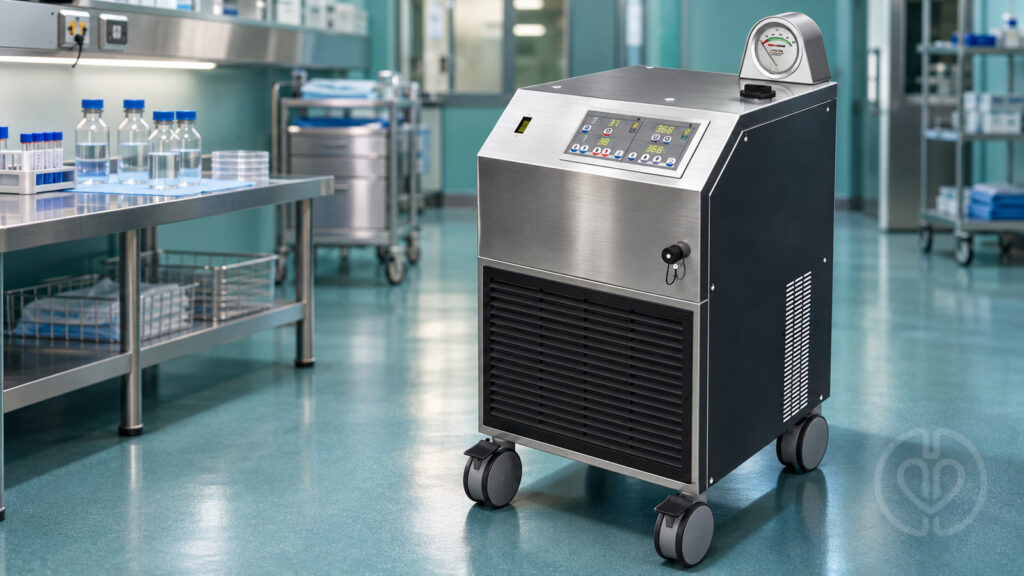
The source PDF is unchanged. The cover is an AI-generated editorial illustration modeled on a 3T heater-cooler; it does not depict a documented contamination event or provide equipment setup instructions.