ECMO in sickle cell disease remains a rescue option supported by limited evidence. A systematic review by Flurin and colleagues pooled seven retrospective studies involving 252 patients and estimated mortality at 64.5%, with wide uncertainty and substantial variation between studies. These findings describe severely ill patients who received ECMO; they do not measure its benefit compared with conventional treatment.
What the Review Included
The investigators searched four databases for studies published from January 2000 through January 2025. Seven retrospective cohorts entered the quantitative analysis, while 22 individual case reports were considered separately in the narrative review. Patients with sickle cell trait alone were excluded.
The largest cohort, an ELSO registry analysis, contributed 208 of the 252 patients. Other cohorts were much smaller, with three to 22 patients each. The populations differed in age, indication, illness severity, and ECMO configuration. Acute chest syndrome accounted for 107 of 252 indications; other patients required support for different cardiopulmonary conditions.
ECMO in Sickle Cell Disease: Mortality Findings
| Group | Pooled mortality | 95% confidence interval |
|---|---|---|
| Overall | 64.5% | 39.3–86.0% |
| Adults | 73.0% | 50.4–90.6% |
| Children younger than 18 years | 53.0% | 43.2–62.6% |
| Venovenous ECMO | 54.5% | 23.4–83.3% |
| Venoarterial ECMO | 83.3% | 35.9–99.6% |
| Acute chest syndrome | 66.7% | 39.1–86.2% |
The overall estimate had substantial heterogeneity (I² = 80%). It should not be interpreted as the expected mortality for every patient with sickle cell disease receiving ECMO.
Why 64.5% Is Different From the Raw Death Proportion
The paper also reports 122 deaths among 252 patients, approximately 48%. That crude proportion is different from the 64.5% random-effects estimate because the meta-analysis pools study-specific proportions using statistical weights rather than dividing all deaths by all patients. Small cohorts with high mortality influence the pooled estimate differently from their contribution to a simple patient count.
Mortality timing also deserves care: the Results text describes these deaths as occurring during ECMO, whereas table captions refer to in-hospital mortality. This summary retains the paper’s general term “mortality” rather than treating all reported endpoints as a uniformly defined discharge outcome.
ECMO Configuration Reflects the Clinical Problem
Higher observed mortality with venoarterial support does not demonstrate that VA-ECMO caused worse outcomes. Patients needing circulatory support may have profound shock, pulmonary hypertension, right ventricular failure, cardiac arrest, or multiorgan dysfunction. These conditions differ substantially from isolated respiratory failure managed with venovenous support.
Exploratory study-level meta-regression suggested higher predicted mortality in cohorts containing more adults or more patients with acute chest syndrome, and lower predicted mortality in cohorts with more VV-ECMO. With only seven studies, these patterns cannot separate age, disease severity, configuration, and timing. They are not individual patient risk predictions or evidence that switching configuration would improve survival.
Complications and the Hemolysis Evidence Gap
Among patients with available data, hemorrhagic complications excluding intracranial bleeding occurred in 57 of 236 patients, thrombotic complications excluding intracranial ischemia in 22 of 236, and neurologic complications in 31 of 214. Renal replacement therapy was reported in 83 of 236 patients. Different denominators reflect incomplete reporting.
Hemolysis was systematically assessed in only one study, which reported increased lactate dehydrogenase during support. This is a major limitation in a disease already associated with hemolysis and microvascular injury. The review cannot quantify how much additional hemolysis the circuit causes or establish the safety of a particular pump, oxygenator, anticoagulation regimen, or transfusion strategy.
Relevance for Perfusion and ECMO Teams
The authors emphasize care in centers with expertise in both ECMO and sickle cell disease, alongside treatment of acute chest syndrome and hemolysis, including transfusion or exchange transfusion when appropriate. ECMO supports gas exchange or circulation while the underlying disease process is addressed; it does not resolve the full biology of a sickling crisis.
For perfusionists, the review highlights the importance of coordinated assessment of respiratory and right ventricular function, bleeding and thrombosis, hemolysis, and transfusion requirements. These are practice considerations raised by the review, rather than management protocols validated by its data. It does not establish HbS targets, anticoagulation thresholds, flow settings, transfusion triggers, or criteria for withholding ECMO.
Limitations and Interpretation
All included studies were judged to have serious overall risk of bias, primarily from confounding and selection. Evidence spanned a long treatment period, and the largest registry population differed from the small adult cohorts. Individual patient information was incomplete, preventing reliable adjustment for severity, cannulation timing, cardiac arrest, and co-interventions.
The case reports had lower reported mortality but were excluded from pooling and are particularly susceptible to publication bias. Their successful rescues cannot establish an average treatment effect. Conversely, high mortality in selected ECMO recipients cannot show that support is futile without an appropriate comparison group.
The most useful conclusion is the need for prospective, disease-specific registries that consistently capture indication, severity, timing, configuration, transfusion, anticoagulation, hemolysis, and outcomes. The authors report no external funding and no competing interests.
Original Article
Flurin L, Vidal E, Parent T, Rollé A. Outcomes of extracorporeal membrane oxygenation in critically ill patients with sickle cell disease: a systematic review and meta-analysis. Annals of Intensive Care. 2026;16:100194. doi:10.1016/j.aicoj.2026.100194.
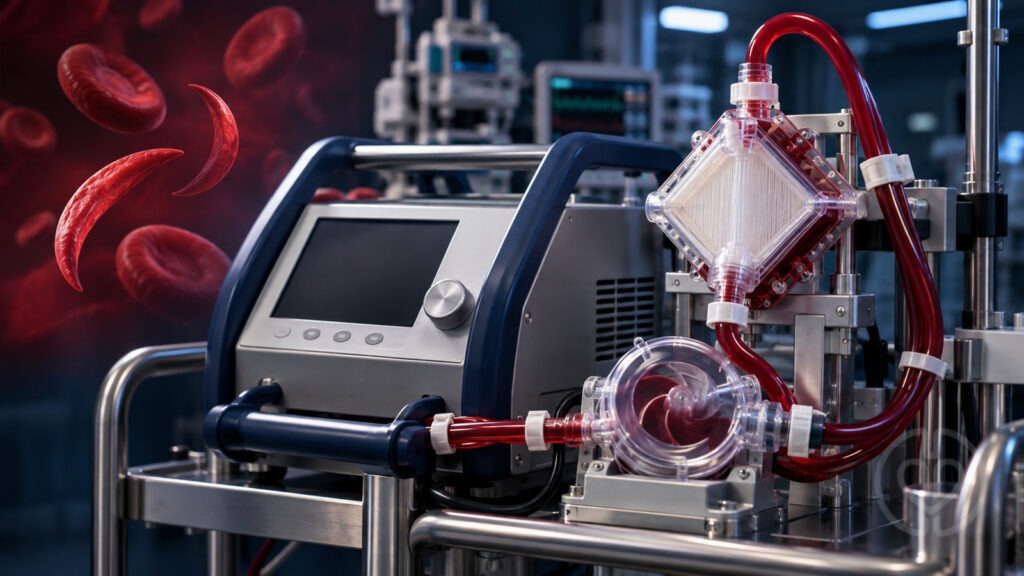
The source PDF is unchanged and is published under a Creative Commons Attribution license. The cover is an AI-generated editorial illustration, not a circuit assembly or cannulation guide.