Readmission after heart valve surgery affected approximately one in 14 patients in a retrospective cohort from northeastern Thailand. Mechanical valve implantation, postoperative acute kidney injury, and longer cardiopulmonary bypass duration were associated with higher adjusted odds of returning to the treating hospital within 28 days. Anticoagulation-related problems were the most frequently documented reason for readmission.
Study Design and Population
Sittiwong and colleagues examined open heart valve operations at a tertiary cardiac referral center during 2021–2025, with readmission ascertainment through January 28, 2026. From 1,543 operation records, the analysis retained 1,336 unique adults after exclusions and removal of repeat operations. Patients who died before discharge, left against medical advice, or transferred directly to another hospital were excluded.
The median age was 60 years and median bypass duration was 140 minutes. The cohort included valve repair, replacement, and combined procedures. The outcome was an unplanned inpatient admission to the same hospital within 28 days after discharge, regardless of cause. Admissions elsewhere were unavailable, so the observed proportion does not represent all-hospital readmission.
Readmission After Heart Valve Surgery: Key Findings
There were 97 readmissions, corresponding to 7.26% of the cohort (95% confidence interval, 5.93–8.79%). Anticoagulation-related problems accounted for 24.7% of readmissions, followed by heart failure at 18.6% and arrhythmia at 13.4%.
| Factor or comparison | Adjusted odds ratio | 95% confidence interval |
|---|---|---|
| Mechanical valve versus repair without replacement prosthesis | 3.98 | 1.97–8.25 |
| Mechanical versus bioprosthetic valve | 2.95 | 1.65–5.32 |
| Acute kidney injury by creatinine criteria | 2.00 | 1.10–3.53 |
| Each additional 30 minutes of bypass | 1.16 | 1.03–1.29 |
The authors selected adjustment variables on clinical grounds and used penalized regression to reduce small-sample bias. Six sensitivity analyses produced broadly consistent findings. Nonetheless, adjustment cannot eliminate confounding from differences in disease, procedure complexity, prosthesis selection, or post-discharge care.
Anticoagulation and Mechanical Prostheses
Most anticoagulation-related returns involved an INR outside the target range without documented bleeding. Nineteen of the 24 anticoagulation-related readmissions occurred in mechanical valve recipients. This supports attention to anticoagulation transitions, but the study did not measure treatment intensity or time in therapeutic range and cannot establish the mechanism behind the prosthesis association.
The results should not be used alone to select a biological rather than mechanical valve. Prosthesis choice involves considerations beyond short-term readmission, and treatment allocation was not randomized.
Relevance for Perfusion Practice
The bypass-duration association links an intraoperative measure with recovery after discharge. Longer runs may also reflect more demanding operations or greater illness severity. The study does not show that shortening bypass by a specified number of minutes prevents readmission, and it did not compare perfusion techniques, oxygen-delivery targets, or renal-protection protocols.
For multidisciplinary quality review, bypass duration and postoperative renal injury may help identify patients whose transition home deserves closer assessment. The authors propose evaluating discharge processes that document the INR target and testing arrangements, renal-function follow-up, and patient recognition of bleeding or fluid overload. These are candidates for service evaluation; their effectiveness was not tested in this cohort.
Limitations and Interpretation
Single-center retrospective records limit generalizability. Readmissions elsewhere and deaths after discharge were not captured. Excluding transferred patients may introduce selection bias. Kidney injury classification used one postoperative creatinine measurement with nonstandardized timing and lacked urine-output criteria. Exact discharge and readmission dates were unavailable in the analysis dataset, preventing time-to-event analysis.
Day-7 follow-up attendance cannot establish whether early follow-up works, because an earlier readmission could itself prevent attendance. The model also showed modest discrimination, with an optimism-corrected c-statistic of 0.65 and calibration slope of 0.81. It should not be used as an individual risk calculator.
The authors report university grant support and no conflicts of interest. They disclose AI assistance for language editing and review of statistical code, with author verification and responsibility for the final manuscript.
Original Article
Sittiwong G, Anpanya O, Silarat S, Banharak S. Factors Associated with Unplanned 28-Day Index-Hospital Readmission After Open Heart Valve Surgery: A Retrospective Cohort Study. Vascular Health and Risk Management. 2026;22:659252. doi:10.2147/VHRM.S659252.
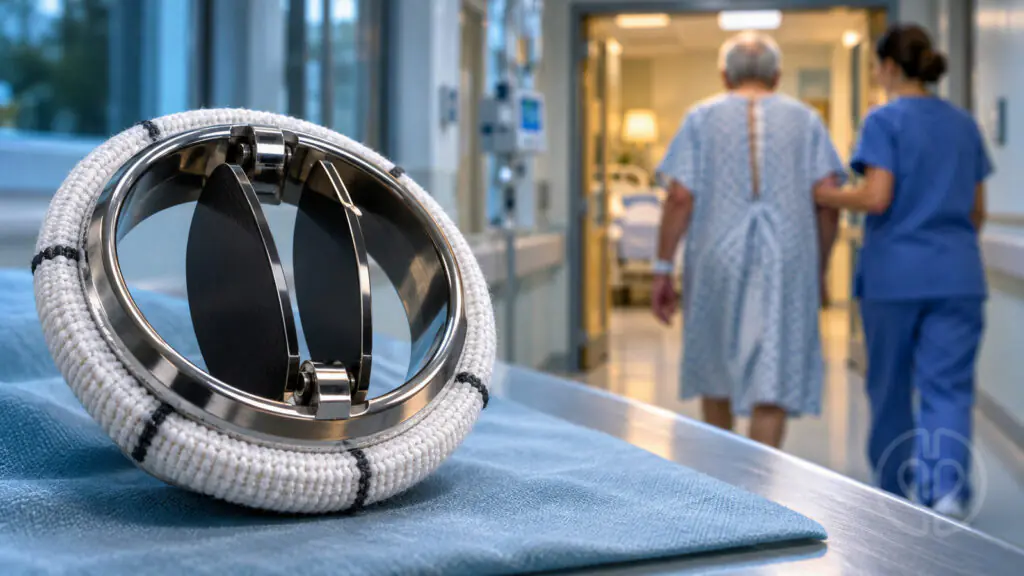
The source PDF is unchanged. The cover is an AI-generated editorial illustration.