Research summary: A four-center randomized trial compared activated clotting time targets of at least 400 and 480 seconds in 1,021 adults undergoing first-time cardiac surgery with coated bypass circuits. Red-cell transfusion rates met the prespecified equivalence criterion (19.1% versus 17.2%). The lower target reduced heparin and protamine exposure and produced small reductions in postoperative blood loss. Findings are specific to the tested protocol and ACT devices; rare-event safety remains uncertain.
Why the ACT target matters
Anticoagulation is essential during cardiopulmonary bypass (CPB), but the amount of heparin needed to protect the extracorporeal circuit has consequences after bypass. Larger doses require more reversal with protamine, and both drugs can affect postoperative hemostasis. Activated clotting time (ACT) is widely used to guide this balance. Gorter and colleagues examined whether a minimum target of 400 seconds could achieve red-cell transfusion outcomes equivalent to the commonly used 480-second target in contemporary cardiac surgery with biocompatible coated circuits. Their trial addresses a practical perfusion question without establishing a universal replacement threshold for every device or surgical setting.
Four-center randomized equivalence trial
The investigators studied adults undergoing first-time elective cardiac surgery at four hospitals in the Netherlands. The intention-to-treat population included 1,021 patients: 510 assigned to the lower ACT target and 511 to the higher target. Most underwent coronary bypass or valve surgery, with smaller numbers receiving combined procedures or aortic surgery. Allocation was randomized in blocks and stratified by hospital. Surgeons and intensive care personnel were blinded; perfusionists and anesthesiologists knew the allocation because they administered the anticoagulation protocol. The primary transfusion outcome was assessed per protocol, while secondary endpoints used intention-to-treat analyses and safety outcomes used an as-treated population. Sensitivity analyses supported the primary finding.
What the anticoagulation protocols involved
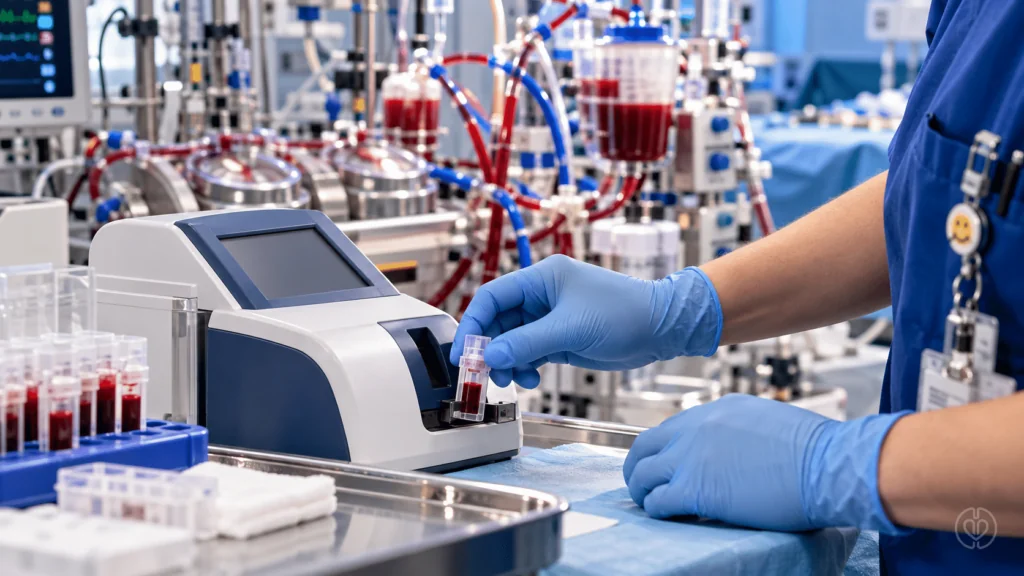
The lower-target group initially received 250 IU/kg of heparin, compared with 350 IU/kg in the higher-target group. Additional heparin was administered to reach the assigned minimum ACT. The circuit prime contained 7,500 IU and 10,000 IU, respectively. ACT was measured with Hemochron Signature Elite or Hemochron Jr. Signature Plus systems. After CPB, protamine reversal followed a specified ratio based on the heparin needed to establish anticoagulation. The circuit setup used biocompatible coated tubing and conventional extracorporeal equipment; local surgical and perfusion practices otherwise varied. These are descriptions of the study intervention, not standalone dosing instructions. The comparison concerns two complete heparin and reversal strategies, not an isolated ACT number detached from equipment and monitoring.
Primary result: equivalent red-cell transfusion rates
Packed red-cell transfusion occurred in 19.1% of patients in the lower-target group and 17.2% in the higher-target group. The estimated risk difference was 1.9 percentage points, with a 95% confidence interval from -2.9 to 6.6 percentage points. Because that interval remained within the predefined equivalence boundaries of -7 to +7 percentage points, the study met its primary equivalence criterion. This is more informative than simply finding a nonsignificant difference: the investigators specified an acceptable margin in advance. It also means the result allows differences within that margin; it does not prove identical outcomes. The initial sample-size plan of 1,536 was revised to 1,010 after an interim analysis found a lower overall transfusion rate than expected. The final study population exceeded that revised requirement.
Less heparin and protamine, modestly less bleeding
Mean total heparin exposure was 35,182 IU in the lower-target group versus 47,346 IU in the higher-target group. Mean protamine exposure was also lower, at 20,167 versus 27,634 IU. Median postoperative blood loss was 260 versus 300 mL at six hours and 480 versus 550 mL at 24 hours, favoring the lower target. These differences were statistically significant, but the authors considered their clinical importance limited. Hemoglobin was slightly higher with the lower target at six hours and the following day. Importantly, the reduction in measured drainage did not translate into a lower primary red-cell transfusion rate. A broader secondary endpoint combining receipt of red cells, plasma, or platelets was 31.9% versus 38.3%, favoring the lower-target group, with p = 0.045. That secondary finding should be interpreted separately from the primary equivalence result.
Safety findings require careful interpretation
Reported thromboembolic event frequencies were broadly similar, and no circuit components required replacement because of thrombus formation. Nevertheless, small thrombi were observed in the venous or cardiotomy reservoirs in eight lower-target patients and five higher-target patients. The investigators reported no subsequent adverse events linked to those observations. Cerebrovascular accidents occurred in six versus three patients in the as-treated populations. One-year mortality was eight versus nine patients. These small event counts do not establish equivalence for stroke, thrombosis, or death. The authors explicitly noted that the trial was not powered to detect differences in thromboembolic complications. A transfusion-focused equivalence trial therefore cannot settle every safety question about reducing anticoagulation intensity.
Who and what the results do not cover
The eligibility criteria excluded reoperations, emergency surgery, circulatory arrest, minimized extracorporeal circuits, planned temperatures below 32 degrees Celsius, infective endocarditis, coagulation-factor abnormalities, preoperative hemoglobin below 10.5 g/dL, and preoperative unfractionated heparin. These exclusions substantially define the population to which the findings apply. The trial did not evaluate ACT targets below 400 seconds. It also used specific Hemochron devices, and the authors emphasized that ACT values are not directly interchangeable across instruments with different measurement methods or activators. Applying the numerical target to another device, deep hypothermia, or a different circuit requires separate assessment. Contemporary institutional standards and the patient’s circumstances remain central to any protocol review.
Methodological strengths and limitations
The multicenter randomized design, substantial sample size, prespecified equivalence margin, and consistent sensitivity analyses strengthen the transfusion finding. Important limitations remain. The clinicians managing heparin and transfusion were not fully blinded. Transfusion decisions followed patient blood-management recommendations rather than a rigid universal hemoglobin cutoff, leaving room for clinical interpretation and differences between centers. Patients withdrawn before receiving treatment were not followed, and major protocol deviations led to exclusions from the primary per-protocol analysis. The investigators examined multiple secondary outcomes, so isolated secondary p-values warrant caution. The trial also tested a selected elective adult population using one ACT device family, limiting broader generalization. Medtronic funded the study; the authors stated that the company had no role in design, data collection, analysis, interpretation, or manuscript writing.
What perfusion teams can take from the study
For the studied setting, an ACT target of at least 400 seconds met the chosen equivalence criterion for red-cell transfusion compared with at least 480 seconds, with less heparin and protamine exposure and modestly less postoperative drainage. That is useful evidence for multidisciplinary review of anticoagulation protocols. It should not be described as proof that lower ACT targets are universally safer, that 400 seconds works on every analyzer, or that rare thrombotic risks have been excluded. The practical next step is to compare the trial’s patient selection, circuit coatings, device methodology, temperature range, and reversal strategy with local practice. Any protocol change should incorporate those details and monitor both bleeding and circuit-related complications.
Keywords: Activated Clotting Time, Cardiopulmonary Bypass, Heparin, Protamine, Anticoagulation, Blood Transfusion, Patient Blood Management, Cardiac Surgery, Randomized Controlled Trial, Hemochron.
Source: Gorter KAM, Stehouwer MC, de Vroege R, et al. Comparison of Two Activated Clotting Time Targets During Cardiac Surgery With Cardiopulmonary Bypass: A Prospective Multicenter Randomized Controlled Trial Journal of Cardiothoracic and Vascular Anesthesia. 2025;39(10):2626–2635. doi:10.1053/j.jvca.2025.07.001. Open access under CC BY 4.0. This IPA educational summary is an original interpretation of the research, not the original study.