
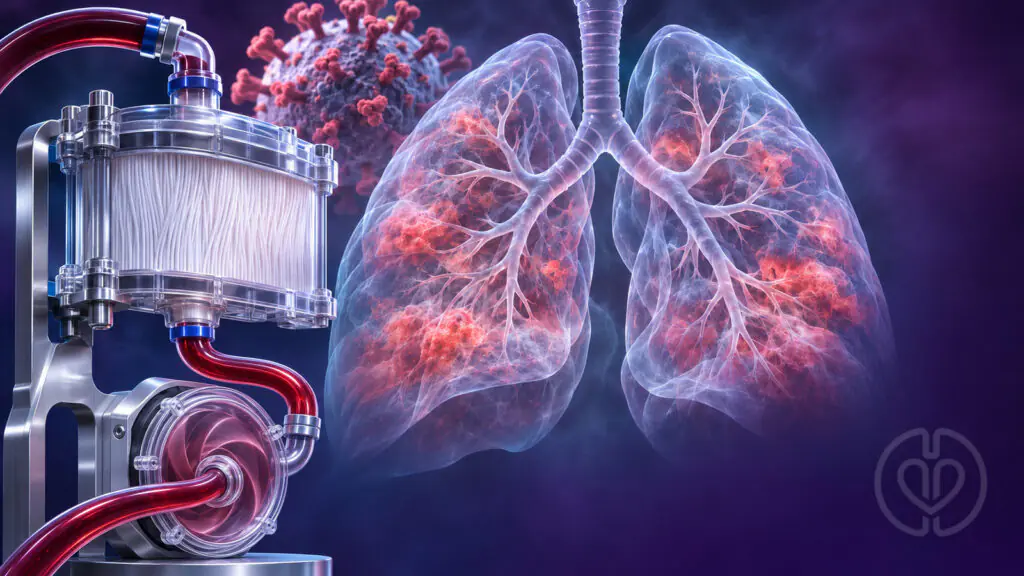
COVID-19 ECMO outcomes in Central and Eastern Europe remain less clearly documented than outcomes in many international registries. A systematic review by Szułdrzyński and colleagues brings together regional reports of adults receiving extracorporeal membrane oxygenation for severe COVID-19. The analysis describes substantial mortality and bleeding, but the authors rated every pooled outcome as very low-certainty evidence. Its value is in identifying the reported regional burden and the data needed for more reliable comparisons.
Study Design and Regional Coverage
The review included 12 observational studies covering 802 patients from six countries: the Czech Republic, Poland, Hungary, Croatia, Slovenia, and Romania. Most patients received venovenous ECMO, although some cohorts also included venoarterial support. This was a synthesis of published cohorts, rather than a population-based registry of every ECMO case in the region.
PubMed, Scopus, Embase, and Web of Science were searched for studies published from January 2020 through August 1, 2025. Eligible reports included at least 10 adults with COVID-19 treated with ECMO and were published in English, Polish, or Czech. The authors excluded conference abstracts and overlapping cohorts and used random-effects models to pool available outcomes. Each analysis included only the studies reporting that particular endpoint.
COVID-19 ECMO Outcomes: Mortality and Serious Bleeding
The principal pooled findings were:
- In-hospital mortality: 65% (95% confidence interval 57–72%), based on 10 studies and 691 patients.
- ICU mortality: 61% (95% confidence interval 47–74%), based on seven studies and 526 patients.
- Serious bleeding: 40% (95% confidence interval 22–61%), based on five studies and 366 patients.
These percentages describe different evidence subsets and should not be applied interchangeably to all 802 patients. In particular, the difference between pooled ICU and hospital mortality cannot be used to calculate deaths occurring after ICU discharge.
Results varied substantially between studies. Heterogeneity was considerable for hospital mortality and even greater for ICU mortality and serious bleeding. The pooled estimates therefore offer context for the cohorts studied, with limited precision for predicting outcomes in another program or a different pandemic period.
What the Mortality Estimates Can and Cannot Explain
This was a single-arm analysis of patients who received ECMO. It did not provide a comparable group managed without ECMO, so the mortality proportion does not measure the benefit or harm caused by ECMO itself. Patient selection, disease severity, pandemic wave, referral timing, and treatment practices may all influence the outcomes observed.
Country-specific analyses were limited to countries with at least two studies reporting the relevant mortality endpoint. Several estimates had wide confidence intervals, and the review could not adequately account for differences in case mix or care organization. The country results should therefore be treated as descriptive observations, not as rankings of national ECMO care.
The authors discuss center experience, referral networks, and resource availability as possible explanations for variation. However, these factors were not systematically measured. The review cannot establish that any one of them caused the reported differences or that the regional estimates are directly comparable with earlier international registry results.
Duration of Support and ICU Resource Use
The pooled mean duration of mechanical ventilation before ECMO was approximately 4.8 days, while mean ECMO duration was 17.8 days. Mean ICU length of stay was 23.6 days, with a wide confidence interval of 7.5–39.7 days. These analyses drew on different groups of studies, and some reported medians were converted into estimated means for pooling.
The pre-ECMO ventilation estimate describes historical practice; it does not identify an optimal waiting period before cannulation. Similarly, average ECMO or ICU duration should not be used as a treatment limit. Recovery, complications, weaning, and death can each affect the time a patient spends receiving support, making duration difficult to interpret without patient-level clinical context.
Complications and Relevance for Perfusion Teams
Serious bleeding was the only complication reported often enough for meta-analysis. Its pooled frequency highlights the importance of documenting bleeding events alongside anticoagulation exposure, transfusion, and circuit management. However, the review did not establish a uniform bleeding definition across all cohorts or test an anticoagulation strategy.
Other complications, including sepsis, pneumothorax, deep venous thrombosis, neurological bleeding or stroke, and oxygenator failure, were reported too infrequently for pooled estimates. Limited reporting should not be interpreted as evidence that these events were uncommon.
For perfusion and ECMO programs, a practical implication is to record complications consistently and relate them to the timing of support. Useful local and regional data would include the ECMO configuration, indication, severity at cannulation, referral interval, bleeding definition, circuit complications, and outcome timeframe. This would support more meaningful comparison than a single unadjusted mortality percentage.
Evidence Limitations and Priorities
All eight pooled outcomes were rated very low certainty using GRADE. Observational designs, selection and reporting concerns, substantial heterogeneity, and imprecise estimates limit confidence in the results. Language restrictions and a search strategy partly based on author affiliations may also have missed relevant reports. The evidence does not represent all countries or all ECMO-treated patients in Central and Eastern Europe.
Several secondary forest-plot labels and sample totals differ from the main tables and text, adding a reporting concern. The overall mortality and serious-bleeding estimates summarized here are consistent across the abstract and main results. The absence of detected publication bias in the hospital-mortality analysis does not exclude it, given the small number of contributing studies.
Long-term survival, functional recovery, and quality of life were inadequately reported. The review therefore supports better standardized regional data collection and prospective multicenter studies, with follow-up beyond discharge. It provides questions for future evaluation rather than evidence for a new treatment threshold or definitive organizational recommendation.
Original Article
Szułdrzyński K, Jankowski M, Molnar Z, et al. Clinical Outcomes and Complications of Extracorporeal Membrane Oxygenation (ECMO) in Adult Patients With COVID-19 in Central and Eastern Europe: A Systematic Review and Meta-Analysis. Medical Science Monitor. 2026;32:e954002. doi:10.12659/MSM.954002.
The authors declared no financial support or conflicts of interest. The original article is distributed under the Creative Commons Attribution-NonCommercial-NoDerivatives 4.0 International license.