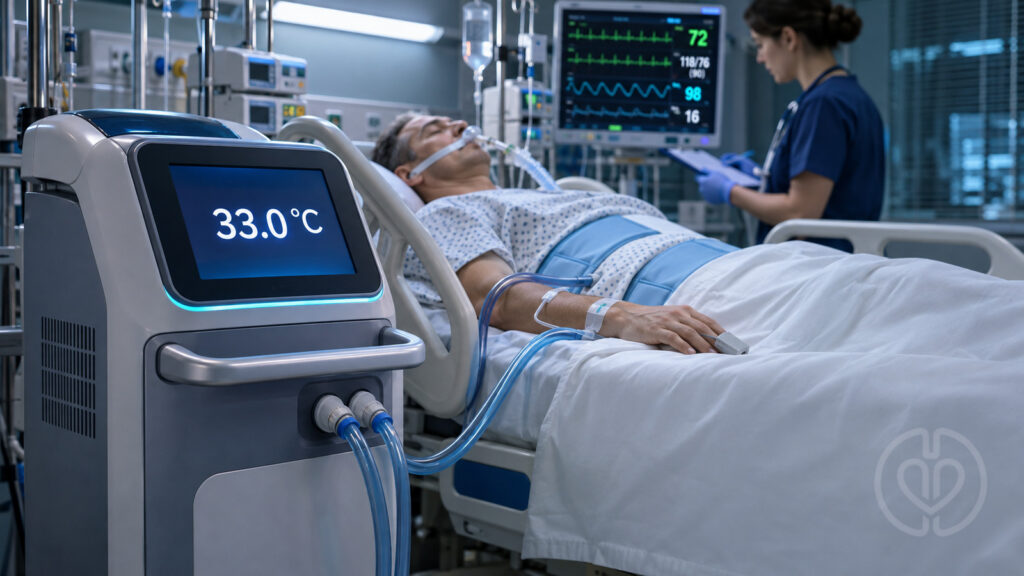
Hypothermia after cardiac arrest may seem most promising when ischemic exposure is prolonged or the initial neurological examination is poor. A new analysis of 2,789 participants from the TTM and TTM2 trials tested that hypothesis using several machine-learning methods. The investigators found no detectable pattern identifying patients who benefited differently from a 33°C target compared with controlled normothermia, based on the admission variables available.
What the study compared
Lileikyte and colleagues performed a post hoc secondary analysis of the primary analysis populations of two randomized trials: 939 participants from TTM and 1,850 from TTM2. These were adults resuscitated from out-of-hospital cardiac arrest of presumed cardiac cause in TTM, or cardiac or unknown cause in TTM2. Median age was 65 years, and approximately 80% were men.
The comparison differed between trials. TTM tested 33°C against a 36°C target. TTM2 tested 33°C against controlled normothermia with treatment of fever at 37.8°C or above. Both comparator groups received active temperature management; neither represented an approach that simply allowed temperature to drift without fever control.
Searching for patients who respond differently
The analysis examined 11 baseline characteristics. Arrest-related measures included time to advanced life support, time to return of spontaneous circulation, bystander CPR, initial shockable rhythm, and arrest location. Neurological measures included motor and eye responses, spontaneous breathing, pupillary and corneal reflexes, and generalized myoclonus.
The investigators used causal forests and Bayesian additive regression trees (BART) to estimate how the effect of treatment might vary across combinations of these characteristics. A complementary variable-importance analysis assessed potential effect modifiers. Models were fitted separately within each trial, with pooled analyses treated as exploratory because the trials used different comparator strategies and were conducted in different periods.
The main endpoint was all-cause mortality at six months. The secondary endpoint was poor functional outcome at six months, defined as a modified Rankin scale score of 4–6, encompassing moderately severe disability, severe disability, or death.
No detectable subgroup benefit from 33°C
Six-month mortality was 691 of 1,398 participants (49.4%) assigned to 33°C and 666 of 1,391 (47.9%) assigned to controlled normothermia. These descriptive pooled figures should be interpreted alongside the different trial comparisons.
Across the modeling approaches, estimated variation in treatment effects was small, and no statistically significant treatment-effect heterogeneity was identified. In the pooled causal-forest analysis, estimated conditional mortality risk differences ranged from approximately −1.2 to +2.1 percentage points; the heterogeneity test yielded P = 0.99. BART estimates ranged from approximately −0.5 to +1.5 percentage points, with posterior probabilities of benefit from 33°C between 42% and 53%.
Functional-outcome analyses, additional subgroup analyses, and sensitivity analyses were consistent with the main finding. These estimates do not provide a validated bedside rule for selecting a lower temperature target.
Implications for perfusion and critical care
The practical finding is specific: the admission findings studied did not identify a group with demonstrably greater benefit from 33°C. A feature that predicts a poor outcome does not necessarily predict a better response to a particular treatment. Longer resuscitation or a worse early examination therefore cannot be assumed, from these data, to establish a benefit from deeper cooling.
For perfusion teams involved in post-arrest care, the study adds context to temperature-target discussions while underscoring the difference between controlled normothermia and absence of temperature control. It did not test temperature strategies during cardiopulmonary bypass, circulatory arrest, or extracorporeal CPR, and it does not establish targets for those settings.
Limitations that matter
This was an exploratory secondary analysis, rather than a new trial prospectively testing a subgroup-based treatment strategy. Failure to detect treatment-effect heterogeneity does not prove that every patient responds identically. Relevant subgroups may have been uncommon, absent from the trials, or poorly represented by the selected variables.
Arrest times are indirect measures of ischemic burden and do not fully distinguish no-flow from low-flow exposure. Early neurological findings may be affected by sedation, neuromuscular blockade, and hemodynamic instability. Assessments differed between the trials and required harmonization. EEG, brain-injury biomarkers, and neuroimaging were not included in the models.
Missing data were handled with single imputation, which cannot fully capture imputation uncertainty. Differences in trial populations, comparator strategies, and clinical practice also limit interpretation of pooled results. The findings support caution about choosing 33°C from these baseline characteristics alone; they do not establish that active temperature management is unnecessary.
Source
Lileikyte G, Marinho LL, Lu Y, et al. Differentiated effect of hypothermia versus normothermia after cardiac arrest by neurological status and clinical correlates of ischemic burden. Critical Care. 2026;30:561. doi:10.1186/s13054-026-06414-x.
The authors declared no competing interests. The parent trials received independent research grants, and Lund University provided open-access funding. This summary is an original educational synthesis; the unchanged source article is available below under its stated CC BY 4.0 license.