Endotracheal tube cuff pressure during CPB may influence measurable upper airway soft-tissue changes after coronary artery bypass grafting. In a 76-patient randomized trial, complete cuff deflation during bypass produced smaller increases in several ultrasound measurements than maintaining 20–30 cmH₂O. These anatomical findings do not establish less airway edema, safer extubation, or a reason to change routine practice.
Study Design and Population
Çetin and colleagues conducted a prospective, single-center trial at Kocaeli City Hospital in Türkiye. Seventy-six adults undergoing elective CABG were randomized equally to complete cuff deflation (0 cmH₂O) or maintenance at 20–30 cmH₂O throughout cardiopulmonary bypass. Recruitment ran from September 2025 through April 2026; all randomized patients completed follow-up and were analyzed.
Patients and outcome assessors were blinded, while the anesthesia team implementing the intervention could not be. Allocation used a computer-generated sequence and sealed opaque envelopes. Importantly, no patient underwent transesophageal echocardiography (TEE), limiting application to the many cardiac surgical settings where a TEE probe is routinely present.
What the Investigators Measured
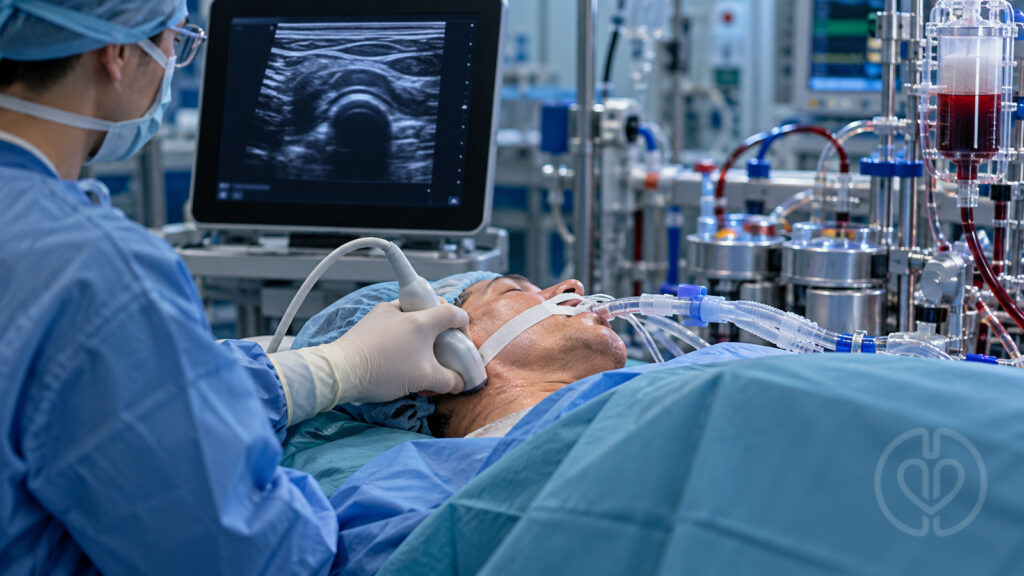
A blinded anesthesiologist measured lateral pharyngeal wall thickness, parapharyngeal distance, tongue thickness, tongue width, and midsagittal tongue area. Assessments occurred before induction, after intubation but before bypass, at the end of bypass, and at postoperative hour two. The primary test evaluated whether the trajectory of lateral pharyngeal wall thickness differed between groups across these time points.
These ultrasound dimensions describe anatomy. They do not directly measure tissue water content or prove edema. The study also recorded respiratory events, but it was powered for an ultrasound endpoint rather than patient-centered clinical outcomes.
Cuff Pressure During CPB: Key Findings
| Outcome | 0 cmH₂O | 20–30 cmH₂O |
|---|---|---|
| Lateral pharyngeal wall thickness at end of CPB | 12.2 ± 0.5 mm | 13.8 ± 0.7 mm |
| Parapharyngeal distance at end of CPB | 16.2 ± 1.0 mm | 18.0 ± 1.3 mm |
| Tongue thickness at end of CPB | 56.9 ± 1.7 mm | 58.2 ± 1.4 mm |
| Study-defined difficult extubation | 0/38 | 7/38 (18.4%) |
| Post-extubation stridor | 1/38 | 5/38 |
| Reintubation | 1/38 | 1/38 |
The primary group-by-time interaction for lateral pharyngeal wall thickness was significant (P < .001). The maintained-pressure group had a 1.50 mm greater increase from pre-induction to the end of CPB (95% CI, 1.27–1.73), with a 1.00 mm difference at postoperative hour two (95% CI, 0.82–1.18). A sensitivity analysis using the immediate pre-intervention assessment as baseline showed a consistent end-of-bypass difference of 1.43 mm (95% CI, 1.30–1.57).
Interpreting the Extubation Signal
The study defined “difficult extubation” as inadequate upper airway patency immediately after tube removal requiring jaw thrust and/or an oral or nasopharyngeal airway. This operational definition is different from extubation failure or reintubation. The unadjusted comparison was 0 versus 7 events (P = .012), with an absolute difference of 18.4 percentage points (95% CI, 5.4–33.4).
Only seven such events occurred, and clinical outcomes were exploratory. Stridor did not differ significantly, and one patient in each group required reintubation. The findings therefore do not demonstrate that cuff deflation prevents clinically important airway complications. Ultrasound was last obtained at postoperative hour two, whereas extubation occurred around hour six, leaving no imaging assessment at the actual time of extubation.
Relevance for Perfusion and Cardiac Anesthesia
The trial connects an airway-management variable with the bypass period, when extracorporeal gas exchange supported patients while ventilation was suspended. In this protocol, both groups had cuff pressure restored to 20–30 cmH₂O before ventilation resumed. Orogastric tube placement and oropharyngeal suctioning were also incorporated, but silent microaspiration was not objectively assessed.
For perfusionists, the report is relevant to multidisciplinary discussions about the transition onto and off bypass, airway physiology, and postoperative recovery. It does not validate an independent perfusion intervention or a universal cuff-deflation protocol. The authors explicitly advise against adopting routine cuff deflation on the basis of these data.
Limitations and Disclosures
This was a small, single-center trial in a selected elective CABG population. Patients with high obstructive sleep apnea risk, anticipated difficult airways, BMI above 35 kg/m², severely impaired ventricular function, or advanced kidney dysfunction were excluded. Findings may differ in emergency operations, valve or combined surgery, and procedures using TEE.
One investigator performed all ultrasound assessments, and measurement reproducibility was not formally quantified. That matters when the reported differences are approximately 1–2 mm. Baseline Mallampati class and sex were imbalanced despite randomization. Several relevant perioperative variables—including nadir hematocrit, transfusion and ultrafiltration volumes, complete fluid balance, and cumulative sedative exposure—were not recorded at the patient level.
The registration did not specify the statistical model, and several reported outcomes were planned in ethics documents but absent from the registry. Numerous secondary comparisons and post hoc analyses further limit interpretation. Intermediate cuff-pressure reduction was not studied, and objective aspiration safety remains unresolved. The investigators report no external funding and no conflicts of interest.
Original Article
Çetin E, Günel B, Yılmaz M, et al. Point-of-Care Ultrasound of Upper Airway Changes During Cardiopulmonary Bypass in Coronary Artery Bypass Grafting: A Randomized Controlled Trial. Medicina. 2026;62(10):1829. doi:10.3390/medicina62101829.
This independently written educational summary accompanies the unchanged source PDF. The cover is an AI-generated editorial illustration and is not a technical airway-management guide.