Planned Impella 5.5 support may offer a practical way to transition selected patients with severely impaired left ventricular function from cardiopulmonary bypass to temporary ventricular assistance. In a single-center series of 16 high-risk cardiac surgical patients, investigators describe implantation through the brachiocephalic artery or ascending aorta, postoperative support, and bedside removal. The findings support technical feasibility, but the small uncontrolled study cannot establish a survival benefit.
Why Plan Support Before Separation From Bypass?
Patients with a low ejection fraction may struggle to maintain adequate circulation after coronary revascularization or valve surgery. The authors evaluated an approach that anticipated this vulnerability: prepare temporary left ventricular support during the operation and transition directly from cardiopulmonary bypass, rather than waiting for postoperative deterioration before escalating assistance.
The physiological rationale combines forward flow with left ventricular unloading. A transvalvular microaxial pump moves blood from the left ventricle into the ascending aorta. This differs from the support provided by an intra-aortic balloon pump or VA-ECMO. However, physiological differences alone do not establish that one strategy produces better clinical outcomes; this report did not directly compare these alternatives.
Study Design and Patient Population
Habertheuer and colleagues queried a prospectively maintained institutional database covering March 2022 through June 2025. The analysis included 16 patients undergoing planned Impella-supported surgery at Brigham and Women’s Hospital. All operations were performed by one surgeon, and the analysis used descriptive statistics without a contemporaneous control group.
Median baseline ejection fraction was 20%, and the median Society of Thoracic Surgeons predicted operative mortality was 12.1%. Fifteen patients were male. Six underwent isolated coronary artery bypass grafting, four underwent valve procedures, and six underwent combined coronary and valve surgery. These characteristics describe a highly selected population managed by an experienced team.
Planned Impella 5.5 Implantation and CPB Transition
Twelve devices were inserted through the brachiocephalic artery and four through the ascending aorta. The team used a surgically attached graft tunneled to the right supraclavicular region, allowing chest closure and later access for removal. Transesophageal echocardiography and direct surgical visualization guided placement; fluoroscopy was not used in this series.
Device implantation was technically feasible in every patient. All 16 initially separated from cardiopulmonary bypass directly onto Impella 5.5 support without another mechanical support system at that transition. Initial pump flow was individualized to balance ventricular decompression against suction, with a reported median of 3.0 L/min. This is a description of the study’s practice, not a universal flow target or implantation protocol.
Early postoperative escalation remained necessary. Two patients developed inadequate support associated with biventricular failure during the first postoperative night: one received a temporary right ventricular assist device and one received peripheral VA-ECMO, both while Impella support continued. Successful separation from bypass therefore did not guarantee that isolated left ventricular assistance would remain sufficient.
Support Duration, Weaning, and Complications
| Reported measure | Finding |
|---|---|
| Patients treated | 16 |
| Technical implantation success | 16 of 16 |
| Brachiocephalic / ascending aortic access | 12 / 4 patients |
| Median duration of Impella support | 8.5 days |
| Additional early mechanical support | 2 patients: RVAD or VA-ECMO |
| Non-disabling stroke | 2 patients |
| New renal failure | 2 patients |
| Re-exploration for bleeding | 4 patients |
| Median ICU / hospital stay | 18.5 / 26 days |
The authors report a 94% weaning rate. One patient with extensive ischemic cardiomyopathy could not be weaned and underwent durable LVAD implantation on postoperative day 28. Following successful weaning, devices were removed at bedside without reported removal-related bleeding or thromboembolic complications. This removal result applies to successfully weaned patients and should not be interpreted as evidence that every patient recovered without ongoing support.
Echocardiographic measurements showed increasing median ejection fraction during postoperative recovery. These observations are encouraging, but revascularization, valve correction, loading conditions, and concurrent intensive care also influence ventricular measurements. The study cannot isolate the contribution of the pump to recovery.
Mortality Reporting Requires Caution
The paper contains inconsistent survival reporting. Its abstract and Results text report approximately 94.8% freedom from mortality at discharge and one year, while the survival figure caption gives 95.2%. Table 3 lists one operative death but two overall deaths. The report does not clearly reconcile these figures. A single definitive one-year survival percentage should therefore not be taken from this series without clarification from the authors.
The median follow-up was 10 months. Comparing observed outcomes against a median predicted operative risk also does not demonstrate a treatment effect: a risk estimate is not a randomized control group, and operative risk and one-year survival describe different time horizons.
Relevance for Perfusion and Mechanical Support Teams
For perfusionists, the report highlights the importance of planning the transition from bypass to temporary support before separation begins. The postoperative escalation cases emphasize continued assessment of right ventricular performance and systemic perfusion even after an apparently successful initial transition. These are practical considerations illustrated by the series, rather than tested recommendations for all low-EF operations.
Bleeding, stroke, renal dysfunction, and prolonged critical care remained substantial concerns. The authors used systemic heparin guided by institutional monitoring. Their anticoagulation and operative details should be read as institution-specific methods; this educational summary does not replace current device instructions or local protocols. Related discussion is available in IPA’s article on direct aortic access for CPB and Impella 5.5.
Limitations and Disclosures
This small, nonrandomized, single-surgeon experience establishes neither comparative safety nor superiority over pharmacologic therapy, IABP, or VA-ECMO. Selection bias, lack of a control group, limited follow-up, and inconsistent reporting restrict interpretation. Larger prospective comparative studies are needed to determine which patients benefit and whether planned support improves outcomes.
The authors report no external funding. Akinobu Itoh disclosed speaking honoraria from Abiomed and Abbott; the remaining authors reported no relevant commercial or financial relationships. The study had institutional review board approval with consent waived.
Original Article
Habertheuer A, Reyes Macaranas A, Hirji S, et al. Planned Impella 5.5 Support via Brachiocephalic Artery or Ascending Aorta for Low Ejection Fraction, High-Risk Cardiac Surgery. Journal of Cardiovascular Development and Disease. 2026;13(10):475. doi:10.3390/jcdd13100475.
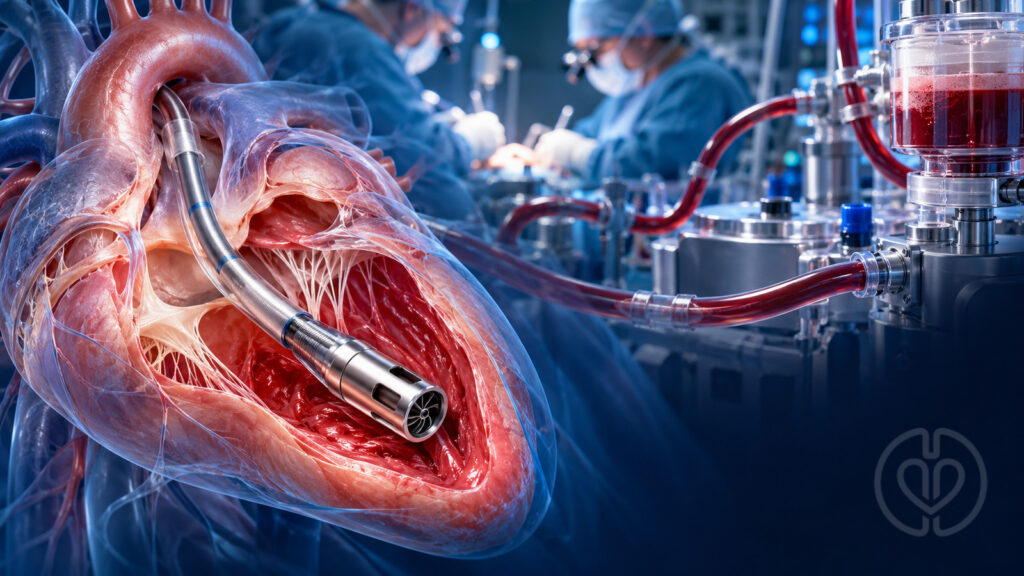
This independently written educational synthesis is based on the original open-access article. The source PDF is unchanged. The cover is an AI-generated editorial illustration and is not a technical placement guide.