Hemoadsorption to prevent acute kidney injury during elective cardiac surgery remains an appealing concept, but a new synthesis of randomized trials has not demonstrated a clear clinical benefit. Abou-Arab and colleagues evaluated intraoperative sorbent-based blood purification during cardiopulmonary bypass (CPB), asking whether removing circulating inflammatory mediators translates into fewer postoperative kidney injuries or better recovery. Their findings support a cautious interpretation: the available studies did not show a statistically significant improvement, while the accumulated evidence remains insufficient to rule out a clinically meaningful effect.
Why Study Hemoadsorption During Cardiopulmonary Bypass?
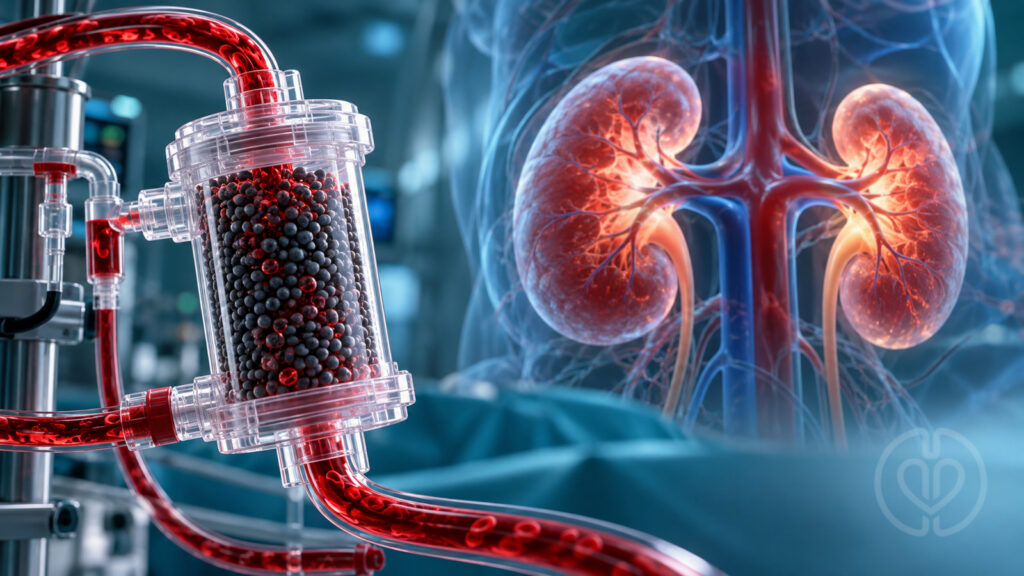
Cardiac surgery can trigger inflammation through surgical trauma, blood contact with artificial surfaces, and ischemia-reperfusion. Hemoadsorption attempts to reduce circulating mediators by exposing blood to materials that bind selected molecules. For perfusion teams, the attraction is practical as well as biological: an adsorption device can be incorporated into extracorporeal support during the operation.
However, kidney injury after cardiac surgery has multiple causes. Inflammation interacts with renal perfusion, hemodilution, hemolysis, pre-existing disease, and perioperative hemodynamic changes. Removing some inflammatory molecules therefore does not necessarily prevent the full range of mechanisms responsible for postoperative acute kidney injury (AKI). The review addresses clinical outcomes rather than assuming that an attractive mechanism establishes patient benefit.
How the Review Was Conducted
The investigators searched PubMed, Embase, and the Cochrane Library through February 3, 2025. Their protocol was prospectively registered in PROSPERO as CRD42025634991. Eligible studies were randomized controlled trials comparing intraoperative hemoadsorption with standard CPB care in adults undergoing cardiac surgery. Six trials with 798 patients were included overall; four trials with 723 patients contributed to the primary kidney outcome.
The primary endpoint was cardiac surgery-associated AKI within seven postoperative days. Secondary outcomes included 28-day mortality, organ dysfunction assessed by the Sequential Organ Failure Assessment (SOFA) score, intensive care unit (ICU) length of stay, and circulating interleukin-6 and tumor necrosis factor-alpha. The authors used random-effects pooling, assessed trial bias and evidence certainty, and performed trial sequential analysis to examine whether the available sample could support a firm conclusion.
Hemoadsorption and Acute Kidney Injury: Main Findings
Across the four trials reporting AKI, events occurred in 144 of 355 patients receiving hemoadsorption (40.6%) and 165 of 368 controls (44.8%). The pooled risk ratio was 0.93, with a 95% confidence interval of 0.71 to 1.21 and a p value of 0.57. Between-study heterogeneity was moderate (I² = 42%). These results did not establish a reduction in postoperative AKI.
The crude event percentages and the pooled risk ratio answer related but different statistical questions. Random-effects meta-analysis weights trial-specific estimates; its result should not be replaced by a simple ratio calculated from the combined patient totals. More importantly, the confidence interval accommodates both benefit and harm. A nonsignificant result is therefore insufficient to demonstrate equivalence or prove that hemoadsorption has no effect.
Trial Sequential Analysis Leaves Uncertainty
The trial sequential analysis estimated a heterogeneity-adjusted required information size of 1,491 patients, based on an anticipated 20% relative reduction in AKI. The 723 patients available for that endpoint represented approximately 48% of this target. The cumulative analysis crossed neither a monitoring boundary nor the futility boundary.
Although parts of the manuscript discuss the curve moving toward futility, the boundary was not crossed. The most defensible interpretation is that current evidence has not demonstrated benefit and remains inconclusive. The analysis does not establish that another adequately designed trial would necessarily be futile.
Mortality, Organ Dysfunction, and Inflammatory Markers
The review also found no statistically significant difference in 28-day mortality, with a pooled risk ratio of 1.03 (95% confidence interval, 0.69–1.53). There was no significant improvement in SOFA score or ICU length of stay. Measurements of interleukin-6 and tumor necrosis factor-alpha likewise did not show a significant pooled reduction after CPB.
These results matter because the proposed treatment pathway links mediator removal to reduced inflammation and then to better organ function. Neither the measured biomarker outcomes nor the clinical endpoints consistently confirmed that pathway in the included trials. However, the studies differed in size, patient selection, and outcome priorities, and some clinically important endpoints were secondary rather than the original focus of individual trials.
Device Differences and Relevance to Perfusion Practice
Four included trials used CytoSorb and two used AN69-based oXiris technology. These approaches differ in binding mechanisms, target spectrum, and extracorporeal configuration. Pooling them evaluates a broad sorbent-based treatment strategy; it does not establish that the devices are interchangeable. Subgroup analyses did not demonstrate a significant AKI reduction with either device type, but limited numbers make reliable device-to-device conclusions difficult.
All included interventions were confined to the intraoperative period. Because postoperative inflammation may continue after separation from bypass, the findings cannot determine whether longer exposure would change outcomes. Similarly, the results should not be extended to emergency rescue treatment, heart transplantation, acute aortic dissection, or drug-removal indications that were outside this review’s intended scope.
For perfusion education and multidisciplinary discussion, the useful distinction is between technical feasibility and demonstrated clinical effectiveness. Adding a cartridge or adsorptive membrane to a circuit is a treatment decision that requires a clear indication, appropriate device-specific procedures, and attention to the evidence for the intended outcome. This review does not establish routine intraoperative hemoadsorption as an effective AKI-prevention strategy.
Limitations and Publication Status
Most included studies were small, and clinically relevant differences between populations and devices limit precision. The authors classified certainty for the primary AKI outcome as moderate. Small numbers of trials also limit the ability of publication-bias tests to exclude missing evidence. The supplied pre-proof contains reporting inconsistencies, including differences between the narrative and table descriptions of trial bias, which merit checking against the final published version.
This PDF is an accepted journal pre-proof, not the definitive version of record. No funding was reported. Osama Abou-Arab disclosed personal fees from Medtronic, AOP Pharma, Viatris, and LFB; the other authors declared no conflicts of interest. Their discussion of more targeted patient selection and longer treatment exposure should be understood as research hypotheses rather than demonstrated indications.
Source Article and Full Text
Abou-Arab O, Beyls C, Ibrahima A, et al. Hemoadsorption to prevent acute kidney injury in elective cardiac surgery: a systematic review of randomized controlled trials with meta-analysis and trial sequential analysis. Anaesthesia Critical Care & Pain Medicine. 2026. Accepted September 15, 2026. doi:10.1016/j.accpm.2026.101931.
Educational summary prepared by the International Perfusion Association. Refer to the original article for full methods, data, and context.