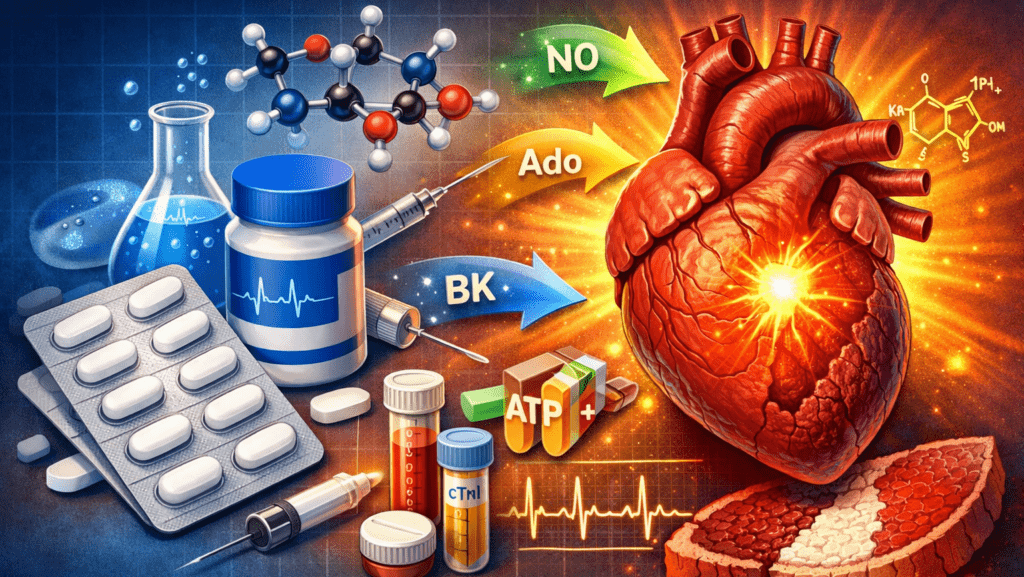
This original research article explores whether ranolazine, an antianginal drug already used in cardiovascular medicine, can mimic the biologic effects of ischemic preconditioning and protect the heart from ischemia-reperfusion injury. The investigators used an isolated rat heart model to test a focused mechanistic hypothesis: that ranolazine’s cardioprotective activity depends on endogenous signaling pathways involving nitric oxide, adenosine, bradykinin, and ATP-dependent potassium channels. The work is clinically relevant because ischemia-reperfusion injury remains a major challenge in myocardial infarction care and in cardiac procedures such as coronary artery bypass grafting and transplantation, where restoring blood flow can paradoxically worsen tissue injury.
The study was performed in Wistar albino rats using the Langendorff isolated heart technique, a standard preclinical approach for studying cardiac physiology under controlled conditions. After anesthesia and heparinization, the hearts were excised, mounted on the perfusion apparatus, stabilized, then subjected to 30 minutes of ischemia by left anterior descending coronary artery ligation followed by 120 minutes of reperfusion. This model allowed the researchers to quantify both structural and functional damage. Myocardial infarct size was measured by triphenyltetrazolium chloride staining, while coronary effluent was analyzed for classic cardiac injury biomarkers including lactate dehydrogenase, CK-MB, and troponin I. Hemodynamic performance was also measured through left ventricular developed pressure, maximum contraction rate, and maximum relaxation rate. The experimental design is clearly diagrammed in the protocol figure and supported by infarct photographs shown in the early results pages.
Sixty-six rats were divided into 11 groups of six animals each. These included a control ischemia-reperfusion group, an ischemic preconditioning group, a ranolazine-only group, and eight combination groups in which ranolazine was paired with pathway inhibitors. These inhibitors targeted nitric oxide synthase, inducible nitric oxide synthase, adenosine signaling, bradykinin signaling, and ATP-sensitive potassium channels. This design is important because it moves the paper beyond showing simple benefit and instead tests which signaling mediators are necessary for ranolazine’s effect. In other words, the study is not just asking whether ranolazine works, but how it works in this model.
The main findings were striking. Compared with the control group, both ischemic preconditioning and ranolazine sharply reduced myocardial infarct size. Control hearts had infarct sizes around 65.7%, while ischemic preconditioning lowered this to about 26.2% and ranolazine to about 26.8%. Biomarker release followed the same pattern. LDH, CK-MB, and troponin I were all markedly reduced in the ranolazine group compared with ischemia-reperfusion alone. Ventricular function also improved substantially. Left ventricular developed pressure rose from about 35.7 mmHg in controls to 105.2 mmHg with ranolazine, while contractility and relaxation indices also improved. These results support a robust cardioprotective effect in this ex vivo model. The figures and tables in the middle section of the paper consistently show the same direction of benefit across infarct size, enzyme release, and ventricular mechanics.
The mechanistic portion of the paper is what makes the study especially interesting for translational readers. When ranolazine was combined with L-NAME or aminoguanidine, its protective effects were largely abolished, suggesting a key role for nitric oxide signaling. Similar loss of protection occurred with theophylline and aminophylline, implicating adenosine-related pathways. When bradykinin signaling was blocked using icatibant or reduced with bromelain, the benefit again disappeared. Finally, inhibition of ATP-sensitive potassium channel signaling with 5-hydroxydecanoate or glimepiride also reversed ranolazine’s protection. Across these inhibitor groups, infarct size rose back toward control levels, biomarkers increased, and functional recovery deteriorated. The consistency of these reversals strengthens the authors’ conclusion that ranolazine acts through multiple endogenous cardioprotective mediators associated with ischemic preconditioning.
From an SEO and medical education perspective, this paper sits at the intersection of ranolazine, myocardial infarction, ischemia-reperfusion injury, pharmacologic preconditioning, and cardiac biomarker research. It argues that ranolazine may not simply be a symptom-relief drug for chronic angina, but also a pharmacologic trigger of cellular defense programs that resemble ischemic preconditioning. That idea has potential implications for perioperative cardioprotection and ischemic heart disease management. The authors suggest ranolazine could someday serve as a more practical alternative to surgical ischemic preconditioning, especially before major cardiac interventions.
That said, the paper remains preclinical and should be interpreted with caution. The sample size is small, the work is performed in isolated rat hearts rather than living humans, and the study does not address clinical endpoints such as mortality, heart failure, arrhythmia burden, or long-term remodeling. The design is mechanistically useful, but it is not a randomized human trial, and translation from animal cardioprotection studies to bedside benefit has historically been difficult. Even so, the article provides a coherent mechanistic dataset and a plausible biologic framework for further study. For readers interested in ranolazine mechanism of action, cardioprotection, ischemic preconditioning mediators, and myocardial infarction experimental models, this is a focused and hypothesis-driven contribution.