Tranexamic acid, commonly known as TXA, is one of the most important antifibrinolytic medications used in cardiac surgery with cardiopulmonary bypass. During cardiopulmonary bypass, the body’s clotting and fibrinolytic systems are disrupted, increasing the risk of postoperative bleeding, blood transfusion, and reoperation. Intravenous TXA is widely used to reduce bleeding by preventing the breakdown of fibrin clots, but systemic administration can raise concerns about adverse effects, including seizures, neurologic symptoms, renal complications, and thromboembolic events in selected patients. This randomized clinical study evaluated whether topical intrapericardial TXA could provide a safer local alternative while maintaining effective bleeding control.
The article, published as an Article in Press in BMC Anesthesiology, studied 492 adult patients undergoing elective cardiac surgery with planned cardiopulmonary bypass. Patients were randomly assigned in a 1:1 ratio to receive either topical TXA or standard intravenous TXA. The topical group received 2.5 g of TXA diluted in 50 mL saline through the pericardial drainage catheter after completion of the cardiac procedure, surgical hemostasis, and sternal closure. The drain was clamped for 30 minutes to allow local exposure. The intravenous group received a standard systemic regimen: a 10 mg/kg loading dose after anesthesia induction, a continuous infusion of 2 mg/kg/hour until the end of surgery, and an additional 1 mg/kg added to the cardiopulmonary bypass priming solution.
The main question was whether topical TXA was non-inferior to intravenous TXA for preventing postoperative red blood cell transfusion while maintaining safety. The primary efficacy endpoint was the rate of allogeneic red blood cell transfusion from the postoperative period to hospital discharge. The primary safety endpoint was a 30-day composite adverse event rate, including all-cause mortality, cardiac surgery-associated acute kidney injury, stroke, myocardial infarction, lower extremity venous embolism, and seizures. The study also examined postoperative drainage volume, mechanical ventilation duration, ICU stay, hospital length of stay, transfusion of plasma and platelets, coagulation tests, and thromboelastography.
The trial found that red blood cell transfusion occurred in 35.0% of patients in the topical TXA group compared with 27.6% in the intravenous TXA group. This difference did not reach conventional statistical significance, but it raised an important clinical concern because the topical group had a numerically higher transfusion rate. The median red blood cell transfusion volume was also numerically higher in the topical group, although this comparison was marginally non-significant. In practical terms, topical intrapericardial TXA did not demonstrate superior bleeding control and did not satisfy stricter efficacy non-inferiority criteria.
Safety findings were more favorable for topical TXA. The 30-day composite adverse event rate was 9.8% in the topical group and 15.4% in the intravenous group. Individual adverse events, including seizures, acute kidney injury, stroke, myocardial infarction, venous embolism, and mortality, were not statistically different between groups. Seizures occurred in 1.2% of topical TXA patients and 2.0% of intravenous TXA patients. Although these results do not prove that topical TXA is safer, they support the idea that topical administration does not increase short-term adverse events and may reduce systemic exposure.
The study’s coagulation findings are especially important because they provide mechanistic insight into why topical TXA may not control bleeding as effectively as intravenous TXA in cardiopulmonary bypass surgery. At 24 hours postoperatively, patients in the topical TXA group had significantly prolonged thrombin time and lower fibrinogen levels than patients in the intravenous group. Thromboelastography showed a longer R value after cardiopulmonary bypass in the topical group, suggesting delayed initiation of clot formation. These findings do not mean that TXA acts as an anticoagulant; rather, they suggest that topical TXA may provide strong local antifibrinolytic exposure while failing to fully suppress the systemic fibrinolytic activation triggered by cardiopulmonary bypass.
A notable clinical finding was that postoperative 24-hour drainage volume was significantly higher in the topical TXA group: 1063 mL compared with 1032 mL in the intravenous TXA group. The absolute difference was modest, but it was statistically significant. This finding may seem counterintuitive because TXA is intended to reduce bleeding. The likely explanation is that cardiopulmonary bypass causes widespread systemic fibrinolysis, while topical intrapericardial TXA acts mainly at the local surgical site. Because the topical dose was administered after sternal closure, it may also have been given too late to blunt the peak coagulation disturbance caused by bypass.
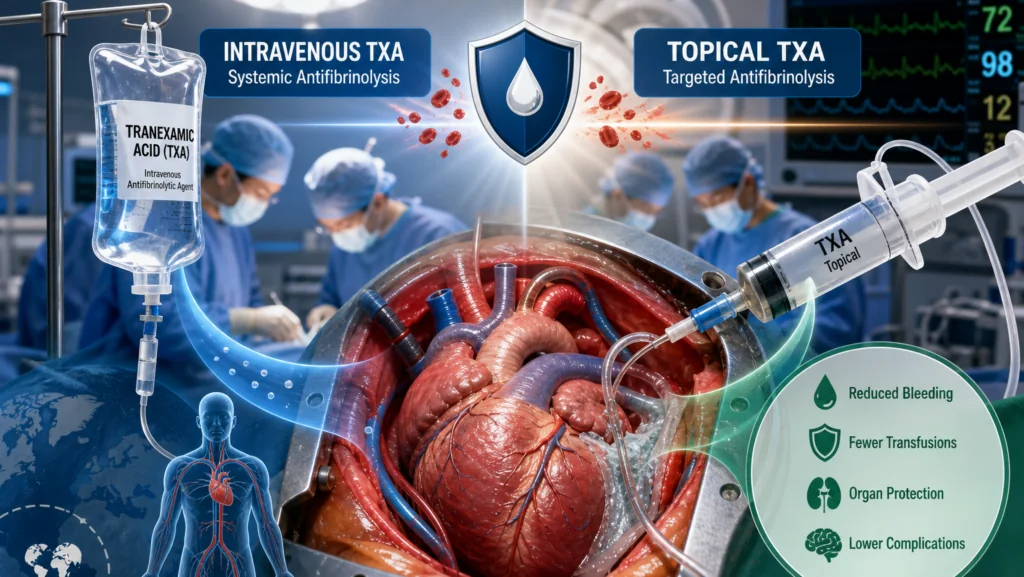
The graphic abstract on page 3 of the manuscript visually reinforces the central message: topical TXA was evaluated as a targeted alternative to intravenous TXA, but intravenous TXA remained the first-line option because strict efficacy non-inferiority was not established. The graphic also highlights the key tradeoff: topical TXA appeared safe, but patients had more postoperative drainage and numerically more red blood cell transfusion.
Clinically, this study suggests that intravenous tranexamic acid should remain the standard antifibrinolytic approach for most patients undergoing cardiac surgery with cardiopulmonary bypass. However, topical TXA may still have an important role for patients who are not good candidates for systemic TXA, such as those with a history of seizures, high neurologic risk, severe renal dysfunction, or other concerns about systemic exposure. The authors emphasize that topical TXA should not be viewed as a routine replacement for intravenous TXA, but rather as a reasonable alternative in selected cases.
The study also points toward future research. The topical regimen used here may not have been optimized. Higher local doses, earlier administration before sternal closure, combination strategies using low-dose intravenous TXA plus topical TXA, or sustained-release local delivery systems could potentially improve hemostatic efficacy. Larger multicenter trials, ideally with blinding and broader inclusion of elderly patients and high-risk cardiopulmonary bypass cases, are needed to determine whether topical TXA can be refined into a stronger blood conservation strategy in cardiac surgery.
Overall, this randomized clinical study adds meaningful evidence to the debate over topical versus intravenous tranexamic acid in cardiac surgery. It supports topical TXA as a safe option but not as an equally effective replacement for intravenous TXA under strict bleeding-control criteria. For cardiac anesthesia, cardiothoracic surgery, and perioperative blood management, the practical takeaway is clear: intravenous TXA remains first-line, while topical intrapericardial TXA may be reserved for patients who need an alternative to systemic antifibrinolysis.