This article presents a rare and clinically important case of thrombotic mitral valve obstruction during venoarterial extracorporeal membrane oxygenation, or VA-ECMO, in a patient who required left ventricular venting after highly complex valve surgery. The report focuses on a 69-year-old woman with hypertrophic cardiomyopathy, severe left ventricular outflow tract obstruction, severe mitral regurgitation with marked annular calcification, moderate aortic regurgitation, and systolic anterior motion of the mitral valve. Her presentation with exertional dyspnea reflected advanced structural heart disease that required an extensive operative approach.
The patient underwent septal myectomy, aortic valve replacement with a bioprosthesis, mitral valve replacement with a bioprosthesis using the skirt technique, and tricuspid annuloplasty. The operation then became even more complicated when active bleeding during the first attempt to separate from cardiopulmonary bypass prompted re-initiation of bypass. Surgical exploration revealed a ventricular rupture at the anterior commissure of the mitral valve. This led to removal of the implanted aortic and mitral prostheses, patch repair with bovine pericardium, and reimplantation of both prosthetic valves. The total cardiopulmonary bypass and cross-clamp times were extremely prolonged, underscoring the severity and physiologic burden of the procedure.
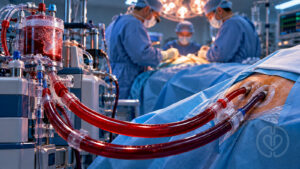
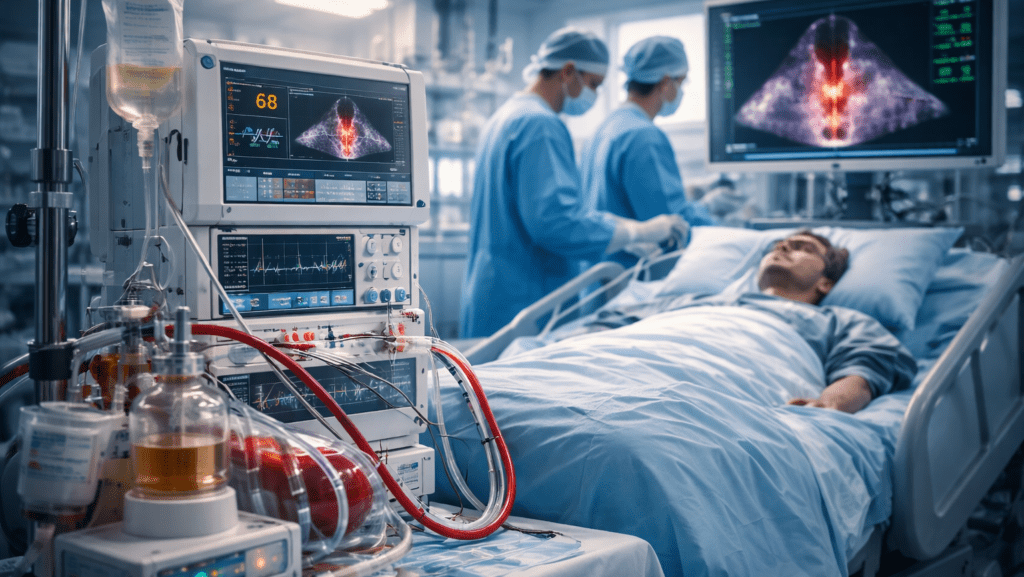
Because the repaired ventricle remained fragile and postoperative cardiac function was poor, the team initiated VA-ECMO for circulatory support. To reduce left ventricular pressure and limit the risk of recurrent rupture, they added direct left ventricular venting through the right superior pulmonary vein. This choice was clinically logical, but it also created a setting with major competing priorities: the need to unload the ventricle and protect the repair versus the heightened risk of thrombosis in a patient with fresh prosthetic valves, heavy surgical trauma, altered flow dynamics, and delayed anticoagulation.
Early after surgery, anticoagulation had to be withheld because of substantial coagulopathy and bleeding. Once bleeding stabilized and coagulation parameters improved, intravenous heparin was started and adjusted using activated clotting time and activated partial thromboplastin time. Although that approach followed routine practice, the case raises an important question for clinicians: are standard anticoagulation targets enough in a postcardiotomy VA-ECMO patient who has newly implanted prosthetic valves and has already experienced prolonged low-flow and inflammatory stress? The authors suggest that the answer may be no, or at least not always.
By postoperative day 4, cardiac contractility had improved enough to begin ECMO weaning. Flow was reduced gradually while bedside echocardiography and laboratory data were monitored. The patient initially appeared stable, and ECMO was removed. However, within hours she deteriorated dramatically, developing hypotension, tachycardia, severe hypoxemia, and frothy pulmonary secretions consistent with acute pulmonary edema. An intra-aortic balloon pump was placed, but the instability persisted, requiring urgent reinstitution of VA-ECMO. This rapid decline became one of the key turning points in the case.
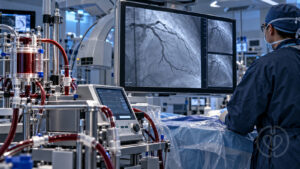
Further evaluation showed bilateral pulmonary edema on computed tomography, while transesophageal echocardiography later revealed thrombotic obstruction of the mitral bioprosthesis with mild regurgitation. During reoperation, surgeons found extensive thrombus coating the mitral prosthesis and subvalvular apparatus, with one leaflet immobilized by clot. White thrombi were also present on both atrial and ventricular surfaces, the aortic bioprosthesis was covered with white thrombus, and red thrombi were seen in the left ventricular outflow tract. All thrombi were removed. This operative confirmation makes the case especially valuable because it links the clinical collapse to a clearly documented mechanical cause.
After thrombectomy and further support with VA-ECMO and intra-aortic balloon pump therapy, cardiac function recovered. The patient was later weaned from ECMO successfully, and follow-up echocardiography showed a left ventricular ejection fraction of 50 percent with improvement in pulmonary infiltrates. However, the case still had serious neurologic consequences: the patient developed bilateral cerebral infarctions. Despite this complication, she survived and at one month remained alive while gradually being weaned from ventilatory support.
From a scientific and clinical perspective, the article’s main value lies in its discussion of why thrombosis developed. The authors do not blame left ventricular venting alone. Instead, they describe a convergence of thrombogenic factors: surgical trauma, prosthetic valve surfaces, blood interaction with extracorporeal circuitry, delayed anticoagulation, reduced pulsatility, altered transvalvular flow, and the specific hazards of both high-flow ECMO support and low-flow ECMO weaning. This broader interpretation is one of the strengths of the paper because it avoids oversimplification and reflects the true complexity of postcardiotomy ECMO care.
The article also emphasizes the challenge of diagnosing prosthetic valve dysfunction during VA-ECMO. Reduced pulsatility and limited forward flow can mask early prosthetic failure on routine imaging, meaning clinicians may not recognize obstruction until the patient deteriorates. The authors therefore argue for careful echocardiographic surveillance, especially with transesophageal echocardiography during ECMO weaning in high-risk patients. They also discuss intra-aortic balloon pump support as a potentially reasonable unloading strategy in selected patients with residual left ventricular function, though they acknowledge its unloading effect is less powerful than direct venting or microaxial devices.
Overall, this case report is highly relevant for cardiac surgeons, intensivists, ECMO teams, and perioperative echocardiographers. It contributes practical insight into prosthetic valve thrombosis, ECMO weaning failure, postoperative anticoagulation dilemmas, and left ventricular unloading strategy after complex valve surgery. Its central message is clear: in patients with recent valve replacement receiving VA-ECMO, especially when anticoagulation is delayed and direct ventricular venting is used, clinicians must maintain a high index of suspicion for catastrophic valve thrombosis and use individualized monitoring and management to reduce risk.