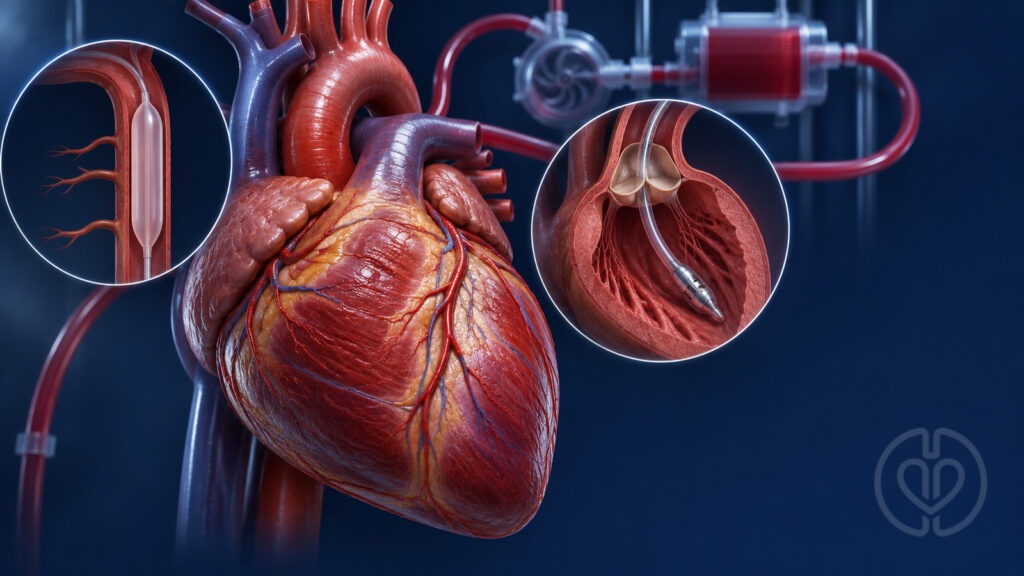
Left ventricular (LV) unloading during veno-arterial extracorporeal membrane oxygenation (VA-ECMO) is intended to counter the increased LV afterload that can accompany retrograde aortic flow. The HERACLES trial compared the acute hemodynamic effects of an intra-aortic balloon pump (IABP) and a micro-axial flow pump, the Impella CP, in patients with cardiogenic shock. Its principal finding was physiological: IABP improved an estimated myocardial oxygen supply-demand ratio, whereas Impella CP did not significantly change that ratio during the measurement period. This small trial did not establish a difference in patient survival or myocardial recovery.
Why Compare LV Unloading Strategies?
VA-ECMO can restore systemic perfusion while raising LV afterload. In some patients this contributes to ventricular distension, pulmonary edema, aortic valve non-opening, or impaired myocardial recovery. IABP and micro-axial flow pumps work differently, so a similar decrease in LV pressure need not produce the same effect on coronary flow or myocardial work.
HERACLES was an investigator-initiated, randomized mechanistic study at two UK cardiac centers. Adults supported with VA-ECMO for cardiogenic shock were eligible when cardiac catheterization and LV unloading were clinically indicated. Patients with postcardiotomy shock were excluded. Randomization was stratified by ischemic versus nonischemic shock etiology.
Measurements and Participants
Of 60 screened patients, 24 were randomized: 13 to IABP and 11 to Impella CP. Twenty-three of the 24 had Society for Cardiovascular Angiography and Interventions (SCAI) stage D or E shock. Median age was 51 years, median LV ejection fraction was 10%, and 14 patients had experienced cardiac arrest before randomization.
Investigators compared measurements with the assigned device at a low-support or standby setting and during active unloading, after a stabilization period. The IABP was assessed at 1:1 augmentation; Impella CP was assessed principally at P5. Invasive measurements included coronary thermodilution transit time and LV and aortic pressure. The primary endpoint was a calculated myocardial oxygen supply-demand ratio based on estimated coronary flow, the systolic LV pressure-time integral, and heart rate. A ratio above 1 indicated improved estimated balance on activation of the device.
Primary Physiological Finding
The median supply-demand ratio was 1.48 (interquartile range 1.23–2.10) with IABP activation, compared with 0.97 (0.92–1.39) with Impella CP activation. The between-group comparison was statistically significant (P = 0.036). Within the IABP arm the ratio differed from 1 (P = 0.005), whereas the Impella CP arm did not (P = 0.64).
The difference appeared driven mainly by a larger reduction in the estimated myocardial oxygen demand component with IABP. Median estimated demand changed by −25% with IABP versus −6% with Impella CP (between-group P = 0.05). Estimated supply rose numerically with IABP, but that between-group comparison was not significant. These measurements should be interpreted as invasive physiological surrogates, not direct proof of improved tissue oxygenation or recovery.
Coronary Flow and LV Pressure
The coronary device-flow ratio was 1.16 (1.00–1.51) with IABP and 1.00 (0.86–1.13) with Impella CP. The between-group flow comparison was not significant (P = 0.23). Impella CP increased mean distal coronary pressure without a corresponding measured increase in coronary flow, an observation the authors discuss in the context of coronary autoregulation.
Both devices reduced LV end-diastolic and end-systolic pressure. There was no statistically significant between-group difference in the change in LV end-diastolic pressure (−4 versus −5 mmHg; P = 0.92) or LV end-systolic pressure (−12 versus −7 mmHg; P = 0.19). Thus, the primary ratio difference should not be simplified to one device failing to unload the ventricle: the measured pressure responses and calculated energetic responses were distinct.
Clinical Outcomes and Practical Interpretation
At 30 days, 10 of the 24 participants had died. Mortality did not differ statistically between randomized groups (reported as 38% versus 45%; log-rank P = 0.84). The study also reported no clear differences in successful VA-ECMO decannulation, duration of support, intensive care stay, bleeding, or vascular complications. It was not powered to establish differences in those exploratory outcomes. Four patients originally assigned IABP crossed over to Impella CP after completion of the catheter-laboratory physiology protocol.
For perfusion and shock teams, the study highlights that LV pressure, coronary perfusion pressure, measured flow, and estimated myocardial demand are related but not interchangeable. The observed acute supply-demand difference may help guide future research, but device choice in a particular patient still depends on the clinical problem and cannot be settled by this mechanistic comparison alone.
Limitations
Only 24 participants were enrolled, with incomplete physiological measurements in some patients. Baseline LV end-diastolic pressure and pulse pressure differed between groups despite randomization. The primary endpoint used surrogate estimates, and measurements were made acutely after device activation; sustained myocardial recovery was not measured. Impella CP was tested at P5 rather than its maximum setting. Participants were selected because clinicians already judged catheterization and unloading necessary, limiting generalization to all VA-ECMO patients, including those with postcardiotomy shock.
Original Article
Ezad SM, Panoulas VF, Li Kam Wa ME, et al. Hemodynamic Effects of Reducing LV Afterload With Impella or Intra-Aortic Balloon Counterpulsation During Veno-Arterial Extracorporeal Membrane Oxygenation in Cardiogenic Shock: HERACLES Trial. Circulation: Cardiovascular Interventions. Accepted manuscript, 2026. doi:10.1161/CIRCINTERVENTIONS.126.017625. The supplied PDF is the accepted, not yet copyedited version; journal production may change its final presentation.
Funding was reported from the British Heart Foundation and King’s Health Partners Cardiovascular and Respiratory Partnership Clinical Academic Innovation Fund. The authors reported no disclosures, including industry disclosures.