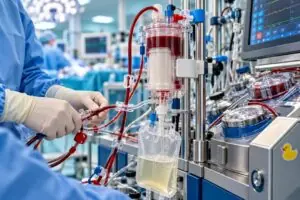

In a 30-patient randomized pilot study, higher cardiac index combined with pulsatile bypass increased oxygen delivery and was associated with lower lactate. Small sample size, baseline imbalances, inconsistent reporting, and the absence of a high-flow-only arm limit clinical conclusions.
Why pump flow and pulsatility remain important
During cardiopulmonary bypass (CPB), adequate oxygen delivery depends on more than maintaining a customary pump-flow index. Hematocrit, arterial oxygenation, metabolic demand, temperature, and the characteristics of delivered flow all contribute to tissue oxygen availability. Goal-directed perfusion approaches aim to assess oxygen delivery in the individual patient rather than relying exclusively on body surface area and a fixed cardiac index. Whether adding pulsatile flow to higher pump flows offers an additional benefit is a separate and clinically relevant question.
Bagherinasab and colleagues investigated this combination in a small prospective pilot study of adults undergoing coronary artery bypass grafting (CABG). The research asks whether increasing cardiac index while applying pulsatility improves perfusion-related measures compared with conventional nonpulsatile bypass. The results are encouraging for some physiological endpoints, but the design does not establish which component of the combined intervention is responsible.
Study design and intervention
Thirty patients undergoing elective on-pump CABG with anticipated prolonged bypass were randomly assigned to two groups of 15. The control group received nonpulsatile flow at a cardiac index of 2.4 L/min/m². The intervention group received pulsatile flow at 2.6–3.0 L/min/m². Both groups began bypass at 2.4 L/min/m² before the study protocol was applied after aortic cross-clamping and cardioplegia.
Investigators used a Stöckert S5 roller-pump heart–lung machine and an Inspire 8F oxygenator. The pulsatile settings initially used a 30% baseline flow, 60% pulse width, and 70 beats per minute. They assessed pulsatile energy using energy equivalent pressure (EEP), adjusting settings when necessary to achieve EEP approximately 15% above mean arterial pressure. The intervention therefore changed both mean pump flow and flow pattern, rather than testing either factor independently.
Outcomes included indexed oxygen delivery (DO₂i), serum lactate, creatinine, urine output, ultrafiltration, inotropic requirements, blood transfusion, and ICU and hospital length of stay. The paper describes lactate, nadir DO₂i, and urine output as primary endpoints. Measurements and follow-up covered the bypass period and early postoperative course.
Key numerical findings
The intervention group achieved a mean DO₂i of 316.40 ± 21.25 mL/min/m², compared with 275.06 ± 11.44 mL/min/m² in controls (reported p < 0.001). This is consistent with the expected increase in oxygen delivery when pump flow rises, but it does not isolate a pulsatility-specific effect.
Lactate levels diverged substantially. At 60 minutes after aortic cross-clamping, mean lactate was 1.12 ± 0.27 mmol/L in the intervention group versus 4.54 ± 1.63 mmol/L in controls. Immediately after unclamping, the corresponding values were 1.59 ± 0.39 and 5.45 ± 1.56 mmol/L. The authors report p < 0.001 for these comparisons. These findings support a hypothesis that the combined intervention improved some aspects of perfusion physiology under the study conditions, although lactate is influenced by multiple intraoperative factors and is not a direct measure of organ-level oxygenation.
Other reported perioperative differences also favored the intervention: urine output was 760 versus 507 mL (p = 0.03), ultrafiltration volume was 1,667 versus 2,360 mL (p = 0.02), and reported inotropic requirement was 110 versus 281 micrograms (p = 0.002). These outcomes are potentially relevant but should be interpreted cautiously in a 15-patient-per-group comparison with multiple endpoints and limited information on standardization of clinical decisions.
Table 4 reports lower postoperative creatinine at 24 and 48 hours in the intervention group, with statistically significant differences at those time points. Table 6 reports ICU stays of 3.93 versus 5.33 days (p = 0.002) and hospital stays of 8.06 versus 11.66 days (p < 0.001), again favoring the intervention. However, the abstract describes the length-of-stay differences as not statistically significant, an inconsistency that should be resolved before relying on those outcomes as firm evidence.
Important limitations and reporting concerns
Two treatments changed simultaneously. The study did not include a third arm with higher nonpulsatile flow or an arm with pulsatility at conventional flow. It therefore cannot determine whether lower lactate arose from greater oxygen delivery, pulsatile energy, their interaction, or another aspect of management. The authors explicitly acknowledge this limitation.
Baseline imbalance complicates comparison. The preoperative table reports mean ejection fraction of 42.33% in the intervention group and 48.33% in controls (p = 0.04). Both reported means also appear inconsistent with the eligibility criterion requiring an ejection fraction of at least 50%. The discrepancy needs clarification and raises questions about patient selection and baseline comparability.
Several statements conflict with the reported tables. The abstract describes creatinine and length-of-stay differences as nonsignificant, whereas selected time points and Table 6 show significant p values. These inconsistencies do not necessarily invalidate every result, but they reduce confidence in the precision and interpretation of the secondary outcomes.
Small sample and multiple comparisons. With only 30 participants, the study is underpowered to assess uncommon complications or reliably establish improvements in patient-centered outcomes. Many biochemical and clinical measures were compared. The article does not provide the type of multiplicity control or sufficiently detailed prospective analysis plan needed to treat every nominally significant result as confirmatory.
Mechanisms and safety remain uncertain. The investigators identify hemolysis markers and additional renal-injury biomarkers as priorities for future work. This pilot does not establish that increased pulsatile energy improves microcirculatory perfusion independently of higher mean flow, nor does it define the safest or most effective pump-flow target for broader CABG populations.
Clinical interpretation for perfusionists
The study supports continued investigation of individualized pump flow, indexed oxygen delivery, and the possible contribution of pulsatility during CPB. Its strongest finding is the large observed separation in lactate and DO₂i between the combined-intervention and conventional-flow groups. The evidence is insufficient, however, to recommend routine adoption of 2.6–3.0 L/min/m² pulsatile flow solely on the basis of these data.
For a perfusion service evaluating goal-directed protocols, the practical lesson is to distinguish a physiological signal from proof of improved clinical outcomes. Future adequately powered randomized studies should compare higher nonpulsatile flow, conventional-flow pulsatility, and the combined strategy; standardize transfusion and vasoactive treatment; and prospectively assess kidney injury, hemolysis, neurological outcomes, and recovery. Until then, individual patient physiology, validated oxygen-delivery measures, circuit limitations, and institutional protocols remain central to decisions.
iPerfusion evidence appraisal
Research quality score: 3/5 — promising, hypothesis-generating evidence. Strengths include prospective randomization, clearly described perfusion interventions, and objective physiological measurements. Confidence is reduced by the very small sample, intervention confounding, baseline ejection-fraction discrepancy, multiple comparisons, and inconsistencies between the abstract and results tables. This is useful educational material, but not practice-changing evidence.
Keywords: Cardiopulmonary Bypass, Pulsatile Flow, Cardiac Index, Goal-Directed Perfusion, Oxygen Delivery Index, Lactate, Coronary Artery Bypass Grafting, Pump Flow, Energy Equivalent Pressure, Perfusion Research.
Source: Bagherinasab M, Rezaei S, Moradi AR, Aghal B, Steele-Pruett J, Darban NH. A pilot study of the impact of enhanced cardiac index coupled with pulsatile flow on goal direct perfusion during cardiopulmonary bypass. Journal of ExtraCorporeal Technology. 2026;58(2):110–116. doi:10.1051/ject/2025060. Original paper distributed under CC BY 4.0. PDF download is hosted in the iPerfusion media library.