
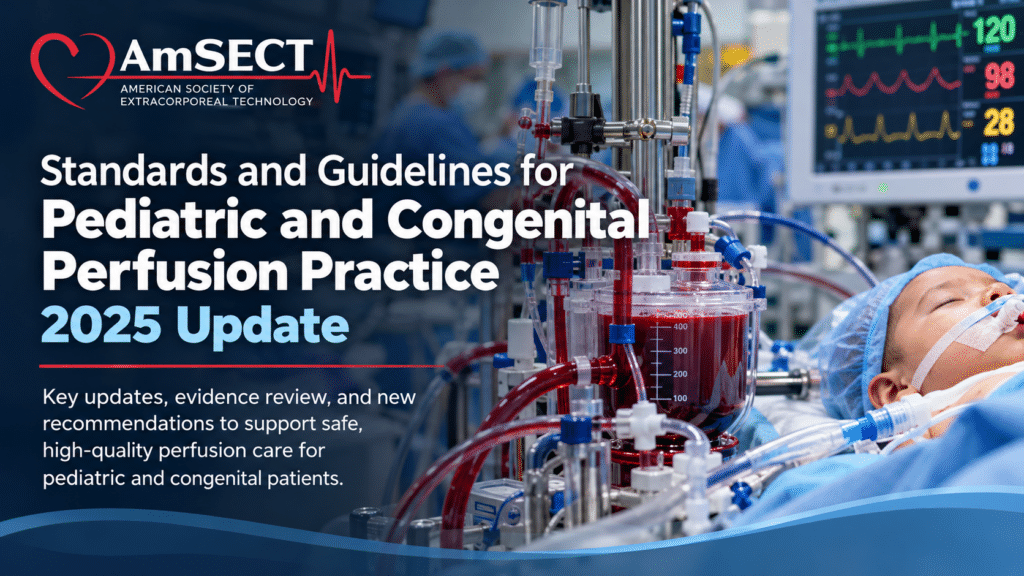
The American Society of ExtraCorporeal Technology (AmSECT) has updated its Standards and Guidelines for Pediatric and Congenital Perfusion Practice, revising the foundational 2019 document to reflect newer evidence, technology and patient-safety expectations. The 2025 update elevates five existing guidelines to standards, introduces three pediatric-specific guidelines and one new standard, and incorporates additional safety provisions from AmSECT’s 2023 adult perfusion standards.
Why the standards were updated
Pediatric and congenital cardiopulmonary bypass requires decisions that differ from adult practice because of patient size, physiology, metabolic demand and circuit-related hemodilution. A pediatric perfusion subcommittee initiated the revision in 2023, reviewed more than 140 publications and sought feedback from the AmSECT Pediatric and Congenital Perfusion Committee, Fellows of Pediatric Perfusion, the International Consortium for Evidence-Based Perfusion and conference attendees. AmSECT members approved the update in 2025, and the Congenital Heart Surgeons’ Society endorsed it later that year.
Five guidelines elevated to standards
The revision strengthens requirements in five areas: continuous arterial oxygen saturation monitoring during bypass; identification and management of heparin resistance; point-of-care blood gas analysis; pre-bypass ultrafiltration and/or washed red blood cells when exogenous blood products are used for circuit priming; and perfusion data collection through a clinical registry or database. These changes signal that practices previously described as recommendations are now expressed as professional standards.
New guidance on oxygen delivery and blood flow
The authors emphasize indexed oxygen delivery (DO₂i), especially in infants and children with greater metabolic requirements. A new standard calls for considering hemoglobin’s contribution to oxygen delivery and transfusing when indicated. A new guideline recommends considering higher pump blood-flow rates to achieve adequate perfusion and DO₂i targets. The update also adds attention to systemic vascular resistance, base excess or deficit, and age- or weight-derived blood pressure goals.
Blood gas management, priming and transfusion
A new guideline suggests considering pH-stat blood gas management for neonates and infants undergoing hypothermic bypass. Another recommends washing packed red blood cells using an autotransfusion device or blood bank before transfusion whenever feasible. For blood-containing circuit primes, the document highlights dilutional hematocrit, osmolarity or osmolality, compatibility with patient physiology and documentation of blood-prime gases. These are elements for clinical evaluation within institutional protocols, not universal numeric targets.
Continuous monitoring and safety culture
The authors distinguish continuous monitoring—without interruption—from continual assessment at frequent intervals. The updated language emphasizes uninterrupted surveillance of selected parameters, including arterial oxygen saturation and other critical oxygenation measures during bypass. Additional provisions address accessible emergency protocols, communication and documentation of departures from treatment plans, structured post-procedure debriefs, aseptic circuit assembly and maintenance, and collaborative blood-conservation practices.
Crisis management and institutional readiness
The revised pediatric document incorporates a crisis-management standard informed by pandemic disruptions and other emergencies. Perfusion teams are expected to participate in planning for supply-chain interruption, equipment shortages and circumstances that compromise normal clinical operations. The update also reinforces onboarding, competency, quality improvement and readiness processes.
What the update means for perfusion departments
Departments can use the revised standards as a framework to review local policies, checklists, monitoring capabilities, anticoagulation procedures, circuit-priming protocols, transfusion processes, data collection and emergency plans. The distinction between a standard and a guideline matters: the former describes an expected professional practice, while the latter leaves greater room for patient- and institution-specific judgment.
Limitations and future revisions
The authors acknowledge gaps in prospective randomized evidence, variability in practice, possible reviewer bias and limited multidisciplinary involvement in developing the revision. They anticipate further review as pediatric perfusion registries and new research mature. The publication describes the development and changes in the 2025 document; clinicians should consult the full AmSECT standards for the authoritative wording of individual requirements.
Keywords: Pediatric Perfusion, Congenital Heart Surgery, AmSECT, Cardiopulmonary Bypass, Perfusion Standards, Oxygen Delivery, DO₂i, Blood Management, Patient Safety.
Source: Oldeen ME, Striker CW, Angona R, Chianella DA, Capone C, Walczak AB, Klein T. The American Society of ExtraCorporeal Technology Standards and Guidelines for Pediatric and Congenital Perfusion Practice: 2025 Update. Journal of ExtraCorporeal Technology. 2026;58:211–216. https://doi.org/10.1051/ject/2026012. Open access under CC BY 4.0.