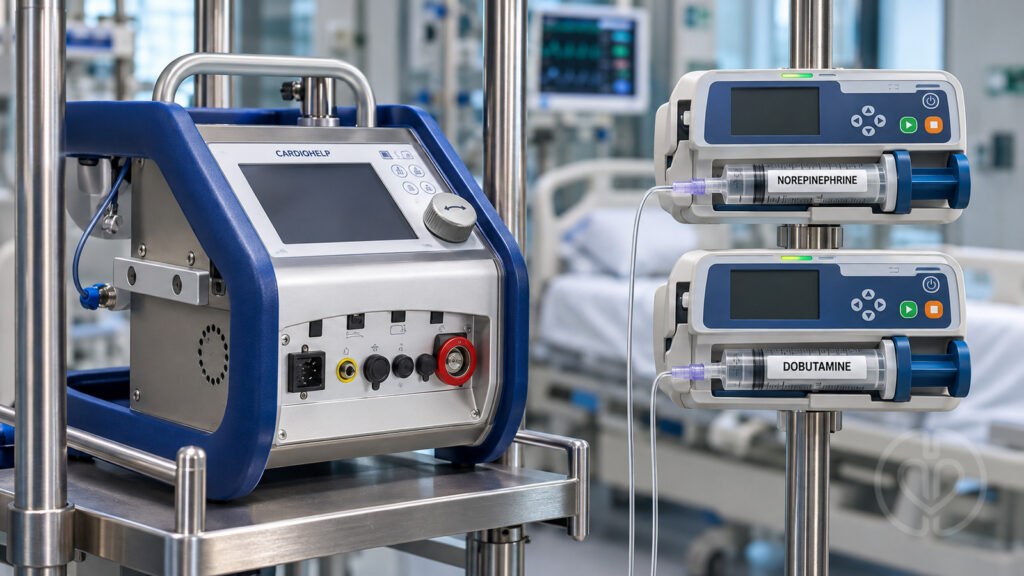
Vasopressors and inotropes during ECMO must be selected with both the native heart and the extracorporeal circulation in mind. In a 2026 narrative review, Brinkman and colleagues examine how vasoactive drugs interact with venoarterial (VA) ECMO physiology, particularly when cardiogenic shock overlaps with vasoplegia. Their central message is that adequate circuit flow and an acceptable arterial pressure do not, by themselves, establish appropriate ventricular loading or regional perfusion.
Why VA-ECMO Changes the Vasoactive Equation
Peripheral VA-ECMO creates parallel circulations: retrograde extracorporeal flow meets blood ejected by the left ventricle. Native cardiac function, circuit flow, and vascular resistance influence where these streams mix. When pulmonary gas exchange is impaired, changes in that balance can affect oxygen delivery to different vascular territories.
Arterial return also raises left ventricular afterload. A poorly ejecting ventricle may distend, contributing to pulmonary edema and myocardial ischemia. Increasing vascular tone may improve pressure while making ejection more difficult. Conversely, an inodilator may help ejection but worsen hypotension when vasoplegia is present. The review therefore emphasizes examination, invasive monitoring, and echocardiography to characterize the actual shock phenotype.
Vasopressors: Restoring Tone Without Losing Sight of the Heart
Norepinephrine
The authors present norepinephrine as a commonly preferred initial vasopressor for cardiogenic or vasodilatory shock because it combines strong vasoconstriction with modest inotropic activity. Much of the comparative evidence comes from broader shock populations, rather than dedicated ECMO trials. During VA-ECMO, the pressure response must still be interpreted alongside ventricular ejection and loading conditions.
Epinephrine and Dopamine
Epinephrine supplies both inotropy and vasoconstriction, but can increase heart rate, myocardial oxygen demand, arrhythmias, and lactate production. Its association with worse outcomes in several ECMO observational cohorts does not establish that the drug caused the excess mortality: more severely ill patients may be more likely to receive it.
Dopamine has dose-dependent receptor effects and a comparatively unfavorable arrhythmia profile. The review also discusses phenylephrine, whose predominantly vasoconstrictive action can be problematic in systolic dysfunction. These distinctions reinforce why raising pressure and improving native cardiac performance are separate therapeutic objectives.
Vasopressin and Angiotensin II
Vasopressin provides a nonadrenergic route to increasing vascular tone and may reduce catecholamine exposure. The authors discuss its potential usefulness when vasoplegia coexists with right ventricular dysfunction or pulmonary hypertension. Evidence favoring earlier administration includes observational studies and findings from non-ECMO shock populations; it does not establish a universal ECMO initiation threshold.
Angiotensin II is another nonadrenergic option discussed for refractory vasodilatory physiology. Small mechanical-support studies report improved pressure and lower catecholamine requirements, but the available ECMO-specific evidence remains limited. A physiological rationale or a lower vasopressor requirement should not be interpreted as a proven survival benefit.
Inotropes and Inodilators: Supporting Native Ejection
Dobutamine and milrinone can improve contractility while reducing vascular resistance. Either effect may be useful when the clinical goal is native ventricular ejection, but systemic vasodilation may be poorly tolerated in mixed cardiogenic and vasodilatory shock.
Milrinone’s renal elimination and longer duration complicate titration during evolving kidney injury. The review cites an ex vivo study in which ECMO circuitry had little effect on milrinone concentration, whereas continuous renal replacement therapy removed the drug. This finding should not be generalized into an automatic bedside dose adjustment or a claim that ECMO has no pharmacokinetic effects on other agents.
Dobutamine’s effect may be attenuated by chronic beta-blocker therapy. Isoproterenol is discussed in selected situations involving marked bradycardia or right ventricular dysfunction, with attention to its strong chronotropic effects and potential myocardial oxygen cost.
Levosimendan: Observational Signals Versus Randomized Evidence
The review highlights an important difference between favorable observational findings and randomized results. Several cohorts and a meta-analysis linked levosimendan with greater ECMO weaning success or lower mortality, but those data were vulnerable to bias and heterogeneity.
In contrast, the multinational LEVOECMO trial randomized 205 patients with severe cardiogenic shock on VA-ECMO to early levosimendan or placebo and found no difference in successful weaning, length of stay, or mortality. The combined literature does not support treating levosimendan as an established solution for routine ECMO separation.
What Perfusion Teams Should Take From the Review
Vasoactive changes are part of the overall support strategy. Circuit flow, arterial pressure, pulsatility, aortic valve opening, ventricular distension, pulmonary status, and evidence of organ perfusion need to be interpreted together. Inadequate native ejection may require reassessment of pharmacological support and mechanical unloading rather than continued escalation of a single drug.
During weaning, reducing circuit flow increases the heart’s contribution to circulation and may reveal residual left or right ventricular dysfunction. The review supports coordinating drug titration with flow changes and repeated hemodynamic assessment. It does not provide evidence for a single drug combination that is best for every patient.
Evidence Limits and Clinical Interpretation
This is a narrative review, not a new randomized comparison or a systematic review with a pooled primary endpoint. Its recommendations combine receptor pharmacology, physiological reasoning, observational ECMO studies, and evidence extrapolated from other shock populations. The underlying studies differ in shock cause, ECMO indication, treatment timing, and concurrent support.
The article is most useful as a framework for understanding why agents behave differently and for identifying questions during multidisciplinary review. It is not a stand-alone dosing protocol, and associations between medication exposure and outcomes require careful attention to confounding by illness severity.
Source and Disclosures
Brinkman HM, Ortoleva JP, Elliott AG, et al. Pharmacology of vasopressors and inotropes during extracorporeal membrane oxygenation. Journal of Anesthesia, Analgesia and Critical Care. 2026;6:133. doi:10.1186/s44158-026-00408-5.
The authors reported no specific funding. Disclosures include consulting fees to Erica D. Wittwer and Patrick M. Wieruszewski, speaker and consulting fees to Marc Leone, and editorial or professional leadership roles for Elena Giovanna Bignami and Jacopo D’Andria Ursoleo; full details appear in the source. This independent IPA educational commentary accompanies the unchanged source PDF, distributed under CC BY-NC-ND 4.0.