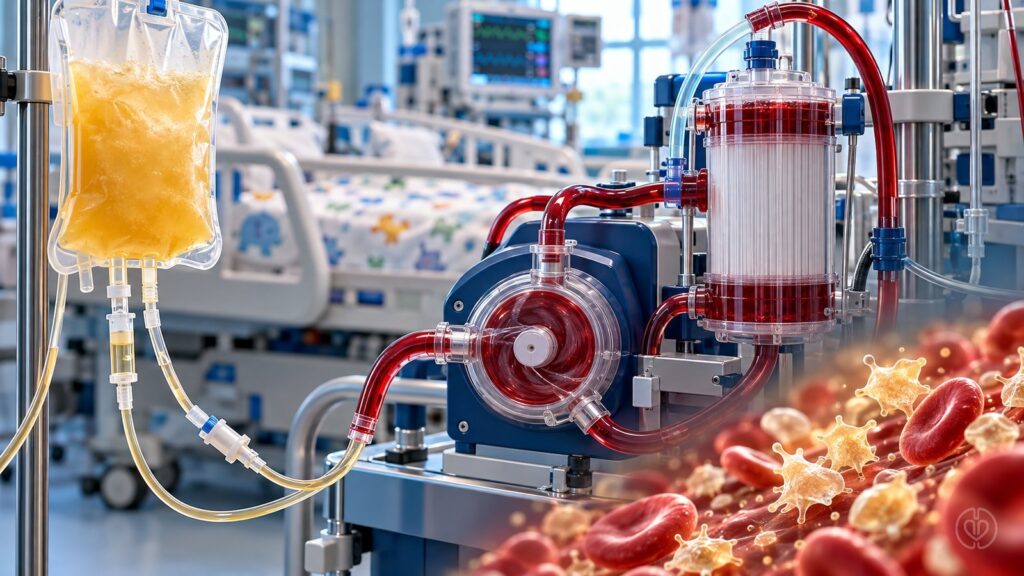
A secondary ECSTATIC analysis examined 161 platelet transfusions in 27 children on ECMO. The median platelet increment was 19 × 10⁹/L. Pathogen-reduced products were associated with lower odds of a higher count response, while higher pre-transfusion counts predicted greater response. Product selection was not randomized, irradiation overlapped completely with pathogen-reduction status, and storage data were often missing. These findings generate hypotheses rather than establish a preferred product.
Why platelet product characteristics matter during ECMO
Children receiving extracorporeal membrane oxygenation frequently develop thrombocytopenia and receive platelet transfusions. Circuit exposure, shear stress, platelet activation, inflammation, and underlying critical illness can all contribute to platelet consumption. Yet a transfusion does not always produce the expected rise in the circulating platelet count. Understanding that variability matters to perfusionists, intensivists, and transfusion services seeking to interpret laboratory trends and limit unnecessary donor exposure.
The ECSTATIC investigators examined whether characteristics of the platelet component were associated with the magnitude of the post-transfusion count response. Their analysis considered pathogen reduction, ABO compatibility, storage duration, platelet additive solution, irradiation, product source, and transfused dose. It addresses an important distinction: deciding when to transfuse is separate from understanding how a particular component performs after administration.
A secondary analysis within a randomized threshold trial
The parent ECSTATIC pilot trial enrolled 50 children younger than 18 years at nine ECMO centers. Participants were randomized to prophylactic transfusion thresholds below 90 × 10⁹/L or below 50 × 10⁹/L. Enrollment focused on children with no or minimal bleeding early after cannulation; the results therefore should not be generalized automatically to severe active hemorrhage.
This report included 161 transfusions from 27 participants with paired pre- and post-transfusion platelet counts during the study intervention. Eight centers contributed these transfusions. Fifteen of the 27 children were neonates, and 26 were receiving veno-arterial ECMO. Although the parent trial randomized transfusion thresholds, it did not randomize platelet product characteristics. Local blood-bank availability and practice determined those characteristics, making the product comparisons observational.
How the response was measured
The primary outcome was the absolute difference between the pre-transfusion and post-transfusion platelet counts. Investigators divided the observed responses at the cohort median: an increment of 19 × 10⁹/L or less was classified as lower, and an increment of at least 20 × 10⁹/L was classified as higher. This was an analytical division within the dataset, rather than a validated clinical definition of successful transfusion.
The median increment was 19 × 10⁹/L, with an interquartile range of 8–36 × 10⁹/L. There were 84 lower-response transfusions and 77 higher-response transfusions. The median interval between the pre- and post-transfusion measurements was 5.9 hours, which includes time before transfusion and should not be confused with a standardized one-hour corrected count increment.
Median pre-transfusion platelet count was 68 × 10⁹/L, and median transfused volume was 10.7 mL/kg. Nearly all products were apheresis-derived. Pathogen-reduced products accounted for 119 of 161 transfusions, or 74%; 100 transfusions were ABO compatible, and 112 used platelet additive solution. Storage duration was unknown for 108 transfusions, substantially restricting analysis of storage effects.
Pathogen reduction and count increment
Mixed-effects logistic regression accounted for repeated transfusions within individual patients and clustering within centers. In the multivariable model, pathogen-reduced platelets were associated with lower odds of a higher count increment: adjusted odds ratio 0.16, 95% confidence interval 0.03–0.99, P = 0.048. The model also included baseline platelet count, storage-duration category, and transfused dose.
This odds ratio describes the chance of falling into the higher increment category. It does not mean that platelet counts rose by 84% less, that the transfusion was ineffective, or that a particular product caused worse clinical outcomes. The confidence interval was wide, and the statistical result was close to the conventional significance threshold.
Every non-pathogen-reduced product in this cohort was irradiated, while every pathogen-reduced product was not irradiated. Consequently, the two characteristics could not be separated reliably. Irradiation was omitted from the multivariable model because of this redundancy. The findings cannot establish an independent benefit of irradiation or isolate a causal effect of pathogen reduction.
Patient context also influenced the observed response
Higher pre-transfusion platelet count was associated with higher odds of a larger increment, with an adjusted odds ratio of 1.03 per unit increase in the platelet-count scale, 95% confidence interval 1.00–1.07, P = 0.049. The authors suggest that a higher baseline count might identify patients with less ongoing platelet consumption. That explanation remains a hypothesis because the study could not adequately characterize illness severity at the exact time of each transfusion.
The randomized threshold assignment itself was not significantly associated with the higher-versus-lower increment category in the univariable analysis. More included transfusions came from the higher-threshold arm, however, so threshold strategy still shaped the dataset. The observed association with baseline count should not be used to infer that transfusing at a higher threshold improves outcomes.
Storage duration and platelet dose did not reach statistical significance in the adjusted model. Missing storage information, small patient numbers, and uneven representation of several component characteristics limit what can be concluded from these negative comparisons. A nonsignificant association does not establish that storage, dose, ABO compatibility, or additive solution never matter.
Limits that matter for clinical interpretation
The 161 transfusions came from only 27 children, so the transfusion count should not be mistaken for 161 independent patients. Center-level variation was substantial, and residual differences in blood-bank practices, component availability, patient selection, and circuit-related consumption may have influenced the findings despite statistical adjustment.
The study measured absolute count increment rather than corrected count increment. Actual platelet content of individual units was unavailable, and standardized one-hour counts were not routinely collected. The population was predominantly neonatal and almost entirely supported with veno-arterial ECMO, limiting extrapolation to older children, venovenous support, or adult ECMO.
Most importantly, a laboratory count response is not the same as hemostatic effectiveness. This analysis does not establish whether a product characteristic changes bleeding, thrombosis, circuit complications, or survival. Pathogen reduction also serves an infectious-safety purpose that cannot be evaluated solely through the platelet-count increment.
What this adds to perfusion practice
The study supports viewing an attenuated platelet-count response as the result of both product characteristics and the patient’s ongoing physiology. It provides a rationale for recording product details alongside transfusion timing, dose, platelet trends, and circuit events when evaluating transfusion performance. It does not justify selecting a preferred platelet product or changing transfusion thresholds on its own.
Larger prospective studies should distinguish component processing from center practice, capture actual platelet dose, standardize post-transfusion measurements, and examine clinical outcomes. For now, the ECSTATIC secondary analysis is a useful hypothesis-generating contribution to pediatric ECMO transfusion research, with a signal that warrants confirmation rather than immediate protocol changes.
Keywords: Pediatric ECMO, Platelet Transfusion, ECSTATIC Trial, Pathogen Reduction, Platelet Count Increment, Thrombocytopenia, Transfusion Medicine, ABO Compatibility, Patient Blood Management.
Source: Karam O, Barney BJ, Coles G, et al.; ECSTATIC collaborators. Transfusion. 2026;66:1727–1736. doi:10.1111/trf.70299.
Funding: National Heart, Lung, and Blood Institute (R34 HL159119) and National Center for Advancing Translational Sciences (U24TR001597).