
Transfusion Blood Cardiac Surgery

Quality Management of Comprehensive Blood Conservation Strategies During Cardiopulmonary Bypass in Pediatric Cardiac Surgery

This retrospective single-center study evaluated 9,792 children aged 14 years or younger undergoing cardiac surgery with cardiopulmonary bypass. After implementation of a quality-managed, multimodal blood conservation program, matched analysis showed lower PRBC and plasma transfusion rates, smaller CPB priming volumes, and fewer postoperative complications, especially liver injury and acute kidney injury, without increased mortality or longer recovery.

Read More »
Bridging the Distance: Pediatric ECMO Access Across America

State and Regional Variation in Access to Pediatric Extracorporeal Membrane Oxygenation

This geospatial cross-sectional study examined how access to pediatric extracorporeal membrane oxygenation varies across U.S. states and Pediatric Emergency Referral Regions. Researchers identified 258 pediatric ECMO centers and 169 ECPR centers, finding major differences in direct access, especially in rural areas. Although interfacility transport made ECMO access nearly universal in many places, access to ECPR remained very limited for most children.

Read More »
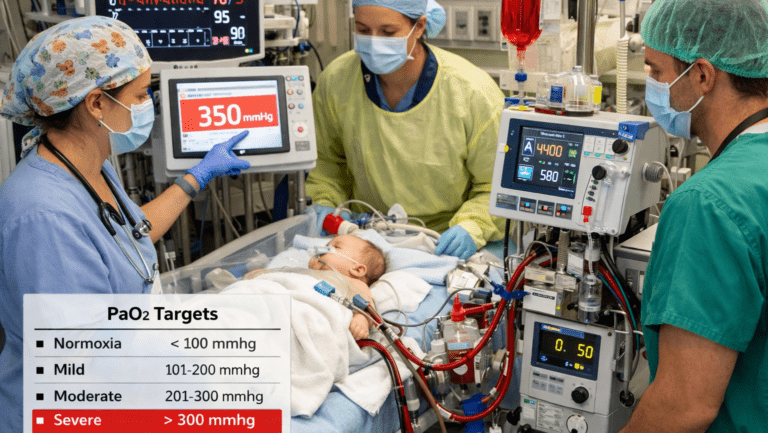
Bright Neonatal ECMO Team Managing Oxygen Targets

Impact of Early Hyperoxia on Outcomes During Neonatal and Pediatric Veno-Arterial Extracorporeal Life Support

This single-center retrospective cohort study examined 229 neonatal and pediatric VA-ECLS patients and found that early hyperoxia was common, affecting 79% of cases. Severe hyperoxia, defined as PaO2 above 300 mmHg, was linked to more cardiovascular or renal complications, but it was not independently associated with in-hospital mortality, acute kidney injury, or worse functional outcomes after adjustment. The authors support standardized oxygen targets during VA-ECLS.

Read More »
Anticoagulation Management and Monitoring in ECMO

Anticoagulation Management and Monitoring in ECMO: An International Survey From the ISTH SSC Subcommittee on Pediatric and Neonatal Thrombosis and Hemostasis

This international survey evaluates anticoagulation strategies in ECMO patients across 17 countries. Findings show unfractionated heparin remains the primary anticoagulant, while bivalirudin use is rising. Despite widespread protocol use, significant variability persists in dosing, monitoring, and transfusion practices. Hematology involvement is often limited to complex cases, highlighting the need for standardized, collaborative approaches to improve ECMO outcomes.

Read More »
Perfusionist-Led Pediatric ECMO Monitoring in a High-Tech ICU

A Bedside Staffing Model With Perfusionists for Pediatric Extracorporeal Membrane Oxygenation (ECMO) at a High-Volume Center 

This study describes a pediatric ECMO staffing model using perfusionists supported by remote monitoring technology and hourly bedside rounding. Implemented at a high-volume center, the model enables one perfusionist to oversee multiple patients safely. Across 289 cannulations and over 62,000 ECMO hours, outcomes including mortality and complications were comparable to ELSO benchmarks, supporting the model’s safety and feasibility.

Read More »
Seamless Transition: Single-Circuit ECMO to CPB in Pediatric Surgery

ECMO to CPB: A Single Circuit Approach

This technique article describes a novel method for converting pediatric patients from veno-arterial extracorporeal membrane oxygenation (VA-ECMO) to cardiopulmonary bypass (CPB) using a single circuit with the addition of a cardiotomy reservoir. In seven patients (eight procedures), the approach preserved circulating blood volume, limited donor exposure, and maintained effective surgical support. All patients were successfully decannulated, demonstrating feasibility and safety in complex congenital heart surgery.

Read More »
High-Exchange Ultrafiltration During Pediatric Cardiopulmonary Bypass

High-Exchange Ultrafiltration to Enhance Recovery After Pediatric Cardiac Surgery: The ULTRA Randomized Controlled Trial

The ULTRA randomized controlled trial evaluated whether high-exchange subzero-balance ultrafiltration (H-SBUF) during pediatric cardiopulmonary bypass improves recovery compared with low-exchange SBUF. In 104 children under 15 kg, high-exchange ultrafiltration did not reduce peak postoperative vasoactive-ventilation-renal (VVR) scores or improve clinical outcomes. Inflammatory mediator profiles were largely similar, suggesting limited immunomodulatory benefit.

Read More »
Evaluation of Transcutaneous Non-Invasive Blood Gas Analysis

Evaluation of Transcutaneous Non-Invasive Blood Gas Analysis for Monitoring Gas Exchange in Pediatric Cardiac Surgical Patients Post Extubation

This study evaluates the effectiveness of transcutaneous blood gas monitoring (TcPCO₂ and TcPO₂) in detecting carbon dioxide and oxygen levels in pediatric cardiac surgery patients after extubation. It found a strong correlation between TcPCO₂ and arterial PaCO₂, suggesting transcutaneous CO₂ can be a reliable, non-invasive monitoring tool. However, TcPO₂ showed less precision and cannot substitute PaO₂.

Read More »
Is Surgery for Congenital Heart Defects in Neonates, Infants, and Children More Challenging and Demanding Than Surgery for Acquired Heart Defects in Adults?

Is Surgery for Congenital Heart Defects in Neonates, Infants, and Children More Challenging and Demanding Than Surgery for Acquired Heart Defects in Adults?

Pediatric cardiac surgery presents unique challenges due to the complexity of congenital heart defects (CHD), requiring highly specialized techniques, individualized interventions, and long-term patient care. Unlike adult cardiac surgery, which addresses standardized conditions, CHD surgery demands precision, adaptability, and multidisciplinary expertise. Limited cardiovascular reserves in younger patients increase surgical risks. Addressing global disparities in pediatric cardiac care is crucial for improving outcomes.

Read More »
Lethal Myocardial Infarction in a Neonate During Extracorporeal Membrane Oxygenation

Lethal Myocardial Infarction in a Neonate During Extracorporeal Membrane Oxygenation

This case study explores a neonate with congenital diaphragmatic hernia (CDH) who experienced a lethal myocardial infarction (MI) while on extracorporeal membrane oxygenation (ECMO). The patient developed a large thrombus extending from the arterial cannula into the left main coronary artery, leading to severe cardiac dysfunction. Despite anticoagulation efforts, the clot progressed, resulting in a fatal outcome. The study highlights the challenges of managing neonatal ECMO and intracardiac thrombosis.

Read More »