ECPR as a Bridge to Heart Transplantation
For a patient with fulminant myocarditis, restoring circulation during refractory cardiac arrest may be only the first step in a longer rescue pathway. Szentgyorgyi and colleagues describe a 36-year-old woman at Wythenshawe Hospital in Manchester who progressed from bedside extracorporeal cardiopulmonary resuscitation (ECPR) to central biventricular assist-device (BiVAD) support and, ultimately, heart transplantation.
The case is particularly relevant to perfusion teams because emergency peripheral VA-ECMO restored systemic flow but did not adequately decompress the failing heart. Definitive support required a further transition, supported by established ECMO, mechanical circulatory support, and transplant expertise.
Clinical Presentation and Rescue Support
The previously healthy patient presented with fever, abdominal pain, hypotension, and severe biventricular dysfunction. After transfer to the specialist centre, transoesophageal echocardiography showed a dilated left ventricle and an ejection fraction of 10%. Despite initial pharmacological support, she developed ventricular tachyarrhythmias and cardiac arrest the following day.
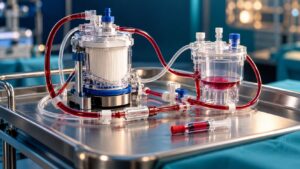
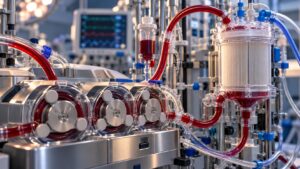
Defibrillation and amiodarone produced transient return of spontaneous circulation, but recurrent ventricular tachycardia and fibrillation led to refractory arrest. The team initiated bedside peripheral VA-ECMO using an emergency circuit that was already primed. Initial drainage was slow; after fluid administration, flow reached 3.3 L/min.
Approximately 68 minutes elapsed between the initial loss of cardiac output and initiation of ECMO flow. This interval included a temporary return of spontaneous circulation and must not be interpreted as 68 minutes of uninterrupted CPR.
Why Peripheral VA-ECMO Was Not the Endpoint
Reassessment showed ventricular standstill, persistent aortic valve closure, and progressive left ventricular dilatation. In the setting of established severe biventricular failure, the team proceeded to central BiVAD support rather than adding an intermediate left ventricular unloading device. Another 162 minutes elapsed on peripheral VA-ECMO before BiVAD support was established.
Myocardial biopsy subsequently confirmed severe lymphocytic myocarditis. Serial echocardiography showed no recovery, shifting the pathway from possible myocardial recovery toward transplantation.
Reported Timeline and Outcomes
| Milestone | Reported finding |
|---|---|
| Initial ventricular function | Severe biventricular failure; ejection fraction 10% |
| Initial loss of output to VA-ECMO flow | Approximately 68 minutes, with transient spontaneous circulation during that interval |
| Initial established ECMO flow | 3.3 L/min after fluid administration |
| Peripheral VA-ECMO to BiVAD | A further 162 minutes |
| Peak lactate during rescue procedures | 19 mmol/L |
| Super-urgent transplant listing | 23 days after BiVAD initiation |
| DCD heart transplantation | 16 days after listing |
| Hospital outcome | Discharged home neurologically intact after 72 days |
| Follow-up | Reported to be physically and neurologically well five months after discharge |
Implications for Perfusion Practice
Readiness Depends on People as Well as Equipment
The centre’s formal ECPR service had been suspended in 2020, but a primed emergency ECMO circuit and specialist MCS infrastructure remained available. Most staff involved lacked prior ECPR experience; the consultant leading the decision had relevant experience, and the off-site perfusionist arrived in time to initiate ECMO. The report illustrates how equipment readiness and experienced leadership contributed to this particular rescue, without establishing that an ad hoc service is equivalent to a structured ECPR programme.
Cannula Selection and Ventricular Assessment Matter
The authors report that a lighthouse-tip return cannula was inadvertently used for venous drainage instead of the usual multistage drainage cannula. Although adequate flow was subsequently achieved, this was a deviation from intended practice, not a technique validated by the case. For perfusion readers, the episode makes equipment identification and team communication a salient learning point.
The transition to BiVAD also illustrates why systemic flow alone does not describe the adequacy of support. In this patient, persistent aortic valve closure and ventricular distension prompted reassessment of the support strategy. The choice was made under substantial uncertainty, including an unresolved neurological prognosis.
Interpretation and Limitations
This is one successful case from a specialist centre, with no comparator group. It cannot determine the survival benefit of ECPR, identify which intervention caused the favourable neurological outcome, or establish the safety of prolonged resuscitation intervals. The authors report intact neurological recovery, but the account does not provide a detailed standardised neurocognitive assessment.
The central contribution is a detailed description of sequential rescue support when myocardial recovery failed: ECPR restored perfusion, BiVAD supported both ventricles, and transplantation provided definitive treatment. The exceptional result should be read alongside the preparation, expertise, and clinical uncertainty described in the report.
This IPA summary is an original educational synthesis of the cited case report. The original article is by Szentgyorgyi and colleagues, published under the Creative Commons Attribution–NonCommercial 4.0 licence. The full-text PDF is provided unchanged.
Original Article
Szentgyorgyi L, Roberts L, Cheung W, Hooper J, Jayne-Coupe FA, Elmahdi H, Mehta V. Extracorporeal Cardiopulmonary Resuscitation as a Bridge to Cardiac Transplantation in Refractory Cardiac Arrest Due to Fulminant Myocarditis: A Case Report. International Medical Case Reports Journal. 2026;19:625131. Published October 9, 2026. doi:10.2147/IMCRJ.S625131.