Temporary mechanical circulatory support was associated with faster access to heart transplantation and shorter cardiopulmonary bypass times than durable LVAD support in a small retrospective Mayo Clinic Florida study. The findings describe selected patients who successfully reached transplant after axillary intra-aortic balloon pump (Ax-IABP), Impella 5.5, or HeartMate 3 support. They do not establish which strategy gives all patients starting mechanical support the best chance of surviving to transplantation.
Study Design and Patient Selection
Mautong and colleagues reviewed adults treated between October 18, 2018, and October 18, 2020, during the early period after the 2018 US heart allocation revision. Of 59 potential transplant candidates evaluated, 26 met the study criteria and underwent transplantation. Eight received axillary IABP support, nine received Impella 5.5 support, and nine received a durable HeartMate 3 LVAD. Temporary support therefore accounted for 17 patients, with nine in the durable support group.
Device selection was individualized by the multidisciplinary team. Temporary support was favored when short-term bridging appeared feasible; durable support was more commonly chosen when prolonged stabilization or outpatient management was needed. This distinction is central to interpretation: the groups were selected for different clinical pathways before their outcomes were compared.
Different Patients and Different Allocation Pathways
The median age was 58 years, and 73.1% of participants were men. Nonischemic cardiomyopathy accounted for 65.4% of cases. The Impella group was older, with a median age of 65 years, compared with 54.5 years for axillary IABP and 50 years for durable LVAD recipients. Kidney function was also worse in the Impella group before implantation.
All patients in the temporary support groups were UNOS Status 2 at transplantation, whereas three of nine durable LVAD recipients were Status 3. These are historical cohort characteristics, not a statement of current eligibility rules. Allocation priority, patient selection, donor availability, and the anticipated duration of support all affect how quickly transplantation occurs. The observed waiting-time differences cannot be attributed to device physiology alone.
Temporary Mechanical Circulatory Support: Transplant Timing
Median waitlist time was 27.5 days with axillary IABP, 34 days with Impella 5.5, and 606 days with durable LVAD support. Reported median device-to-transplant times were seven, 13, and 572 days, respectively. Across the three device groups, the reported P values were .002 for waitlist time and .001 for device-to-transplant time.
An important methodological detail is that the investigators applied a standardized 90-day adjustment to the LVAD device-to-transplant calculation, except for three patients requiring urgent transplantation before 90 days. Readers should therefore avoid treating that measure as a simple, unadjusted duration of device support. It is also distinct from the interval between waitlist registration and transplantation.
In the adjusted strategy-level analysis, temporary support was associated with approximately 495 fewer days to transplantation, with a 95% confidence interval from approximately 276 to 714 fewer days. Adjustment does not eliminate confounding in such a small, nonrandomized cohort. The estimate reflects this center’s selected transplant recipients and should not be used to predict an individual patient’s wait.
Cardiopulmonary Bypass and Early Recovery
Median bypass time was 166.5 minutes after axillary IABP, 158 minutes after Impella 5.5, and 250 minutes after durable LVAD support. The between-group comparison was statistically significant. In the adjusted analysis, temporary support was associated with approximately 89 fewer bypass minutes, with a 95% confidence interval of approximately 51 to 126 fewer minutes.
For perfusion teams, this is a relevant operative signal. Transplantation following durable LVAD implantation can involve re-entry, dissection, and device explantation. However, the study used bypass duration as a surrogate for operative complexity; it did not demonstrate that any particular perfusion protocol caused the difference, or that shorter bypass translated into a proven survival benefit.
Median post-transplant ICU stay was four days in each temporary support group and six days in the LVAD group. Median time from transplantation to discharge was 11.5, 13, and 13 days, respectively. Neither comparison reached statistical significance. With only 26 patients, failure to detect a difference is not evidence of equivalent recovery or safety.
Complications and the Missing Bridge Denominator
Reported post-device events included stroke in four patients, major bleeding in two, pump thrombosis in one, and a vascular complication in one. These event counts were too small to establish reliable differences between strategies. A nonsignificant result should not be interpreted as evidence that the risks are interchangeable.
The most consequential limitation is the inclusion of patients who ultimately underwent transplantation. Outcomes among excluded candidates were not systematically captured sufficiently to classify their subsequent clinical courses. The study therefore cannot estimate the probability of reaching transplant after starting each strategy, compare waitlist death or delisting, or establish which approach produces better overall bridge outcomes. Its time-to-transplant analysis describes timing among selected transplant recipients.
What the Findings Mean for Practice
This report supports further examination of how support selection and allocation pathways influence transplant timing and operative workload. It does not support replacing durable LVADs with temporary devices for every candidate. Anticipated donor wait, support requirements, recovery potential, ability to leave the hospital, and institutional expertise remain relevant considerations.
The study excluded VA-ECMO and other rescue or combination support configurations, so its conclusions should not be extended to those populations. Its retrospective single-center design, small groups, baseline differences, and limited event counts also constrain interpretation. Multivariable and INTERMACS sensitivity analyses remain exploratory because the sample provides limited protection against unstable estimates and residual confounding.
For cardiovascular teams, the practical value is a focused discussion of strategy, timing, and operative preparation. Larger studies that follow all patients from support initiation are needed to evaluate survival to transplant, complications during bridging, and longer-term outcomes. The authors reported no external funding and declared no conflicts of interest.
Original Article
Mautong H, Desai A, Bangari LR, et al. Temporary Mechanical Circulatory Support with Axillary IABP or Impella 5.5 Versus Durable LVAD as Bridge to Heart Transplantation: A Strategy-Level Analysis in the Contemporary Allocation Era. Journal of Cardiovascular Development and Disease. 2026;13:588. doi:10.3390/jcdd13110588.
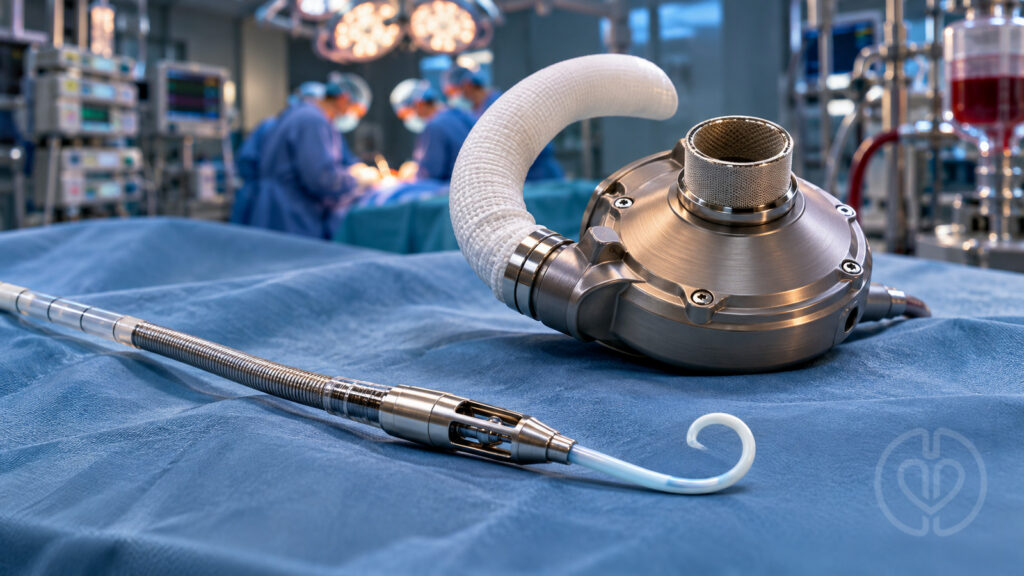
The source PDF is unchanged. The cover is an AI-generated editorial illustration, not a device-placement guide.