Impella-supported CABG outcomes in a Japanese national registry provide a useful reference for a difficult surgical population: acute myocardial infarction complicated by cardiogenic shock. Among 245 patients treated at 116 centers, mortality was 20.8% within 30 days of Impella implantation and 33.1% before discharge from the index hospitalization. These observations describe patients receiving support; they do not establish that Impella improves survival compared with another device or with no mechanical support.
Study Design and Surgical Population
Nakahara and colleagues retrospectively analyzed prospectively collected data from the Japanese Registry for Percutaneous Ventricular Assist Devices (J-PVAD), covering February 2020 through December 2024. The final cohort included patients recorded as undergoing CABG under Impella support after excluding ventricular septal perforation repair and unsuccessful device insertion.
The median age was 72 years, and 82.9% of patients were men. Impella CP was the initial device in 89.4%, and median support duration was 109 hours. ECMO was used at some point in 84 of 244 patients with available data (34.4%); 24 patients underwent Impella-supported off-pump CABG. Concomitant valve surgery occurred in 14.3%, so this was not exclusively isolated coronary surgery.
Cardiogenic shock was inferred from the registered underlying disease and the indication under which Impella is used in Japan. The dataset did not independently verify shock severity or provide SCAI shock stages.
Impella-Supported CABG Outcomes
| Outcome | Patients | Reported proportion |
|---|---|---|
| All-cause death within 30 days of implantation | 51/245 | 20.8% (95% CI 16.2–26.3) |
| Death during the index hospitalization | 81/245 | 33.1% (95% CI 27.5–39.2) |
| Bleeding or hematoma | 43/245 | 17.6% |
| Renal failure | 24/245 | 9.8% |
| Sepsis | 22/245 | 9.0% |
| Hemolysis | 21/245 | 8.6% |
| Stroke | 16/245 | 6.5% |
| Limb ischemia | 11/245 | 4.5% |
Why the Two Mortality Estimates Differ
The 30-day clock began at Impella implantation, not the operation. In-hospital mortality included later deaths before discharge, including 31 that occurred more than 30 days after implantation. Conversely, one patient died within 30 days after being discharged alive. The endpoints therefore capture overlapping but different outcomes.
For 24 patients discharged alive before day 30, the last dated confirmation of survival fell between days 16 and 29; the primary analysis assumed survival to day 30 from their recorded alive status. Censoring these patients at the last confirmed date produced a Kaplan–Meier estimate of 21.1%. This sensitivity analysis was close to the primary estimate, but it does not eliminate uncertainty about follow-up.
Insertion Setting Does Not Establish the Best Timing
Nineteen patients received Impella in the operating room, while 226 received it elsewhere. All operating-room insertions occurred during on-pump CABG: nine before and ten after weaning from cardiopulmonary bypass. The registry did not capture whether insertion was planned, prompted by deterioration, or intended as rescue.
Observed 30-day mortality was 36.8% after operating-room insertion and 19.5% after insertion elsewhere. An exploratory analysis using propensity score overlap weighting yielded an odds ratio of 1.63, with a wide 95% confidence interval of 0.62–4.16. The interval allows materially different conclusions in either direction.
Weighting balanced only the three modeled variables—age, systolic blood pressure, and ECMO initiated before Impella. Sixteen of 31 baseline variables remained imbalanced. Device type and access also differed substantially: larger Impella 5.0/5.5 devices were much more common in the operating-room group. The comparison cannot isolate insertion location, timing, device selection, or clinical severity.
These results should not be presented as proof that preoperative insertion is safer, that operating-room insertion is harmful, or that the two approaches are equivalent. The study supports prospective collection of the indication and timing of support rather than a universal timing rule.
Relevance for Perfusion and Shock Teams
The adverse-event pattern highlights the need for surveillance across the entire support course. Bleeding and hemolysis appeared early, each at a median of day 1 after implantation; renal failure appeared at a median of day 4, while stroke and sepsis occurred later. These are descriptive onset patterns, not fixed windows outside which complications can be excluded.
For perfusionists, the findings are relevant to multidisciplinary planning for ventricular support, transition from bypass, blood conservation, and monitoring for hemolysis, vascular compromise, and organ dysfunction. The frequency of combined ECMO use also shows that many patients required more than isolated left ventricular support. The registry cannot determine whether a particular combined-support strategy improved outcomes.
The paper does not evaluate a specific pump setting, anticoagulation target, bypass-weaning protocol, or escalation algorithm. Its most defensible practical contribution is a national description of outcomes and complications against which more detailed prospective studies can be designed.
Important Limitations
There was no control group receiving CABG without Impella or with an alternative support strategy. Historical mortality comparisons cannot establish treatment benefit because case selection, shock severity, procedures, and outcome clocks differ. Only 19 patients were in the operating-room group, leaving the exploratory comparison imprecise and vulnerable to confounding.
The registry did not record the CABG date, number of grafts, bypass or cross-clamp times, or intensive care length of stay. Left ventricular ejection fraction was missing in approximately one third of patients and lactate in approximately one quarter. Adverse events were not centrally adjudicated, and definitions were not standardized for every category. Transfers ended ascertainment of mortality within the index hospitalization, which is another reason to distinguish that endpoint from broader survival.
Funding and Disclosures
The analysis received a Sakakibara internal research grant. J-PVAD is operated by an academic-society consortium and receives institutional certification fees and fees from Abiomed Japan for device-use and safety information. The authors state that the manufacturer had no role in this study’s design, analysis, interpretation, writing, or publication decision, and declared no commercial or financial conflicts. The source also discloses generative AI use for language editing and translation, with author review.
Original Article
Nakahara Y, Iwakura T, Marui A, Okada Y, on behalf of the J-PVAD Investigators. Early outcomes of microaxial flow pump (Impella)–supported coronary artery bypass grafting for acute myocardial infarction with cardiogenic shock: national reference estimates from the J-PVAD registry. Frontiers in Cardiovascular Medicine. 2026;13:1941963. Published November 2, 2026. doi:10.3389/fcvm.2026.1941963.
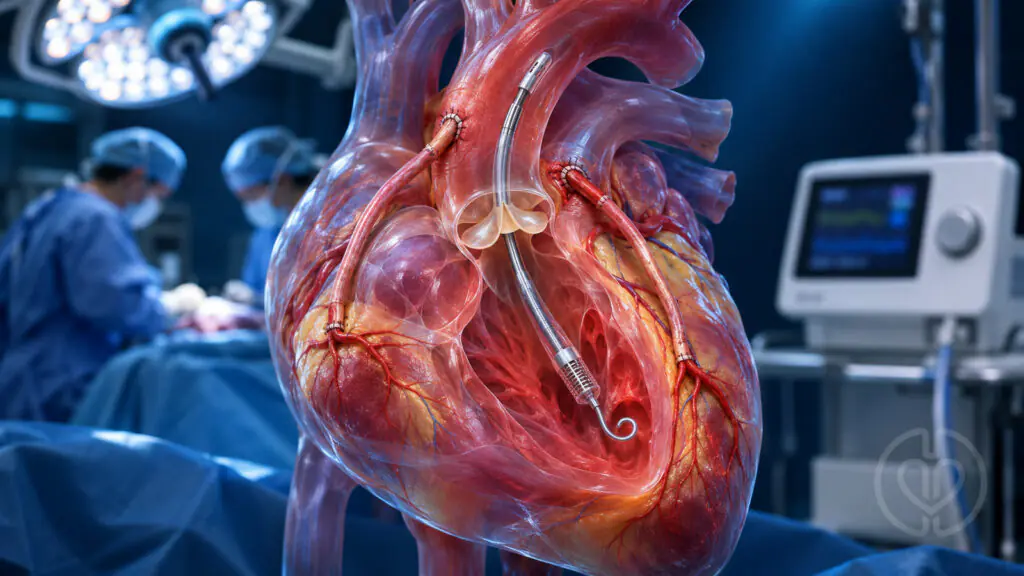
The source PDF is unchanged and is available under its original CC BY license. The cover is an AI-generated editorial illustration and is not a device-placement guide.