Dexmedetomidine in del Nido cardioplegia may offer an additional approach to myocardial protection during pediatric cardiac surgery. In a randomized trial involving 60 children, adding the drug to a modified del Nido solution was associated with lower postoperative troponin I, reduced vasoactive support, and shorter ventilation and intensive care durations. However, important inconsistencies in the published methods and results limit how confidently the findings can guide practice.
Study Design and Patient Population
Samadieh and colleagues conducted a prospective, randomized, triple-blind, controlled trial at three cardiac surgical centers in Iran. Sixty children were assigned equally to dexmedetomidine-enriched modified del Nido cardioplegia or the same cardioplegia with an equivalent volume of saline.
Eligible patients were older than one month and scheduled for elective congenital heart defect repair within RACHS categories 1 or 2. Patients with more complex procedures, specified organ dysfunction, or anticipated bypass or cross-clamp times exceeding 120 minutes were excluded. Mean ages were approximately 34 and 38 months in the intervention and control groups, respectively. These findings should not be generalized directly to neonatal surgery or higher-complexity repairs.
The investigators describe computer-generated block randomization, allocation concealment with opaque sealed envelopes, and blinding of families, clinical teams, and analysts. They report intention-to-treat analysis. The trial was registered retrospectively as IRCT20240415061492N1.
What Was Different About the Cardioplegia?
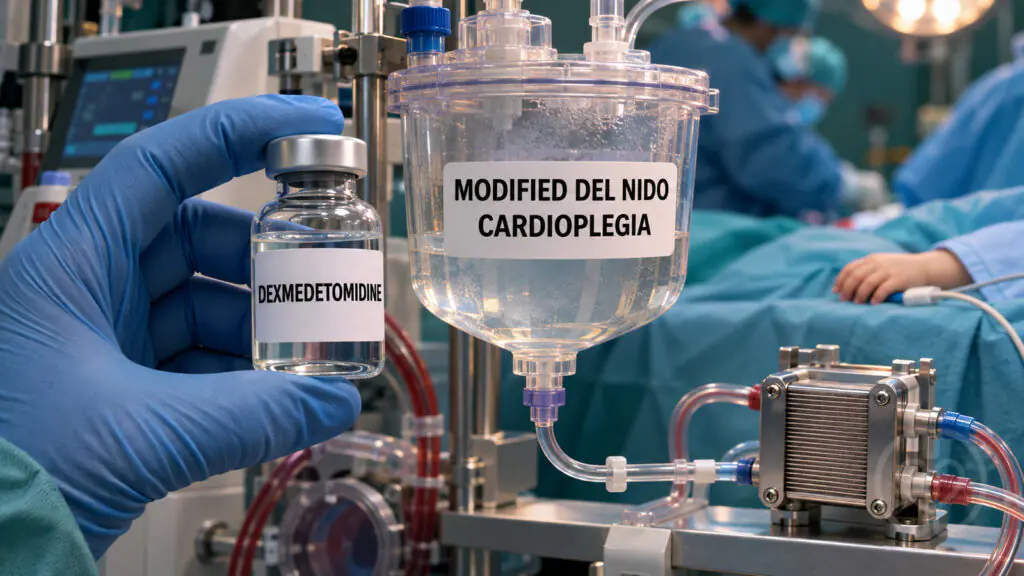
Both groups received a saline-based modified del Nido formulation mixed with autologous blood in a 4:1 crystalloid-to-blood ratio. The experimental difference was the addition of dexmedetomidine to the cardioplegia rather than its use as a conventional intravenous sedative infusion. That route matters when interpreting the study: evidence about systemic dexmedetomidine does not automatically establish the efficacy or safety of a cardioplegia additive.
The source paper contains a discrepancy between its stated final dexmedetomidine concentration and the concentration implied by its preparation description. The actual administered concentration therefore needs clarification from the investigators. This summary does not reproduce the preparation as a clinical mixing protocol.
Dexmedetomidine in Del Nido Cardioplegia: Main Findings
| Outcome | Dexmedetomidine group | Control group |
|---|---|---|
| Patients randomized | 30 | 30 |
| Mean aortic cross-clamp time | 76.00 minutes | 73.17 minutes |
| Mean CPB time | 92.50 minutes | 85.73 minutes |
| Mean ventilator weaning time | 455.0 minutes | 624.5 minutes |
| Mean ICU stay | 79.25 hours | 120.96 hours |
| Arrhythmia | 4 patients | 1 patient |
| Acute kidney injury | 1 patient | 7 patients |
Myocardial Injury Biomarkers
Troponin I was lower in the intervention group at each postoperative measurement. However, it was also significantly lower before surgery. That baseline imbalance makes simple comparisons of postoperative values less conclusive than an analysis that explicitly accounts for starting values.
Table 3 reports lower CK-MB at 12 and 24 hours, with no significant between-group difference at baseline or ICU admission. Some narrative descriptions are broader than the tabulated findings; the distinction matters when deciding whether the effect was consistent across all measurements.
Vasoactive Support and Recovery
The dexmedetomidine group had lower reported vasoactive-inotropic scores across the tabulated observations. However, the methods, narrative results, and Table 3 do not consistently identify the same measurement times. The printed score formula also contains duplicated text. These reporting problems prevent a clean reconstruction of the exact postoperative trajectory.
Mean ventilator weaning time was about 170 minutes shorter, while mean ICU stay was approximately 42 hours shorter. Those differences are potentially clinically meaningful, but the small cohort and wide variability in control-group ICU stay warrant caution. They do not establish a survival benefit or durable improvement in cardiac function.
Coronary Sinus Lactate Did Not Show a Consistent Advantage
Coronary sinus lactate was higher in the dexmedetomidine group both at the initial measurement and immediately before cross-clamp removal. Ten minutes after unclamping, the values were similar: 6.61 versus 6.77 mmol/L, with P = .638.
These findings do not demonstrate that the intervention consistently reduced myocardial lactate levels. Because the groups started with substantially different values, the lactate results should be considered separately from the more favorable postoperative biomarker comparisons.
Safety Findings Require a Larger Trial
Arrhythmias were reported in four intervention patients and one control patient. AKI was reported in one intervention patient and seven control patients. The overall comparison across morbidity categories did not reach conventional statistical significance.
These small event counts cannot establish either an antiarrhythmic effect or renal protection. They also cannot exclude an important safety difference. The paper’s statement that arrhythmia types were not systematically classified sits uneasily with its later description of specific rhythm diagnoses, adding uncertainty to that outcome.
Relevance for Perfusion Teams
The trial raises a practical research question: can a pharmacologic additive improve myocardial recovery beyond the protection provided by the base cardioplegia solution? Its strongest contribution is a direct randomized comparison of the additive strategy within a defined pediatric population.
For clinical interpretation, the exact formulation, delivered exposure, cardioplegia technique, patient complexity, and outcome definitions all matter. Given the concentration discrepancy and incomplete safety evidence, the findings support further investigation rather than adoption of the published recipe as a routine perfusion protocol.
Limitations and Disclosures
The trial is small and was powered around a biomarker endpoint, not rare adverse events or mortality. Retrospective registration limits assurance that all outcomes and analyses were specified before results were known. The exclusion criteria include events that can occur after randomization, such as intraoperative death and postoperative sepsis; their application is not clearly reconciled with the reported intention-to-treat analysis.
Additional concerns include baseline troponin and lactate imbalances, inconsistent VIS timing, the concentration discrepancy, and differences between narrative claims and tables. Longer-term myocardial and renal outcomes were not evaluated. Larger, prospectively registered trials with clarified dosing and standardized outcome reporting are needed.
The authors declare no external funding and no conflicts of interest. They state that no artificial intelligence tools were used in producing the source paper. This independently written summary is intended for professional education.
Original Article
Samadieh F, Maleki MH, Razeghian M, et al. The Effect of Adding Dexmedetomidine to Modified Del Nido Cardioplegia Solution on Myocardial Protection in Children Undergoing Congenital Heart Defect Surgery – A Prospective, Randomized, Triple-Blind, Controlled Trial. Brazilian Journal of Cardiovascular Surgery. 2026;41(4):e20250415. doi:10.21470/1678-9741-2025-0415.
The source PDF is unchanged. The cover is an AI-generated editorial illustration and does not depict a validated drug preparation or technical circuit layout.