This article, Impact of Early Hyperoxia on Outcomes During Neonatal and Pediatric Veno-Arterial Extracorporeal Life Support, explores an important question in pediatric and neonatal critical care: whether exposure to high arterial oxygen levels early during VA-ECLS is associated with worse clinical outcomes. The study focuses on a vulnerable population of children supported with veno-arterial extracorporeal life support, a life-saving therapy used for severe cardiopulmonary failure and after cardiac arrest. Because VA-ECLS delivers highly oxygenated blood directly into the arterial system, it can expose patients to substantial hyperoxia, which may worsen oxidative stress, inflammation, and end-organ injury.
The investigators conducted a single-center retrospective cohort study at Children’s Healthcare of Atlanta and included all neonatal and pediatric patients who required VA-ECLS between January 1, 2014, and December 31, 2019. The cohort included 229 patients, with neonates making up 73.4% of the study population. The median age was 2.5 months and the median weight was 4.4 kg, highlighting just how young and fragile many of these patients were. Cardiac indications were the most common reason for support, accounting for 48.9% of cases, followed by extracorporeal cardiopulmonary resuscitation and pulmonary causes. Overall in-hospital mortality in the cohort was 45%, confirming the severity of illness in this population.
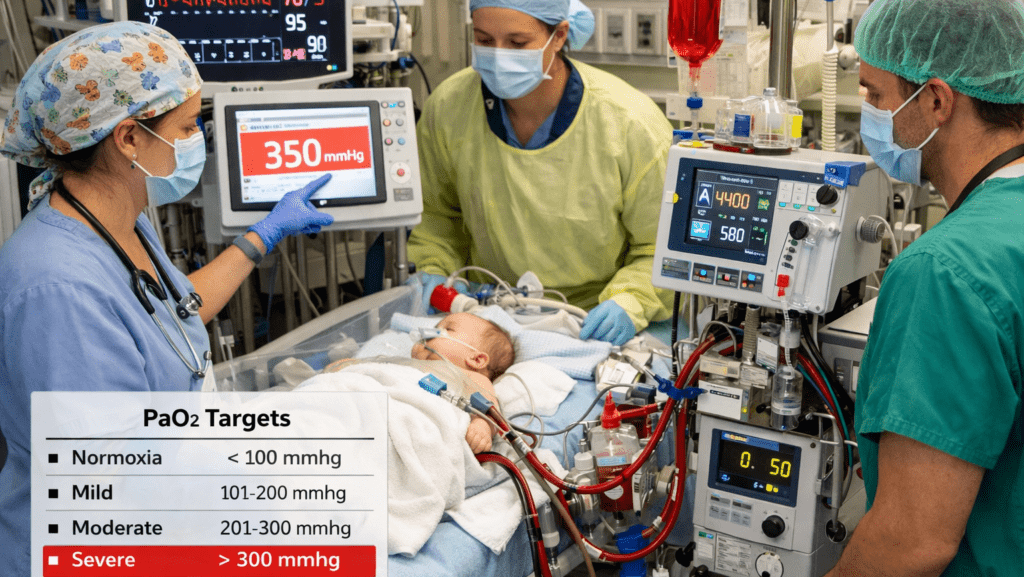
A key strength of the study is its practical approach to defining hyperoxia. The authors reviewed all arterial blood gas measurements collected during the first 48 hours after VA-ECLS initiation and classified patients according to the highest recorded PaO2. Normoxia was defined as PaO2 of 100 mmHg or less. Hyperoxia was divided into mild (101–200 mmHg), moderate (201–300 mmHg), and severe (greater than 300 mmHg). This stratification allowed the researchers to examine whether there might be a threshold effect rather than a simple linear relationship between oxygen exposure and adverse outcomes. The primary outcome was all-cause in-hospital mortality, while secondary outcomes included a composite of cardiovascular or renal complications, stage II or III acute kidney injury, and change in functional status using the Functional Status Scale.
The results show that hyperoxia was extremely common during early VA-ECLS, occurring in 79% of patients. Severe hyperoxia was seen in a smaller subgroup but was clinically meaningful. Mortality increased numerically as hyperoxia became more severe, reaching 64% in the severe hyperoxia group, although this association did not remain statistically significant after multivariable adjustment. In unadjusted analysis, severe hyperoxia was associated with mortality, but after controlling for age group, body surface area, and ECLS indication, the adjusted odds ratio was 2.5 with a p-value of 0.10, which did not meet statistical significance. This suggests that while a signal may exist, the sample size of the severe hyperoxia subgroup was likely too small to establish a firm independent relationship with death.
Where the study did find a statistically significant association was in the composite endpoint of cardiovascular or renal complications. Severe hyperoxia was independently associated with this outcome in multivariable analysis, with an adjusted odds ratio of 4.6 and an adjusted p-value of 0.03. That is a notable finding because it suggests that extremely elevated oxygen tension early in the ECLS course may contribute to important organ-related complications even if its effect on mortality could not be confirmed in this dataset. For acute kidney injury, there was a trend toward harm with severe hyperoxia, but the association did not reach statistical significance. Likewise, no association was found between hyperoxia severity and adverse functional outcomes among survivors, based on Functional Status Scale changes at discharge.
The authors place their findings within the broader literature on oxidative injury, pediatric ECMO, and critical care oxygen exposure. Prior studies have linked hyperoxia with worse outcomes after cardiac arrest, traumatic brain injury, and pediatric ECMO, but thresholds have varied. This study adds to that literature by focusing specifically on neonatal and pediatric VA-ECLS across multiple indications and by suggesting a possible clinically relevant danger zone above a PaO2 of 300 mmHg. The paper argues that the first 48 hours after ECLS initiation may be a particularly sensitive period because the patient is already exposed to a profound inflammatory state, and excess oxygen could amplify tissue injury during this vulnerable window.
The study also has important limitations. It was retrospective and single-center, which limits generalizability. The institution did not use a standardized PaO2 target protocol, meaning oxygen exposure reflected clinician discretion rather than a unified practice model. Although arterial blood gases were obtained frequently, the authors note that measuring cumulative exposure above a threshold remains challenging, and the relatively small number of patients in the severe hyperoxia category reduced statistical power. Even so, the signal toward increased complications is clinically relevant and supports more standardized oxygen management during VA-ECLS.
From an SEO and clinical perspective, this study is especially relevant to pediatric ECMO teams, neonatal ICU physicians, cardiac intensivists, perfusionists, and researchers focused on extracorporeal life support outcomes. Its main takeaway is not that all hyperoxia is definitively lethal, but that severe early hyperoxia may be avoidable and may matter. Standardized oxygen targets during neonatal and pediatric VA-ECLS could reduce cardiovascular and renal complications and possibly improve broader outcomes if tested prospectively. Future multicenter studies are needed to define optimal PaO2 targets, validate the apparent threshold above 300 mmHg, and determine whether protocolized oxygen titration can improve survival and organ protection in this high-risk population.