This article explores a clinically important but often underappreciated issue in cardiac surgery: whether the design of the oxygenator used during cardiopulmonary bypass can influence the amount of gaseous microemboli reaching the arterial circulation and, in turn, affect the risk of postoperative delirium. The study focuses on patients undergoing on-pump coronary artery bypass grafting, a setting in which cardiopulmonary bypass remains essential but can introduce neurological risks. The authors frame the work around the growing belief that embolic load during bypass contributes meaningfully to postoperative neurocognitive complications, including delirium, which remains common, costly, and frequently underdiagnosed after cardiac operations.
The investigators conducted a prospective, observational, single-center cohort study at a tertiary cardiac surgery center in Serbia. They enrolled 102 consecutive adult patients who underwent first-time isolated elective on-pump CABG between January 1 and July 31, 2024. Patients were excluded if they had redo surgery, off-pump or minimally invasive CABG, emergency procedures, severe left ventricular dysfunction, significant neurologic or psychiatric history, or major carotid stenosis. This produced a relatively uniform, low-risk surgical population, which strengthens internal consistency, even though it may limit generalizability to higher-risk patients.
The study compared three contemporary adult membrane oxygenators: Capiox FX25, Inspire 8, and Inspire 8F. Oxygenator allocation was not randomized; instead, it followed an institutional perfusion protocol based on routine availability and logistics. All patients otherwise underwent the same conventional cardiopulmonary bypass setup and standardized intraoperative management, including roller-pump support, mild hypothermia, indexed pump flow, crystalloid cardioplegia, and routine blood salvage. Because the circuit configuration was held constant except for the oxygenator, the comparison centered on how oxygenator-specific characteristics might shape microbubble handling during bypass.
A notable strength of the paper is the detailed real-time measurement of gaseous microemboli. Using an ultrasonic microbubble counter, the team continuously measured microbubble number and cumulative volume both before and after the oxygenator. They also derived reduction metrics such as percentage decrease in bubble count and cumulative volume, along with quality factor and mean diameter index. Delirium assessment was handled carefully: trained physicians who were blinded to oxygenator type screened patients every 12 hours during the first postoperative week using CAM-ICU and RASS, increasing the likelihood that both hyperactive and hypoactive delirium were captured.
The patient groups were broadly comparable at baseline. Demographic characteristics, body size, comorbidities, surgical risk, and preoperative laboratory results did not differ significantly among groups. Most intraoperative and postoperative variables were also similar, including bypass time, cross-clamp time, temperature, blood salvage, ventilation duration, ICU stay, hospital stay, drainage, and atrial fibrillation rates. There were some differences in cardioplegia volume and intraoperative lactate levels, with the Capiox FX25 group showing lower lactate values, a potentially favorable perfusion signal.
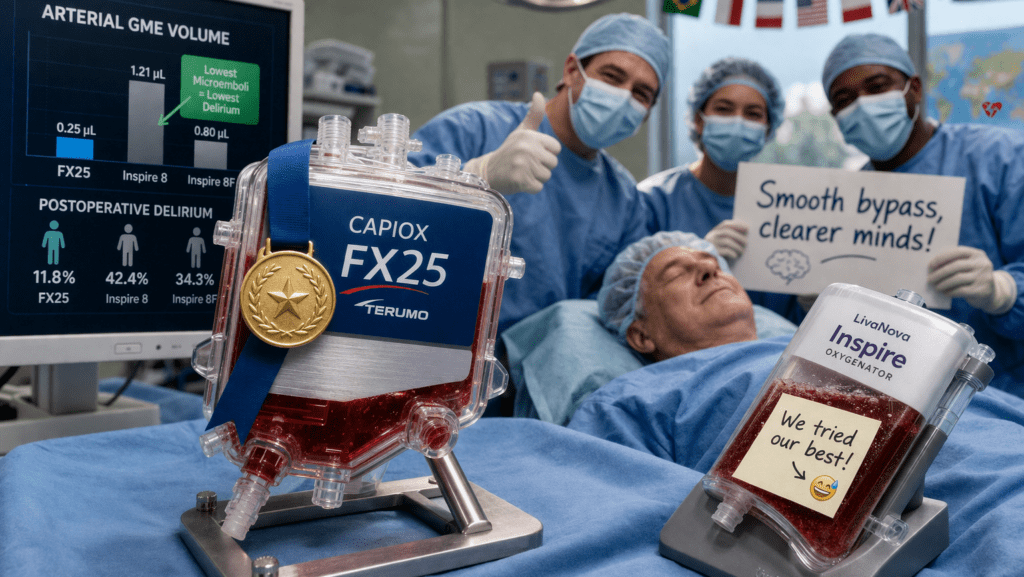
The core findings are compelling. Venous-line microemboli burden was similar across the three groups, suggesting that incoming bubble load before oxygenator processing was comparable. Differences emerged on the arterial side. The Inspire 8 group had the highest arterial microbubble count, while the Capiox FX25 group had by far the lowest arterial microbubble volume. Specifically, arterial GME volume was 0.25 µL with Capiox FX25, compared with 1.21 µL for Inspire 8 and 0.80 µL for Inspire 8F. The Capiox FX25 also had the best volume reduction efficiency at 97.52%, versus 91.21% for Inspire 8 and 93.12% for Inspire 8F. Inspire 8 showed the weakest reduction in microbubble number.
These technical differences were mirrored by clinical outcomes. Postoperative delirium developed in 30 of 102 patients, or 29.4% overall. Importantly, 63.3% of delirium cases were hypoactive, reinforcing how easily this complication can be missed without structured screening. Delirium incidence differed significantly by oxygenator type: 11.8% in the Capiox FX25 group, 42.4% in the Inspire 8 group, and 34.3% in the Inspire 8F group. The pattern aligned closely with arterial GME volume and volume reduction performance, supporting the authors’ argument that oxygenator choice may influence neurological vulnerability after bypass surgery.
The discussion places these findings in a practical clinical context. The authors suggest that cumulative microbubble volume may matter more than bubble count alone, and they note that design differences such as membrane surface area, priming volume, coating, and arterial filter configuration may explain performance variation. For example, Inspire 8F appeared to improve on Inspire 8, possibly because of its integrated arterial filter, while Capiox FX25 still outperformed both, perhaps due to a combination of larger membrane surface area and other structural features. The authors stop short of claiming causality, but they do argue that oxygenator selection should not be seen as a purely technical choice. Instead, it may represent a modifiable intraoperative factor tied to postoperative neurocognitive outcomes and patient safety.
The study does have limitations. It was single-center, observational, modest in size, and non-randomized. Unmeasured factors in perfusion technique or intraoperative management could still have influenced results. Even with structured assessment, some hypoactive delirium may have been missed. Still, the paper offers a thoughtful and clinically relevant signal: better gaseous microemboli filtration may translate into less postoperative delirium after on-pump CABG. For surgeons, anesthesiologists, perfusionists, and hospital decision-makers, this research supports deeper consideration of oxygenator design when aiming to reduce neurologic morbidity in cardiac surgery.