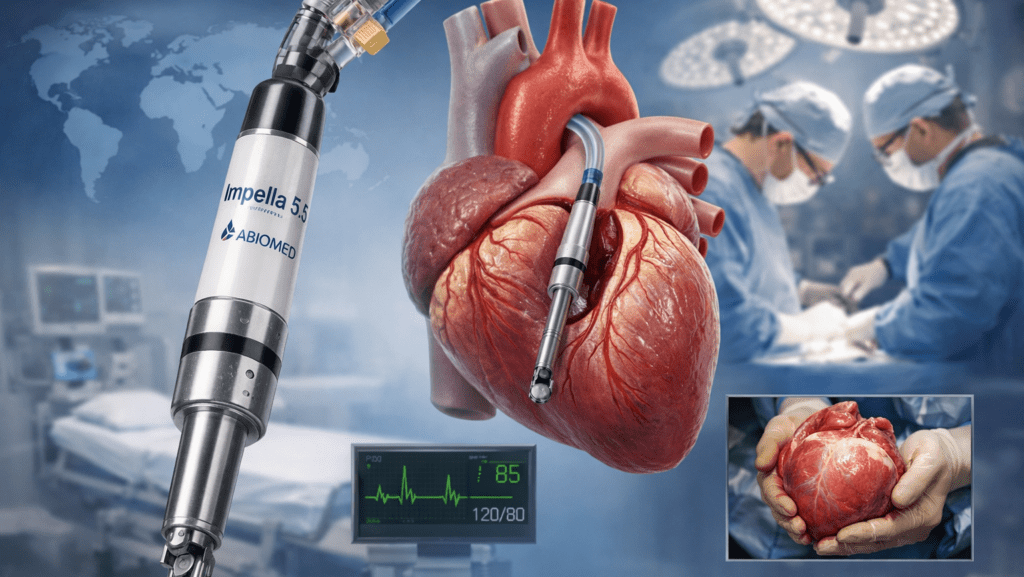
This study, published in Clinical Transplantation, examines an important question in advanced heart failure care: does prolonged support with the Impella 5.5 device before heart transplantation negatively affect outcomes after transplant? The article focuses on patients with cardiogenic shock or severe heart failure who required temporary mechanical circulatory support as a bridge to transplant. While the Impella 5.5 was originally approved for shorter use, many centers now support patients for longer periods while they await donor organs. The authors sought to determine whether this longer duration of support leads to worse post-transplant survival, complications, graft rejection, or rehospitalization.
The investigators performed a retrospective cohort study at a large tertiary academic medical center, reviewing patients supported with Impella 5.5 between December 2021 and December 2024 who were successfully bridged to heart transplantation. Patients whose devices were placed at outside hospitals were excluded. The final study population included 72 transplant recipients. These patients were divided into two groups based on duration of Impella 5.5 support: those supported for 14 days or less and those supported for more than 14 days. This comparison is clinically relevant because 14 days has historically been an important threshold in discussions around approved use and prolonged temporary support.
One of the most notable findings is that prolonged Impella 5.5 support was common. Of the 72 patients who reached transplant, 46 patients, or 64%, were supported for more than 14 days. The median duration of support was 22 days, and the longest duration reached 134 days. This alone reflects how modern heart failure and transplant programs are increasingly using temporary mechanical circulatory support in a more flexible and extended manner when clinically necessary.
Baseline characteristics were largely similar between the short-duration and prolonged-duration groups. The two cohorts did not significantly differ in age, sex, body mass index, heart failure etiology, INTERMACS class, SCAI shock class, or most comorbidities. Measures of end-organ function, including lactate, liver enzymes, bilirubin, INR, hemoglobin, and creatinine, were also similar before transplant. This suggests that patients supported longer were not obviously sicker in terms of pretransplant biochemical instability. Some differences were noted, including blood type distribution, lower white blood cell counts in the prolonged-support group, and a higher frequency of moderate right ventricular dysfunction in those supported beyond 14 days. Even so, the overall clinical condition before transplant appeared comparable across groups.
A major strength of the paper is that it does not stop at transplant survival alone. The authors also examined postoperative cardiac recovery, immediate clinical status, intensive care and hospital length of stay, complications during the index admission, graft rejection, donor-specific antibodies, and rehospitalization patterns. On postoperative day 0, echocardiographic findings were similar between groups, including left ventricular ejection fraction and rates of right ventricular dysfunction. By postoperative day 7, laboratory markers had largely normalized in both groups. Hemodynamics at postoperative day 30 were also similar, indicating that prolonged pretransplant Impella 5.5 support did not appear to compromise early graft function or hemodynamic recovery after surgery.
The index hospitalization outcomes are particularly reassuring. Intensive care unit stay and total hospital stay after transplant were not statistically different between groups. Transfusion needs, postoperative ECMO use, additional surgery, re-intubation, tracheostomy, dialysis, primary graft dysfunction, gastrointestinal bleeding, stroke, and other major complications were also similar. In practical terms, this means that longer support with Impella 5.5 did not translate into a more difficult or unstable transplant recovery.
The long-term outcome data are even more clinically meaningful. Median follow-up was 611 days after transplantation. At one year, survival was 96%, which is excellent for a population with advanced heart failure requiring pretransplant temporary mechanical circulatory support. Importantly, one-year mortality did not significantly differ between patients supported for 14 days or less and those supported for more than 14 days. Rates of graft rejection of grade 2R or higher were also not significantly different, nor were rates of donor-specific antibodies. These findings help address concerns that prolonged mechanical support might increase immune sensitization or worsen graft-related outcomes after transplant.
The study also highlights an important reality of post-transplant care: morbidity remains substantial even when survival is strong. Rehospitalization within the first year was high, affecting nearly three-quarters of patients with one-year follow-up. The most common causes of rehospitalization were infection, rejection, cardiac issues, and renal causes. Infection was the leading reason for first rehospitalization, accounting for 40% of cases. Interestingly, cardiac-related rehospitalizations were more frequent in the shorter-support group than in the prolonged-support group. While this was one of the few significant differences seen, the overall message remains that prolonged Impella support was not associated with a broader penalty in post-transplant recovery.
From an SEO and clinical relevance standpoint, this article adds to the growing literature on Impella 5.5 bridge-to-transplant outcomes, prolonged temporary mechanical circulatory support, and heart transplant optimization. The authors argue that longer support should not automatically be interpreted as a marker of poor prognosis. Instead, prolonged Impella 5.5 use may allow time for functional recovery, patient mobilization, hemodynamic optimization, and better transplant readiness. This is especially meaningful as transplant communities continue to refine waitlist strategies and graft allocation policies.
The paper is limited by its retrospective, single-center design and modest sample size. It only includes patients who were successfully bridged to transplant, which may introduce selection bias. Some subgroup analyses were underpowered, and the authors note missing data limitations. Even so, the study provides granular institutional data that large registries often cannot capture, especially regarding postoperative recovery and causes of rehospitalization.
Overall, this study supports the idea that prolonged Impella 5.5 support beyond 14 days can be a safe and effective bridge to heart transplantation. It does not appear to worsen post-transplant mortality, graft rejection, or major complications, and it may give clinicians valuable time to optimize patients before surgery. For heart failure specialists, transplant cardiologists, and cardiac surgeons, these findings strengthen the case for flexible, individualized use of Impella 5.5 in advanced transplant pathways.