Pediatric roller-pump bypass can achieve similar oxygen delivery through operating combinations that expose blood to very different shear and washout conditions. A new computational preprint by Tu and colleagues explores that trade-off using a three-dimensional model of roller motion, tubing deformation, and blood flow.
Publication status: This report is a bioRxiv preprint posted October 28, 2026 and has not been certified by peer review. It describes simulations, without human participants or direct measurements of blood-cell injury.
What the Model Examined
The investigators modeled a pediatric roller-pump configuration based on a LivaNova S5 pump head. The geometry included two opposed rollers, a 150-mm raceway, and tubing with a 4.76-mm internal diameter. A deformable raceway segment connected to a fixed return segment to create a simplified closed loop.
Forty simulations combined four speeds, 38, 57, 76, and 95 rpm; two modeled occlusion levels, 77% and 83%; and five hematocrit levels spanning 15–50%. The analysis tracked cycle-averaged flow, calculated oxygen delivery, peak shear, and a viscosity-normalized relative residence-time metric.
The model transferred tubing-wall motion from a structural solver to a fluid solver. The authors also report mesh and time-step sensitivity testing and a two-way coupling comparison supporting their simpler one-way approach. These checks support numerical consistency, but they do not substitute for experimental validation in a clinical circuit.
Why Pediatric Roller-Pump Bypass Involves More Than Forward Flow
A roller moves blood forward by compressing tubing against the raceway. In this model, the remaining lumen gap also allowed localized retrograde leakage. Rapid flow through the narrowed region created high shear, while adjacent stagnation and recirculation produced less effective washout.
In the representative high-speed, high-occlusion, high-hematocrit case, localized instantaneous shear stress exceeded 100 Pa near the compressed gap, compared with approximately 2 Pa through much of the remaining tubing. That localized maximum is different from the study’s cycle-averaged peak-shear measure, which averages the spatial maximum over a pump cycle.
The three-dimensional approach captured lateral widening as the lumen flattened. That deformation helps explain why a two-dimensional representation of a compressed tube may not reproduce the same velocities and stresses.
How Speed, Occlusion, and Hematocrit Changed the Results
| Modeled change | Flow and oxygen transport | Shear and washout |
|---|---|---|
| Higher roller speed | Increased flow nearly linearly within the tested range. | Increased peak shear while reducing the relative residence-time indicator. |
| Greater occlusion | Produced more net flow at a given speed. | Increased peak shear while improving modeled washout. |
| Higher hematocrit | Had relatively little effect on flow but increased calculated oxygen-carrying capacity. | Increased viscosity and peak shear stress; effects on washout depended partly on occlusion. |
Similar Oxygen Delivery, Different Mechanical Exposure
Ten simulated conditions produced calculated oxygen delivery of approximately 9–12 mL/min, while cycle-averaged peak shear stress ranged from approximately 25 to 70 Pa. This nearly threefold spread illustrates the central finding: a similar oxygen-delivery value did not uniquely identify the flow environment inside the pump.
These values are unindexed model outputs from a restricted, simplified circuit with flow rates below typical clinical values. They should not be compared directly with indexed clinical oxygen-delivery targets expressed in mL/min/m².
Reducing Shear Can Worsen Washout
Lower speed reduced peak shear but increased the relative residence-time indicator, reflecting more persistent disturbed near-wall flow. A setting that looks favorable by one mechanical metric may therefore look less favorable by another.
The authors used a modified relative residence-time measure derived from wall shear magnitude and directional oscillation. It is a surrogate for poor washout, not a direct measurement of how long each circulating cell remains in the circuit or how much damage it accumulates.
The Hematocrit Finding Needs Careful Interpretation
The investigators also examined combinations meeting an illustrative minimum calculated oxygen delivery of 7 mL/min. Within those retained simulations, lower hematocrit permitted operating choices with lower peak shear and a lower relative residence-time indicator.
The authors explicitly selected that cutoff to retain useful coverage of the simulation space, rather than as a clinically relevant oxygen-delivery target. The result does not establish a safe hematocrit, justify greater hemodilution, or demonstrate that transfusion avoidance improves patient outcomes through reduced pump shear.
The mechanistic point is that hematocrit affects both oxygen-carrying capacity and viscosity. Evaluating those effects together may inform future research, but patient oxygen demand, clinical flow requirements, and organ outcomes were not tested here.
Relevance for Perfusion Practice
The paper offers a useful way to think about pump performance beyond a single flow or oxygen-delivery value. Roller speed, occlusion, and blood viscosity interact, and comparable bulk transport may conceal different local mechanical exposures.
Its practical contribution is a platform for testing hypotheses and identifying conditions for future bench studies. It does not establish a bedside algorithm for setting roller occlusion, choosing hematocrit, or selecting one pump technology over another. A clinically useful optimization approach would need representative circuit resistance, relevant operating flows, and validated links between simulated exposure and actual blood injury.
Limitations and Disclosures
Numerical contact constraints limited modeled occlusion to 77–83%, leaving residual gaps of approximately 0.8–1.1 mm and producing flows below typical clinical values. Those percentages describe the modeled lumen geometry and should not be treated as interchangeable with a clinical retrograde-flow occlusion-setting procedure.
The closed loop omitted the full tubing length and downstream hydraulic resistance. Blood was represented as an incompressible Newtonian fluid, while tubing was modeled using simplified elastic properties. Frictional heating, tubing fatigue, and plasticizer leaching were not included.
Most importantly, the simulations did not measure hemolysis, platelet activation, inflammation, thrombosis, or clinical outcomes. Peak shear and poor-washout indicators identify potential mechanical concerns, but cell injury also depends on exposure duration and other factors. The authors call for experimental validation under more clinically representative conditions.
The authors declare no conflicts of interest. Funding included NIH grants R01HD106628 and R01HL170607 and support from Seattle Children’s Hospital. This independently written synthesis is intended for professional education.
Original Article
Tu Y, Yeh Y-T, de Lecea A, et al. Three-Dimensional Fluid-Structure Interaction Reveals Trade-offs Among Oxygen Delivery, Shear, and Washout in Pediatric Roller-Pump Cardiopulmonary Bypass. bioRxiv [Preprint]. Posted October 28, 2026. doi:10.64898/2026.10.26.761989.
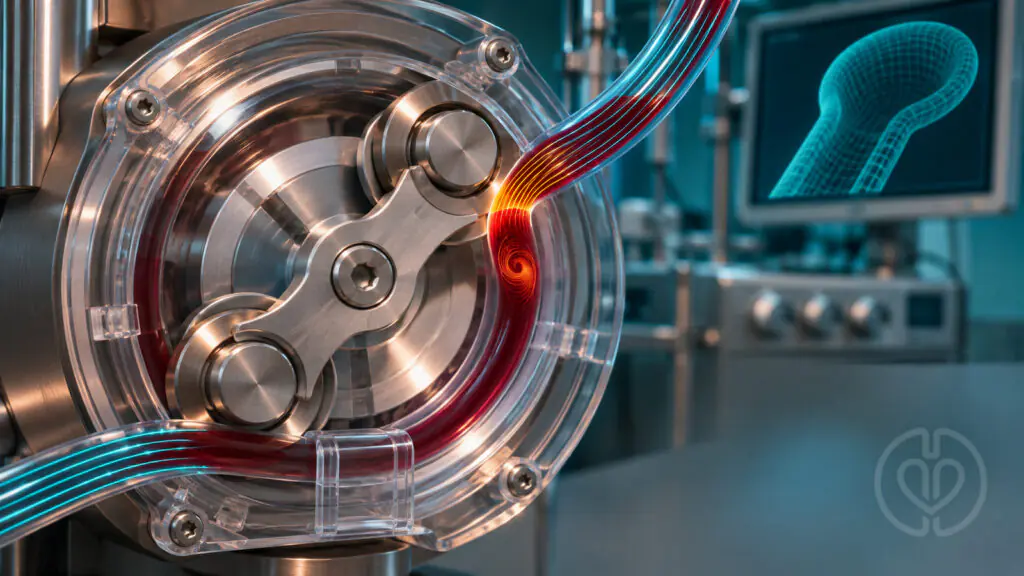
The uploaded source PDF is unchanged. The cover is an AI-generated editorial illustration, not a reproduction of the study’s geometry or numerical flow fields.