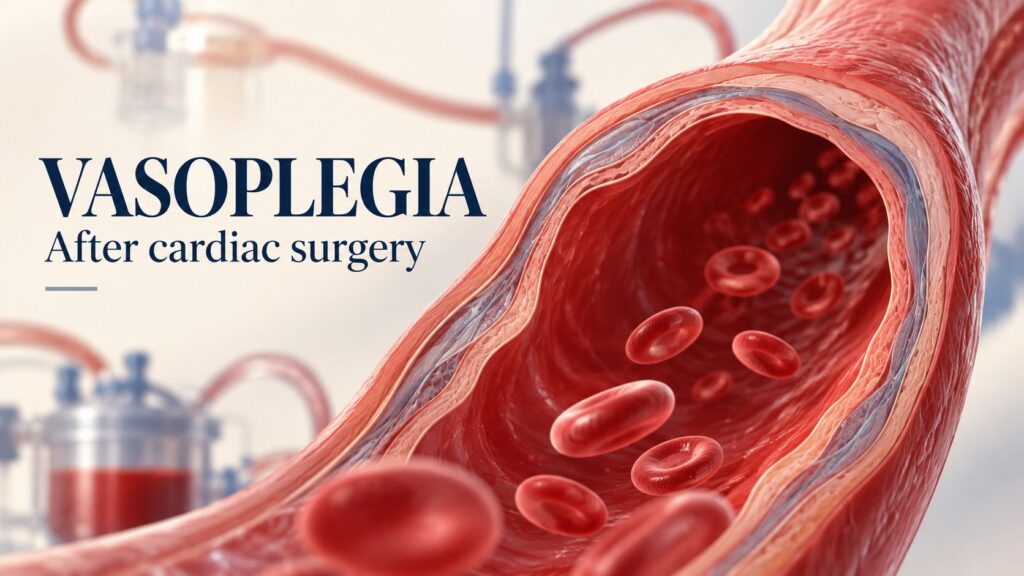
Persistent hypotension after cardiac surgery requires more than escalation of vasopressor doses. Vasoplegic syndrome involves loss of vascular tone despite preserved or increased cardiac output, and it must be distinguished from inadequate preload, ventricular dysfunction, and other causes of perioperative shock.
In this narrative review, Said Khallikane and colleagues examine the mechanisms, risk factors, and treatment approaches associated with vasoplegia after cardiopulmonary bypass (CPB). Their central theme is a physiology-guided approach that considers several vasoregulatory pathways while recognising the limited evidence for optimal drug selection and sequencing.
What the Review Covers
The authors describe a structured PubMed search focused primarily on publications from 2020 through 2026, supplemented by landmark studies. They include trials, observational studies, systematic reviews, and other narrative reviews relevant to adult cardiac surgery. They report using SANRA recommendations to improve narrative-review reporting.
This is not a systematic review or meta-analysis. No formal systematic-review protocol, pooled effect estimates, or detailed study-by-study risk-of-bias assessment is presented. Its value lies in bringing mechanisms and clinical considerations together; the strength of its conclusions depends on the underlying, heterogeneous literature.
Why Vasoplegia Develops After CPB
The review describes several interacting pathways. Blood contact with extracorporeal surfaces, surgical trauma, and ischemia–reperfusion injury can promote inflammatory activation and endothelial dysfunction. Increased nitric oxide signalling contributes to vascular smooth-muscle relaxation. Relative vasopressin deficiency, renin–angiotensin–aldosterone system disturbances, and reduced responsiveness to catecholamines may further impair vascular tone.
These mechanisms provide a rationale for considering agents with complementary actions. They do not, by themselves, demonstrate that a particular drug combination improves survival or that a fixed escalation sequence suits every patient.
Risk Factors Discussed
The authors identify preoperative ACE inhibitor or angiotensin receptor blocker exposure, reduced ventricular function, prolonged CPB, complex or repeat cardiac procedures, older age, and chronic kidney disease as factors associated with susceptibility. These associations are useful for anticipating instability, but the review does not test a prediction score or establish medication-withholding rules.
Recognition Requires Hemodynamic Context
The characteristic pattern discussed is persistent hypotension with low systemic vascular resistance and preserved or elevated cardiac output despite adequate volume resuscitation. The authors emphasise excluding reversible causes and differentiating vasoplegia from other forms of shock before treating low blood pressure as an isolated vascular-tone problem.
A source inconsistency deserves attention: the introduction describes hypotension using a mean arterial pressure below 65 mmHg, whereas a later diagnostic passage lists MAP at or above 65 mmHg alongside low systemic vascular resistance and preserved cardiac index. These statements should not be treated as interchangeable diagnostic criteria. The review itself acknowledges the lack of standardised definitions; its proposed algorithm is an author synthesis rather than a prospectively validated protocol.
Therapies Discussed in the Review
| Therapy | Role described by the authors | Important qualification |
|---|---|---|
| Norepinephrine | Initial adrenergic support to restore vascular tone | Escalating exposure carries adverse-effect concerns; pressure response alone does not establish adequate tissue perfusion |
| Vasopressin | Complementary non-adrenergic support with a catecholamine-sparing rationale | The review notes ischemic risk and uncertainty about optimal integration across patients |
| Methylene blue | Adjunct targeting nitric oxide–cGMP signalling in refractory vasoplegia | Limited robust comparative evidence; serotonin syndrome risk is highlighted |
| Hydroxocobalamin | Adjunct described as scavenging nitric oxide | Evidence remains largely observational; laboratory interference and cost are noted |
| Angiotensin II | Support directed at the renin–angiotensin pathway | Hemodynamic and catecholamine-sparing effects have not established a clear mortality benefit |
| Corticosteroids | Potential anti-inflammatory adjunct | The review describes limited evidence and does not establish routine use |
This table summarises the article’s discussion, not a dosing guide or a complete safety reference. The review’s evidence labels should also be distinguished from formal guideline recommendations: it provides no reproducible grading process that establishes the certainty of each treatment claim.
Relevance to Perfusion Practice
Interpret Pressure Alongside Flow and Oxygen Delivery
For perfusion teams, the review reinforces the importance of interpreting arterial pressure alongside flow, volume status, cardiac function, and the broader perfusion assessment. Low pressure can arise from different or overlapping mechanisms. A shared understanding of the hemodynamic pattern helps the team assess whether treatment is addressing vascular tone, pump function, circulating volume, or more than one problem.
Anticipate the Transition From Bypass
The discussion of prolonged CPB and complex surgery supports advance communication about patients likely to have a difficult hemodynamic transition. The proposed multimodal approach is a framework for multidisciplinary planning; the paper does not establish a universal trigger for adding a second agent or selecting one rescue therapy over another.
Evidence Limitations and Takeaway
The review supports a mechanism-based understanding of post-CPB vasoplegia and explains why escalating a single catecholamine may be insufficient. However, it combines evidence from different study designs and vasodilatory-shock populations. Improvements in blood pressure or vasopressor requirements should not be assumed to translate into better survival, renal outcomes, or recovery after cardiac surgery.
Its most useful contribution is an organised overview of the physiology and available therapeutic categories. Standardised diagnostic criteria, comparative trials, and clearer evidence on treatment timing remain important gaps. The article should be read as an educational synthesis rather than a definitive management standard.
Original IPA educational summary of the review by Khallikane and colleagues. The original article is distributed under the Creative Commons Attribution–NonCommercial–NoDerivatives 4.0 licence; the linked PDF is the source article uploaded to IPA.
Original Article
Khallikane S, Didi M, El Baraka H, El Ghadbane HA, Drissi M. Perioperative management of vasoplegic syndrome in cardiac surgery: a narrative review. Annals of Medicine & Surgery. 2026;88:6683–6688. Published online September 16, 2026. doi:10.1097/MS9.0000000000005611.