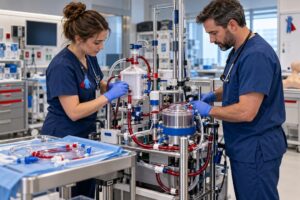

A multicenter randomized trial analyzed 129 adults undergoing elective cardiac surgery to compare pulsatile and non-pulsatile bypass. Neither flow mode significantly changed peak inflammatory or myocardial-injury biomarkers after correction for multiple testing. A modest leukocyte signal favored pulsatile flow but was exploratory. The findings do not establish biochemical equivalence, exclude smaller benefits, or determine outcomes in higher-risk patients. It informs continuing perfusion debate.
Does pulsatile cardiopulmonary bypass reduce the inflammatory response after cardiac surgery? Ljubačev and colleagues addressed this question through a prespecified secondary biomarker analysis of a multicenter randomized trial. Their study examined inflammatory cytokines, routine inflammatory markers, and cardiac biomarkers in 129 adults undergoing elective procedures. Both perfusion groups developed the expected postoperative response, and no peak biomarker comparison remained statistically significant after adjustment for multiple testing. For perfusion professionals, the study adds useful evidence to the pulsatility debate while emphasizing an essential distinction: failure to detect a difference is not proof that two techniques are biologically equivalent.
Cardiopulmonary bypass exposes blood to artificial surfaces and accompanies surgical trauma, ischemia, and reperfusion. These processes can activate inflammatory pathways. Pulsatile flow has been proposed as a way to improve vascular signaling and microcirculatory conditions, potentially modifying that response. However, the biological effects of pulsatility depend on how it is generated and transmitted through the circuit. A pump setting or arterial pressure waveform cannot, by itself, establish that clinically meaningful pulsatile energy reaches the tissues. The investigators therefore tested measurable postoperative responses rather than assuming a physiological advantage.
The parent trial enrolled patients at three tertiary centers in Croatia and Slovenia between May 2024 and June 2026. Of 142 randomized participants, 129 contributed to this analysis: 63 received pulsatile bypass and 66 received non-pulsatile bypass. Allocation used computer-generated, institution-stratified blocks, with assignments held in sequentially numbered opaque envelopes. Patients and laboratory personnel were blinded, although clinicians delivering the intervention could not be. The sample included coronary artery bypass grafting, valve operations, and combined procedures. These design features support the comparison, but the exclusion of 13 participants after randomization remains an important limitation.
Eligibility favored a selected elective population. Patients were scheduled for median sternotomy with an expected aortic cross-clamp duration exceeding 45 minutes. Exclusions included repeat surgery, left ventricular ejection fraction below 30%, significant renal or pulmonary disease, infection, and other conditions that could complicate inflammatory interpretation. The authors characterized the cohort as predominantly low risk. Because sample collection and protocol treatment stopped in excluded participants, an intention-to-treat analysis was not possible. The findings therefore describe the per-protocol population and should not automatically be extended to emergency surgery, severe ventricular dysfunction, or other higher-risk settings.
Across centers, investigators established shared anesthesia, surgery, and intensive-care protocols. Bypass used a Stockert S5 roller-pump system, an INSPIRE 8F oxygenator, and standardized ascending-aortic cannulation. Procedures were conducted under normothermic conditions. In the pulsatile group, pulsatility was applied during aortic cross-clamping, rather than throughout every phase of bypass. The study settings included 75 pulses per minute, a 60% flow width, and 30% base flow, with a minimum pulse-pressure target of 15 mmHg. All 63 pulsatile participants achieved that pressure target. These are study methods, not recommendations for changing an individual perfusion protocol.
Blood was sampled before anesthesia induction and at 2, 6, 18, 42, and 66 hours after bypass. The cytokine panel comprised interleukin-1 beta, interleukin-18, and interleukin-18 binding protein. Measurements were performed in duplicate at a central laboratory, with personnel blinded to allocation. The investigators also assessed leukocyte count, C-reactive protein, procalcitonin, high-sensitivity cardiac troponin I, and NT-proBNP. Their prespecified confirmatory analysis compared each participant’s highest postoperative concentration. A supporting repeated-measures analysis examined trajectories over time, accounting for baseline concentration and recruiting center.
Most biomarkers increased after surgery in both groups. Leukocytes and troponin rose early, while several acute-phase and cardiac-stress markers reached their highest levels later in the sampling period. Interleukin-18 and its binding protein increased from six hours onward. Interleukin-1 beta remained essentially unchanged overall, despite the broader inflammatory response. The authors discuss possible reasons why circulating interleukin-1 beta may poorly represent local inflammatory activity. Similarly, total interleukin-18 concentrations do not necessarily identify the amount of biologically active, unbound cytokine, because its binding protein can neutralize it.
The principal between-group findings were negative after multiplicity correction. The ratio of peak geometric means for interleukin-18, comparing pulsatile with non-pulsatile flow, was 1.00, with a 95% confidence interval of 0.85–1.19. For interleukin-18 binding protein, the ratio was 0.94, with a confidence interval of 0.74–1.20. Peak interleukin-1 beta likewise showed no significant difference. These intervals constrain some larger effects, but still permit smaller differences. They do not justify stating that pulsatile bypass has absolutely no inflammatory effect, nor that the two strategies satisfy a formal equivalence criterion.
Leukocytes provided the most noticeable signal. The peak leukocyte ratio was 0.88, favoring lower counts with pulsatile flow, with an unadjusted p value of 0.032. After Holm adjustment, that p value became 0.16. Supporting longitudinal analyses also suggested modestly lower leukocyte counts in the pulsatile group, but no biomarker showed a significant group-by-time interaction. The leukocyte finding should therefore be treated as hypothesis-generating, especially because the cytokine and other inflammatory results did not show a consistent accompanying benefit. A single favorable signal within a panel of tests is insufficient to establish an anti-inflammatory advantage.
Exploratory correlations between cytokines and routine markers were generally weak to moderate and inconsistent across time points or groups. Later associations between interleukin-18 binding protein and C-reactive protein or procalcitonin were among the more consistent observations. These analyses may help formulate mechanistic questions for future research, but they do not demonstrate causation. The simultaneous rise in interleukin-18 and its antagonist suggests a potentially informative regulatory response after cardiac surgery. Future work measuring free cytokine activity, endothelial responses, and complement activation could add context beyond total circulating concentrations.
Several factors limit certainty. The trial’s sample size was calculated for a different primary outcome, not specifically for the biomarker hypotheses reported here. The achieved sample could detect relatively substantial differences, while smaller effects remained possible. Post-randomization exclusions may weaken the protection offered by randomization. Some routine assays differed between institutions, and statistical adjustment cannot necessarily eliminate all assay-related variation. Follow-up ended at 66 hours, so the analysis does not establish longer-term organ protection, recovery, or survival effects. The paper also does not resolve whether a different circuit, greater pulsatile energy, or longer exposure would produce another result.
For clinical perfusion practice, the defensible interpretation is narrow but useful. Under the study’s conditions, pulsatile bypass did not demonstrate a consistent reduction in the early postoperative inflammatory or myocardial-injury biomarker response. The findings support careful evaluation of proposed physiological benefits and attention to confidence intervals, rather than reliance on isolated p values. They do not establish biochemical equivalence or answer every question about pulsatility. Larger studies designed specifically for these mechanisms, with clinically relevant outcomes and clearly characterized pulsatile delivery, are needed to resolve the remaining uncertainty.
Source: Ljubačev A, et al. Journal of Clinical Medicine. 2026;15:7228. DOI: 10.3390/jcm15187228.
Original educational summary of an open-access study distributed under CC BY 4.0. The featured image is an AI-generated illustration.