A national survey of 42 German ECMO centers without perfusionist support found marked variation in ECPR readiness. Centers performing ECPR reported shorter circuit setup times and greater nursing involvement than non-ECPR centers. Training and written protocols were common, but circuit pre-assembly varied. These self-reported organizational findings highlight preparedness gaps; they do not demonstrate safer staffing, improved survival, or superior patient outcomes. Outcome data are still needed.
Extracorporeal cardiopulmonary resuscitation (ECPR) requires more than access to an ECMO console. Teams must coordinate resuscitation, equipment preparation, cannulation, and communication under severe time pressure. Mishuris and colleagues examined how German ECMO centers organize these responsibilities when dedicated perfusionist support is unavailable. Their national cross-sectional survey describes circuit preparation, professional roles, recurrent training, and standard operating procedures. It provides a useful picture of organizational readiness, while leaving unanswered the more difficult question of how these arrangements affect patient safety and outcomes.
The investigators identified potential participants through the German intensive-care registry and cross-checked them against perfusionist-supported centers and institutional websites. They invited 78 centers to complete an anonymous online questionnaire between November 27, 2024, and January 31, 2025. Forty-four centers responded; two did not meet the inclusion criteria, leaving 42 centers for analysis, equivalent to 54% of those invited. The questionnaire contained 34 questions, including open-ended and multiple-choice items. Conditional questions meant that denominators differed between some analyses.
Most participating institutions had relatively low ECMO volumes: 38 of 42 centers, or 90%, reported fewer than 50 cases annually, and 24 reported fewer than 20. Twenty-seven centers, representing 64% of the sample, performed ECPR. Of the remaining 15, three reported non-ECPR veno-arterial ECMO as their most complex configuration and 12 reported veno-venous ECMO alone. The survey therefore compared institutions with different capabilities and clinical demands, rather than two otherwise equivalent groups assigned to different workflows.
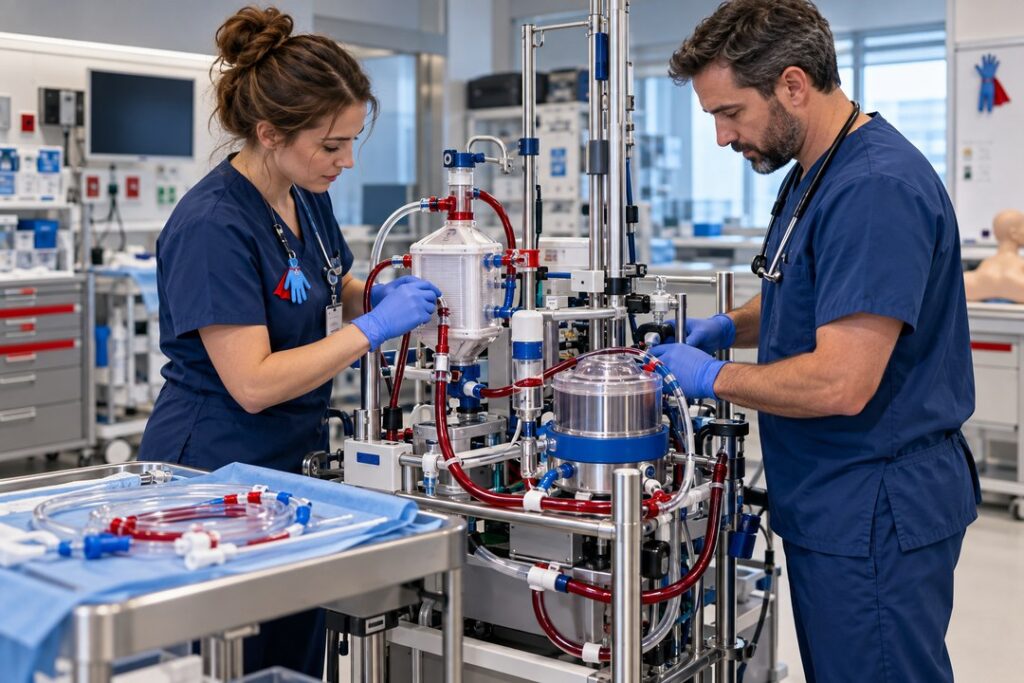
Circuit preparation varied substantially. Twenty-five centers, or 60%, did not maintain pre-assembled ECMO systems. The other 17 reported different levels of preparation: one used dry pre-assembly, four maintained wet pre-assembled circuits, 11 used wet pre-assembly with circulation, and one added warming. More than half of ECPR-performing centers also did not hold pre-assembled systems. These findings show that an ECPR service does not necessarily imply that a primed circuit is continuously ready for deployment. They also demonstrate why readiness cannot be reduced to a single equipment checklist.
The most prominent comparison concerned reported setup time. ECPR centers reported a median of 15 minutes, with an interquartile range of 12–18 minutes and a range of 5–30 minutes. Non-ECPR centers reported a median of 30 minutes, an interquartile range of 20–40 minutes, and a range of 15–105 minutes. The difference was statistically significant, with a Mann–Whitney U value of 46 and p < 0.0001. Cliff’s delta was 0.77, with a 95% confidence interval of 0.54–0.94, indicating a substantial separation between the reported distributions.
That timing result needs careful interpretation. Setup times were supplied by respondents rather than prospectively recorded during emergencies. Local definitions of assembly, priming, and readiness may have differed, and responses could reflect estimates or favorable institutional experience. The survey did not measure the interval from cardiac arrest to effective extracorporeal support. Accordingly, the reported 15-minute median should not be treated as a validated activation-to-flow target, a benchmark for every institution, or proof that any particular preparation method shortened low-flow duration.
Responsibility for circuit setup also differed between groups. Nursing involvement was reported in 16 of 27 ECPR centers, or 59%, compared with three of 15 non-ECPR centers, or 20%. Physicians were responsible in 10 ECPR centers and 11 non-ECPR centers. Other arrangements included specially trained personnel such as physician assistants or medical assistants. The authors interpret nursing participation as part of an interdisciplinary response to urgent, parallel tasks. These observations do not establish that nurses or physicians can replace perfusionist expertise, nor do they compare the safety of professional staffing models.
Training was reported by 32 centers, or 76%, at least annually. Within ECPR programs, 14 of the 16 centers assigning circuit setup to nurses reported regular training, compared with six of the 10 assigning it to physicians. Those proportions were 87.5% and 60%, respectively. They describe training provision at centers, rather than independently assessed competence in individual clinicians. The overall pattern suggests that some institutions combine task allocation with recurrent preparation, but the survey cannot determine which training frequency, curriculum, or simulation approach produces the best clinical performance.
Written procedures were relatively common: 36 centers, or 86%, reported internal standard operating procedures, while 29, or 69%, wanted a broadly applicable evidence-based procedure. Existing local documentation therefore coexisted with demand for more consistent guidance. The authors favor adaptable standards that define responsibilities and preparation processes while accounting for institutional resources. For perfusion educators and ECMO program leaders, the findings offer a basis for reviewing local workflow clarity, escalation arrangements, and training coverage. Those are organizational implications, not patient-specific treatment recommendations.
Pre-assembly involved practical tradeoffs. Among centers maintaining prepared systems, 94% cited emergency time pressure as a reason. Centers that did not pre-assemble cited storage duration, disposal costs, perceived available time, and hygiene restrictions. Of 31 centers answering the wet-circuit storage question, 28 reported a predefined maximum duration; none exceeded 30 days. The reported mean was 19.5 days. This describes local storage policies and the authors’ comparison with cited ELSO guidance. It does not independently validate sterility or authorize storage of every circuit for 30 days; device instructions and institutional infection-control requirements remain relevant.
Several limitations reduce the certainty of the findings. Participation may have favored institutions with better organized programs. Respondent roles were not systematically documented, and anonymity prevented the investigators from excluding duplicate submissions. All data were self-reported without independent audit. Differences in case volume, equipment, staffing, pre-assembly, and local protocols could explain some group differences. Small subgroup sizes further limit precision. Because ECPR-capable centers can also perform other ECMO configurations, the categories overlap in practice and should not be interpreted as isolated, directly comparable clinical populations.
Most importantly, the study did not assess cannulation success, complications, low-flow duration, survival, or neurological outcomes. It cannot establish the superiority of a readiness strategy or demonstrate that ECPR without perfusionist support is safe. Its contribution is descriptive: participating centers showed considerable variation, ECPR programs reported faster preparation, and interdisciplinary staffing, recurrent training, and written procedures were common organizational features. Prospective studies using consistent time definitions, observed emergency performance, and patient-centered outcomes are needed to determine which approaches improve care. Until then, this survey supports informed discussion of preparedness rather than definitive clinical conclusions.
Source: Mishuris E, et al. BMC Emergency Medicine. 2026;26:253. DOI: 10.1186/s12873-026-01766-7.
This is an original educational summary of the open-access study, adapted under CC BY 4.0. The featured image is an AI-generated illustration.