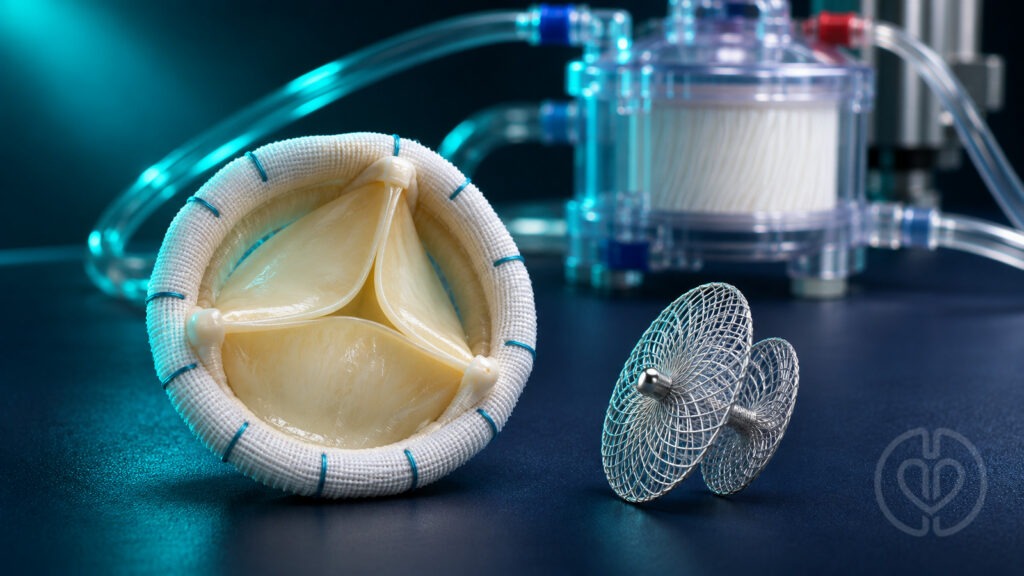
On-pump beating-heart redo mitral valve surgery was used to treat severe mechanical hemolysis after transcatheter paravalvular leak closure in a highly complex patient. In this Cleveland Clinic case report, Pasic and colleagues describe removal of the occluder plug and replacement of the mitral prosthesis without aortic crossclamping or cardioplegic arrest. Hemolysis markers improved rapidly, and the patient was discharged on postoperative day 13.
Severe Hemolysis Despite Trivial Residual Regurgitation
The 63-year-old man had end-stage renal disease requiring hemodialysis, reduced left ventricular ejection fraction, and multiple myeloma treated with stem cell transplantation and maintenance therapy. Ten months earlier, he had undergone aortic and mitral bioprosthetic valve replacement and coronary bypass surgery, followed by a difficult recovery requiring temporary Impella support.
A subsequent mitral paravalvular leak was treated with an Amplatzer occluder. Although transesophageal echocardiography showed only trivial residual regurgitation, the patient developed severe intravascular hemolysis. Lactate dehydrogenase reached approximately 670–700 U/L, haptoglobin was below 10 mg/dL, and reticulocytes rose to about 3.2%. The peripheral smear supported mechanical red-cell shearing.
The case illustrates that a small residual leak on imaging can coexist with clinically important hemolysis. The authors attributed the process to shear associated with the residual jet and occluder interface. Renal disease also contributed to the anemia, making multidisciplinary assessment essential.
Why a Beating-Heart Strategy Was Selected
The team sought to avoid global myocardial ischemia and limit dissection and aortic manipulation in a patient with prior bypass grafts, extensive coronary calcification, ventricular dysfunction, and a difficult previous postoperative course. They selected full cardiopulmonary bypass with the heart continuing to beat.
This remained a redo open operation through median sternotomy. The report should not be interpreted as a minimally invasive or off-pump procedure. Avoiding cardioplegic arrest was a tailored surgical choice; one successful case cannot establish that this approach reduces operative risk compared with conventional myocardial protection.
Perfusion and Operative Details
After systemic heparinization, the authors established bypass using central aortic, superior vena caval, and right atrial two-stage cannulation. The operation proceeded without an aortic crossclamp or cardioplegia. Localized adhesiolysis and mobilization of a previous venous bypass graft permitted access while limiting broader dissection.
Exposure remained challenging. The superior vena cava was transected, and the left atrial incision was extended onto the atrial roof. The old mitral prosthesis and occluder plug were removed, and a 31-mm bioprosthetic valve was implanted. The authors described chronic ring infection without vegetations at explantation; that observation should not be converted into a claim of microbiologically proven active endocarditis.
The left atrium was closed and de-aired under transesophageal echocardiographic guidance, followed by superior vena caval reconstruction and successful separation from bypass. Maintaining coronary perfusion, adequate drainage, operative exposure, and careful de-airing are central considerations for perfusion teams reviewing this technique. The report does not provide a reproducible protocol for pump flow, perfusion pressure, temperature, anticoagulation targets, or bypass duration.
Postoperative Course and Hemolysis Markers
The patient was extubated on postoperative day 1. LDH declined toward a postoperative range of approximately 310–355 U/L, while haptoglobin increased to 253–288 mg/dL during the first week. Reticulocyte percentages moved toward baseline, hemoglobin stabilized, and platelet counts recovered. Ongoing erythropoiesis-stimulating therapy addressed the renal contribution to anemia.
Postoperative echocardiography showed normal prosthetic valve function without residual paravalvular leak. Brief atrial fibrillation occurred, and the patient went home on day 13. The report supports rapid improvement in mechanical hemolysis after correction of its suspected source; it does not establish long-term valve durability or sustained freedom from recurrent hemolysis.
Clinical Interpretation and Limitations
This is a single-patient case report without a control group, comparative risk estimate, or long-term follow-up. Removal of the plug, replacement of the prosthesis, and elimination of the leak occurred together, so their individual contributions cannot be separated. The favorable outcome also reflects a specialist team’s selection, operative judgment, and multidisciplinary care.
For perfusion practice, the educational value lies in understanding an alternative myocardial management strategy for selected complex redo cases and recognizing that imaging severity alone may understate a hemolytic problem. The report offers a technical example and a rationale for individualized planning, rather than evidence supporting routine adoption.
Source and Disclosures
Pasic M, Shrestha N, Jaber W, et al. On-Pump Beating-Heart Redo Mitral Valve Surgery: A Personalized, Risk-Adapted Surgical Strategy for Plug-Induced Hemolysis. JACC: Case Reports. 2026;111123. doi:10.1016/j.jaccas.2026.111123.
The authors reported no relationships relevant to the paper to disclose. The original article is open access under CC BY 4.0. This is an independent IPA educational summary; the unchanged source PDF is available below.