Impella-assisted PCI and TAVR performed in a single session may offer a practical option for selected patients with complex coronary artery disease and severe aortic stenosis. A retrospective report from three Mayo Clinic centers describes successful coronary intervention followed by valve replacement in 12 patients. The experience supports technical feasibility, but its size and lack of a comparison group prevent conclusions about superiority or reliably established safety.
What Was Studied?
Rivera and colleagues reviewed consecutive patients treated between January 2015 and March 2026. Every patient received Impella CP support during complex high-risk percutaneous coronary intervention (PCI), followed by transfemoral transcatheter aortic valve replacement (TAVR) during the same procedure session.
The median age was 79.5 years, 11 of 12 patients were men, and the median Charlson Comorbidity Index was 7. Left main coronary disease was present in approximately two-thirds of patients. Median aortic valve area was 0.86 cm², mean transvalvular gradient was 38 mm Hg, and left ventricular ejection fraction was 47%, with individual values ranging from 15% to 65%.
Selection was individualized by the heart team. Seven patients declined surgery or preferred a percutaneous approach; five were considered poor surgical candidates. This was therefore a selected cohort, rather than a representative comparison of catheter-based and surgical treatment.
Impella-Assisted PCI and TAVR: The Procedural Sequence
The study describes coronary revascularization first, with the Impella CP providing support throughout PCI. All coronary interventions used intravascular ultrasound guidance, and some required rotational atherectomy, intravascular lithotripsy, or both.
The Impella was weaned and removed before TAVR. The team then exchanged the large-bore sheath and performed transfemoral valve implantation. “Concurrent” in this report means treatment during one session; it does not mean that the pump remained across the valve while the prosthesis was deployed.
A single-access technique was used in 9 of 12 cases. Patients received unfractionated heparin with activated clotting time monitoring, followed by protamine at procedure completion. These details describe the investigators’ workflow and should not be interpreted as a validated universal support or anticoagulation protocol.
Main Outcomes
| Measure | Reported result |
|---|---|
| Patients | 12 across three centers |
| PCI and TAVR procedural success | 12/12 (100%) |
| In-hospital death or stroke | No events reported |
| Major vascular complications | No events reported |
| Acute kidney injury | 2/12 (16.7%); neither required dialysis |
| Discharge home or self-care | 11/12 (91.7%) |
| Median contrast volume | 247.5 mL |
| Median fluoroscopy time | 54.63 minutes |
Procedural success did not mean an absence of technical problems. The authors describe access-site bleeding requiring an additional closure device, a separated balloon shaft that was retrieved, and a distal coronary wire perforation managed conservatively. One patient needed additional vasopressor support during the TAVR portion.
Pacemaker Reporting Requires Caution
The abstract reports a 25% permanent pacemaker implantation rate. The results section instead states “4 (25%)” cases, although four of 12 would be 33.3%. The narrative describes three device implantations before discharge, including one cardiac resynchronization therapy-defibrillator, and one later readmission for a pacemaker. Because the counts, percentage, and timing are not consistently presented, an exact overall pacemaker rate cannot be treated as settled from this report.
The paper also varies in its summary of advanced calcium modification: the abstract reports 50%, whereas the detailed results describe seven patients treated with atherectomy, lithotripsy, or both. These inconsistencies reinforce the need to interpret descriptive percentages cautiously.
Relevance for Perfusion and Mechanical Support Teams
The clinical problem is the combination of limited forward flow through a stenotic valve and transient myocardial ischemia during complex coronary intervention. The authors used a microaxial pump to support circulation during the coronary phase, then proceeded directly to valve treatment once revascularization was complete.
For teams involved in mechanical circulatory support, the study highlights coordination of vascular access, anticoagulation, device removal, sheath exchange, and the transition to valve implantation. Renal surveillance and conduction monitoring remain relevant even when immediate hemodynamic and procedural results appear favorable.
A consolidated session might avoid a second large-bore access procedure and the interval between staged treatments. Those are proposed advantages, however: this study did not compare access complications, kidney injury, radiation, cost, or survival against a staged strategy. It also did not demonstrate renal protection from Impella support.
Strengths, Limitations, and Disclosures
The multicenter experience supplies useful procedural detail for an uncommon combination of disease and treatment. Nevertheless, only 12 patients were included over more than a decade, treatment selection was retrospective and nonrandomized, and there was no staged-procedure or unsupported-PCI control group. Nearly all participants were men, and the study cannot establish which patients would benefit most.
No observed deaths or strokes in such a small series cannot exclude clinically important risks. Likewise, successful valve crossing in these selected patients does not establish routine suitability of a transvalvular pump in severe aortic stenosis. Larger prospective comparative studies are needed before claiming improved outcomes or recommending broad adoption.
The authors reported no potential competing interests and no external funding. Institutional review board approval was obtained, with a waiver of individual consent for the retrospective analysis.
Original Article
Rivera FB, Ingraham B, Di Santo P, Simard T, Hibbert B, Singh M. Clinical Outcomes of Concurrent Impella-Assisted High-Risk PCI and TAVR in Patients With Complex Coronary Artery Disease and Severe Aortic Stenosis. Journal of the Society for Cardiovascular Angiography & Interventions. 2026;5:105562. doi:10.1016/j.jscai.2026.105562.
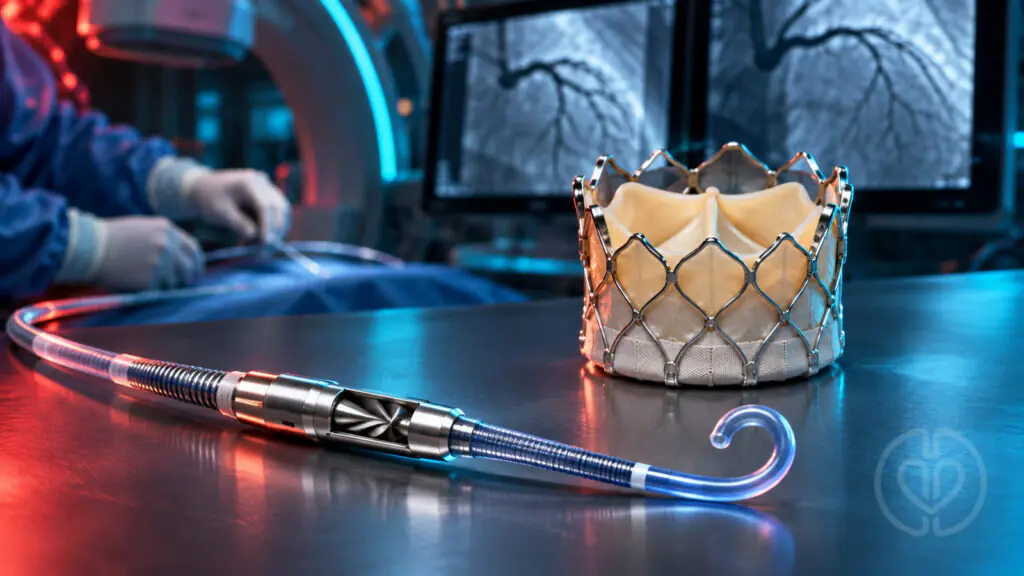
The source article is available under a Creative Commons Attribution–NonCommercial–NoDerivatives license. The linked PDF is unchanged. The cover is an AI-generated conceptual editorial illustration, rather than a device-placement guide.