Can a high-flux hemodialyzer provide a practical alternative to a conventional hemofilter during pediatric cardiopulmonary bypass (CPB)? A randomized study from Alnas Hospital in Egypt examined this question during zero-balance ultrafiltration (Z-BUF), focusing on circulating inflammatory cytokines and early postoperative outcomes.
The investigators reported noninferiority for their cytokine endpoints and no statistically significant differences in the measured clinical outcomes. The findings are relevant to programs facing equipment availability constraints, but this small trial does not establish broad device interchangeability or equivalent protection against uncommon complications.
Study Design
Abdelazim and colleagues enrolled 60 children aged 1–15 years undergoing elective congenital heart surgery between March 2024 and June 2025. Participants were randomized equally to a conventional Medica hemofilter or a Fresenius Helixone high-flux hemodialyzer. Allocation used computer-generated blocks, and laboratory analysis was blinded. The two perfusionists delivering the intervention could not be blinded.
Eligibility required an anticipated CPB duration greater than 60 minutes. Exclusions included preoperative sepsis, previous cardiothoracic surgery, renal impairment, cardiogenic shock requiring inotropes, and elevated preoperative lactate. These criteria describe a selected elective population; the findings should not be extended directly to neonates or unstable, higher-risk patients.
How Ultrafiltration Was Performed
Both groups received Z-BUF using 500 mL of Ringer’s acetate during rewarming, once temperature reached 35°C after aortic cross-clamp removal. No conventional ultrafiltration was applied intraoperatively. The comparison therefore concerns two devices used within this specific Z-BUF protocol, rather than a comparison of Z-BUF with no ultrafiltration.
The hemofilter was the Medica DP 03 HC PUREMA polyethersulfone device. The hemodialyzer group received the Fresenius FX Paed for children weighing less than 10 kg or FX50 for those weighing at least 10 kg. The paper describes use of these cartridges for Z-BUF; the word “hemodialyzer” should not be interpreted as evidence that conventional dialysis with dialysate was delivered.
Blood samples were obtained after anesthesia induction, immediately before Z-BUF, and immediately after completion. Interleukin-6 (IL-6) was the primary inflammatory endpoint. Other measurements included interleukin-1β (IL-1β), hematocrit, lactate, ventilation duration, and lengths of intensive care and hospital stay.
Key Findings
| Outcome | Hemodialyzer (n=30) | Hemofilter (n=30) |
|---|---|---|
| CPB duration, minutes | 90.0 | 91.0 |
| Post-Z-BUF IL-6, pg/mL | 19.99 | 11.09 |
| Post-Z-BUF IL-1β, pg/mL | 1.19 | 1.53 |
| Post-Z-BUF hematocrit | 33% | 33% |
| Mechanical ventilation, hours | 6.0 | 5.0 |
| ICU stay, days | 2.0 | 2.0 |
| Hospital stay, days | 7.0 | 7.0 |
| In-hospital mortality | 1/30 (3.3%) | 1/30 (3.3%) |
Continuous values are medians reported in the source. None of these between-group comparisons reached statistical significance. Absence of a significant difference does not establish clinical equivalence.
Cytokine results require a precise interpretation
The authors reported that their noninferiority criteria were met for both cytokines, using margins of 54.2 pg/mL for IL-6 and 24.2 pg/mL for IL-1β. Those margins were derived from historical cytokine concentrations rather than validated thresholds linked to better clinical outcomes.
Repeated-measures analysis found no significant interaction between filter type and cytokine trajectory. However, IL-6 increased over time in both groups. The study therefore does not show that either device prevented inflammatory activation or produced a net reduction in circulating IL-6 during the sampled interval.
Circulating concentrations also do not directly quantify the mass of cytokine removed by a cartridge. Production, redistribution, dilution, and removal can all influence a measured blood concentration. The findings are best understood as a comparison of short-term circulating cytokine profiles under the tested protocol.
Clinical outcomes were similar, but safety certainty is limited
Ventilation duration, ICU stay, hospital stay, hematocrit, and lactate did not differ significantly. One child died in each group. No acute kidney injury or acute neurological events were reported in the hospital records. With only 30 patients per arm, the study cannot reliably exclude clinically important differences in rare adverse outcomes.
Relevance to Perfusion Practice
The study addresses a practical question for congenital programs where hemofilter cost or availability can affect service delivery. It provides preliminary randomized evidence supporting further evaluation of high-flux hemodialyzers within pediatric Z-BUF protocols.
It does not establish that every dialysis cartridge can replace every CPB hemofilter. The tested models, patient sizes, treatment timing, and exchange volume define the scope of the evidence. Although the authors emphasize potential affordability, the trial did not present a formal comparative cost-effectiveness analysis.
Limitations and Evidence Assessment
The single-center design, small sample, and restriction to elective patients limit generalizability. Only two cytokines were measured, sampling ended intraoperatively, and longer-term organ function and neurodevelopment were not assessed. The fixed 500-mL exchange also warrants attention when considering application across different body weights.
The statistical reporting merits clarification: the manuscript describes a lower-bound noninferiority test for a hemodialyzer-minus-hemofilter cytokine difference, although higher residual cytokine concentrations would ordinarily be the unfavorable direction. It also reports an IL-1β lower confidence bound slightly above its point estimate. These reporting issues limit independent confidence in the noninferiority claim as presented.
Overall, this is useful preliminary randomized evidence with direct perfusion relevance. Its strongest contribution is the observed similarity of short-term measurements within a defined protocol; larger multicenter trials and clearer statistical reporting are needed before drawing broad conclusions about clinical equivalence.
Source and Attribution
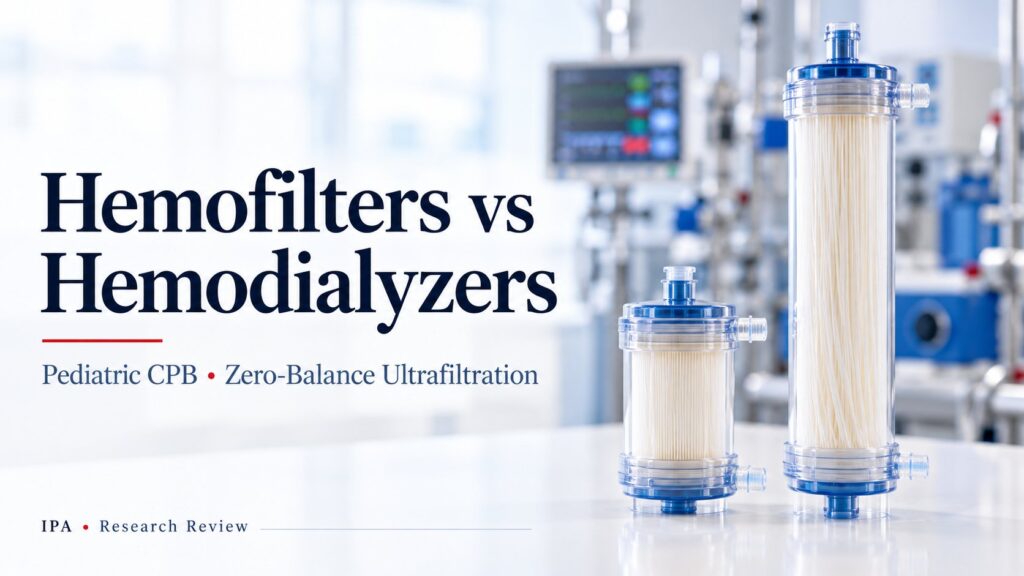
This original IPA educational summary is adapted from the open-access article by Abdelazim and colleagues under the Creative Commons Attribution 4.0 license. Wording and presentation have been adapted. The cover is a conceptual equipment illustration.
Original Article
Abdelazim AM, Alaaeldin B, Amer AM, et al. Hemofilters versus hemodialyzers: impacts on cytokine removal during cardiopulmonary bypass in pediatric cardiac surgery: a randomized controlled trial. Journal of Cardiothoracic Surgery. 2026;21:199. doi:10.1186/s13019-026-04058-0.