Acute type A aortic dissection (ATAAD) represents one of the most critical emergencies in cardiovascular surgery. Rapid diagnosis and surgical intervention are essential to prevent catastrophic complications such as rupture, cardiac tamponade, and organ malperfusion. However, ATAAD surgery is frequently complicated by severe perioperative coagulopathy. Hypothermia, cardiopulmonary bypass (CPB), hemodilution, and extensive operative times often lead to impaired clot formation and excessive bleeding.
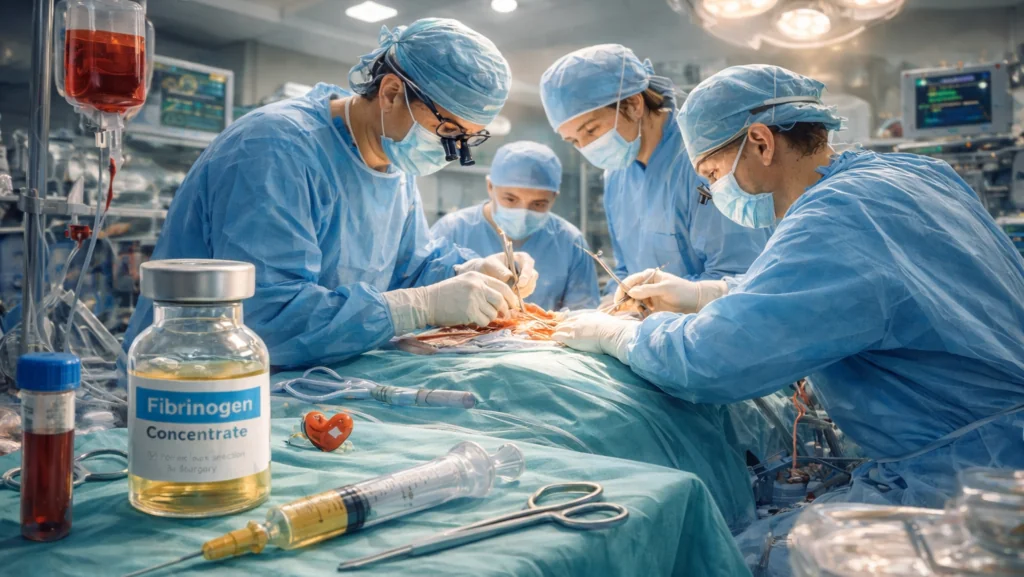
A recent retrospective cohort study examined the clinical impact of intraoperative fibrinogen replacement therapy (FRT) using fibrinogen concentrate (FC) in patients undergoing emergency surgical repair for ATAAD. The research aimed to determine whether rapid correction of hypofibrinogenemia during surgery could improve hemostasis, reduce bleeding, and influence postoperative outcomes.
Study Design and Patient Population
The study included 87 consecutive patients who underwent emergency surgery for ATAAD at a single cardiovascular center between December 2020 and March 2024. Patients were divided into two groups:
- Fibrinogen Replacement Therapy Group (F Group): 42 patients received intraoperative fibrinogen concentrate.
- Control Group (C Group): 45 patients underwent surgery without fibrinogen concentrate administration.
Fibrinogen levels were measured at three key time points:
- Preoperative
- Intraoperative (during CPB)
- Postoperative
Fibrinogen concentrate was administered when intraoperative fibrinogen levels approached 150 mg/dL or when surgeons observed diffuse bleeding from tissues and needle holes. The typical dose used was 3 grams of fibrinogen concentrate, which reflects common dosing practices in cardiovascular surgery.
The study assessed several outcomes including:
- Changes in fibrinogen levels
- Intraoperative and postoperative blood loss
- Postoperative complications
- One-month and one-year survival
Advanced statistical modeling (mixed model for repeated measures) was used to evaluate differences between groups while adjusting for potential confounders.
Effect of Fibrinogen Replacement Therapy on Coagulation
One of the key findings was that postoperative fibrinogen levels were significantly better preserved in the FRT group.
During surgery, both groups experienced a decrease in fibrinogen levels due to dilution and consumption. However, the decline was less severe in patients receiving fibrinogen concentrate. On average, fibrinogen levels increased by approximately 71 mg/dL after treatment, restoring levels closer to baseline.
Subgroup analysis demonstrated that patients who received fibrinogen concentrate—even when their intraoperative fibrinogen levels were relatively low—showed improved postoperative fibrinogen concentrations compared with patients who did not receive replacement therapy.
This suggests that rapid fibrinogen supplementation can effectively correct hypofibrinogenemia during ATAAD surgery, which is critical for maintaining clot stability.
Impact on Surgical Bleeding
The study found an interesting pattern regarding blood loss.
Patients in the fibrinogen therapy group had greater intraoperative blood loss than those in the control group. However, this difference likely reflects the fact that surgeons administered fibrinogen concentrate in cases where bleeding was already more severe or fibrinogen levels were lower.
Despite this initial difference, postoperative bleeding was nearly identical between the two groups. This indicates that fibrinogen replacement may have successfully stabilized coagulation once administered.
In other words, although the FRT group started with worse coagulopathy, treatment appeared to compensate for this deficit and prevent further bleeding complications.
Postoperative Complications
The investigators also evaluated major postoperative complications.
Rates of complications such as:
- Re-exploration for bleeding
- Cerebral complications (stroke)
- Pulmonary thromboembolism
- Other thromboembolic events
were similar between the fibrinogen-treated and untreated groups.
Importantly, no increase in thrombotic complications was observed, addressing a common concern when administering procoagulant therapies.
These findings suggest that fibrinogen concentrate can be used safely in the context of ATAAD surgery.
Survival Outcomes
The study also examined survival outcomes.
Short-term survival was comparable between groups:
- 1-month survival:
- FRT group: 92.9%
- Control group: 97.8%
However, at one year:
- FRT group survival: 73.8%
- Control group survival: 93.3%
While the difference may reflect baseline differences in patient severity rather than treatment effect, the study emphasizes that patients receiving fibrinogen therapy were generally more critically ill at baseline.
Therefore, the survival difference should be interpreted cautiously.
Clinical Implications
This study highlights several key clinical insights for cardiac surgeons and anesthesiologists managing ATAAD.
First, fibrinogen is one of the earliest clotting factors to decline during massive bleeding. Rapid correction of hypofibrinogenemia can therefore play a crucial role in restoring effective coagulation.
Second, fibrinogen concentrate offers advantages over traditional blood products such as fresh frozen plasma (FFP). These benefits include:
- Faster preparation and administration
- Lower infusion volume
- Reduced risk of transfusion reactions
- Lower risk of viral transmission
These characteristics make fibrinogen concentrate particularly attractive in emergency surgical settings where rapid hemostatic correction is required.
Third, the findings support a fibrinogen threshold of approximately 150 mg/dL as a potential trigger for replacement therapy during cardiac surgery.
Study Limitations
Like many retrospective studies, this analysis has limitations.
The study was conducted at a single center with a relatively small sample size, which may limit generalizability. Additionally, the decision to administer fibrinogen concentrate was left to the discretion of the surgical team, introducing potential selection bias.
Despite statistical adjustments, unmeasured confounding factors may still influence the results.
Future research—particularly prospective randomized trials—will be necessary to confirm the optimal dosing strategies and treatment thresholds for fibrinogen replacement therapy in ATAAD surgery.
Conclusion
Intraoperative fibrinogen replacement therapy appears to be an effective strategy for correcting hypofibrinogenemia during surgery for acute type A aortic dissection. The therapy improves postoperative fibrinogen levels and helps maintain hemostasis without increasing complications.
Although patients receiving fibrinogen replacement often present with more severe bleeding, treatment can stabilize coagulation and prevent further blood loss.
These findings support the use of fibrinogen concentrate as a valuable adjunct in the management of complex cardiovascular surgery.