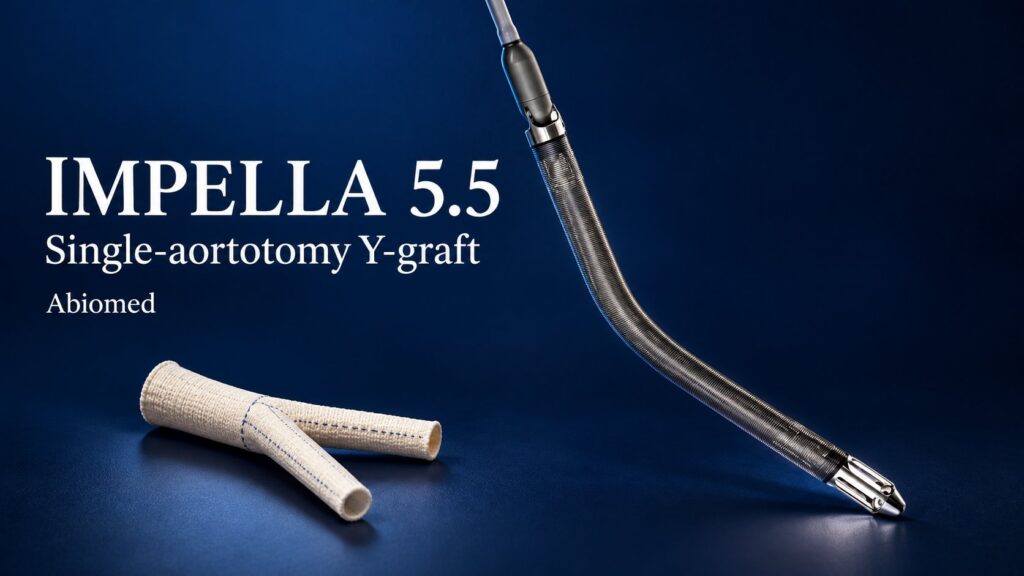
A shared aortic access site may simplify the transition from cardiopulmonary bypass (CPB) to temporary left ventricular support. In a surgical technique report, Tommaso Cambiaghi describes a direct aortic Y-graft used for both CPB arterial return and insertion of the Abiomed Impella 5.5 through a single aortotomy.
Rationale for Shared Aortic Access
Direct aortic Impella placement offers an alternative to separate axillary exposure in patients already undergoing cardiac surgery with planned temporary mechanical circulatory support. However, a separate Impella conduit can compete with the arterial cannulation site for space on the ascending aorta and complicate decannulation. Creating that conduit after crossclamping may also add to myocardial ischemic and pump time.
The described Y-graft combines the two access functions. One limb accommodates the Impella insertion sheath; the other connects to the arterial limb of the CPB circuit through a perfusion adaptor. The author proposes that this arrangement reduces the number of aortotomies and facilitates the transition between support systems.
Overview of the Reported Technique
The author constructs a Y-shaped conduit from a 10-mm woven Dacron graft and tunnels it to the base of the right neck, leaving both limbs outside the chest. A single anastomosis connects the conduit to the ascending aorta. The paper favours woven material over a premade knitted T-graft because of concern about greater porosity and blood loss with the latter.
A key anatomical requirement in the report is an aortotomy at least 7 cm above the aortic annulus, allowing the Impella outlet to remain in the ascending aorta rather than within the graft once the pump crosses the valve. The technique requires partial aortic clamping, with attention to maintaining flow through the supra-aortic vessels.
After deairing the sheath and perfusion adaptor, CPB proceeds through the graft. Before separation from bypass, the Impella is advanced across the aortic valve under transoesophageal echocardiographic or fluoroscopic guidance. Device depth is checked by echocardiography. Following transition to Impella support and return of residual CPB volume, the bifurcated portion of the graft is removed and the remaining conduit is secured around the device. The report also describes retaining sufficient graft redundancy for later removal and rechecking device depth after sternal approximation.
Key Features and Evidence
| Feature | What the report describes |
|---|---|
| Device | Impella 5.5 |
| Conduit | 10-mm woven Dacron graft fashioned into a Y configuration |
| Shared access | CPB arterial return and Impella insertion through one aortic anastomosis |
| Positioning consideration | Aortotomy at least 7 cm above the aortic annulus, as specified by the author |
| Proposed advantages | Fewer aortotomies and simpler decannulation; potential reduction in bleeding and added ischemic time |
| Outcome evidence | No patient cohort, comparator, complication rates, or measured time savings reported |
Considerations for Perfusion Teams
Coordination During the Transition From CPB
The shared conduit places the perfusion circuit and temporary support device in close physical proximity. The report highlights deairing, coordinated graft and arterial-line handling, volume return, and device-position verification during separation from bypass. These details are relevant to planning and communication between the surgeon, perfusionist, and echocardiography team.
The author acknowledges that the Impella driveline within the shared CPB arterial pathway could partially obstruct flow during manipulation. Although this was not described as a limiting factor in the author’s experience, the article provides no flow or pressure measurements to quantify that risk.
Aortic Clamping and Procedure Selection
Partial clamping of the ascending aorta remains necessary, so reducing the number of aortotomies does not eliminate the risks associated with aortic manipulation. In addition, the conduit lies distal to the aortic crossclamp. This prevents advancing the device across the valve under direct vision during procedures such as aortic valve replacement. For those circumstances, the author favours separate arterial cannulation and an Impella conduit below the clamp site.
Interpretation and Limitations
This is a description of a surgical modification, not an outcomes study. It contains no patient-specific clinical data and does not establish whether the technique reduces bleeding, transfusion, stroke, pump time, or mortality. The proposed advantages are plausible procedural goals that require evaluation.
Its educational contribution is the integration of CPB access and Impella insertion into one aortic conduit, together with discussion of anatomical constraints and potential flow interference. The full article provides operative photographs and technical detail; the summary here describes the concept rather than a validated procedural protocol.
Original IPA educational summary of Cambiaghi’s open-access surgical technique report, published under the Creative Commons Attribution 4.0 licence. The full-text PDF has been optimized for download; article content is preserved. The cover is an editorial illustration, not a technical placement diagram.
Original Article
Cambiaghi T. Direct aortic Y-graft for cardiopulmonary bypass initiation and Impella 5.5 insertion through a single aortotomy. JTCVS Techniques. 2026;39:102444. doi:10.1016/j.xjtc.2026.102444.