A randomized trial in Nepal compared pulsatile and non-pulsatile cardiopulmonary bypass in elective atrial septal defect closure and mitral valve replacement. Among 77 analyzed patients, ICU stay, hospital stay, creatinine, liver tests, and complications did not differ significantly. Urea was slightly higher with pulsatile flow. The small, predominantly young cohort and methodological limitations mean these results do not establish equivalence or exclude benefits in higher-risk patients.
Does Pulsatile Flow Improve Clinical Recovery?
Aakriti Sharma and colleagues examined a longstanding question in perfusion practice: whether roller-pump-generated pulsatility during cardiopulmonary bypass improves clinical outcomes compared with continuous flow. Their prospective randomized study was conducted at the Manmohan Cardiothoracic Vascular and Transplant Center in Kathmandu, Nepal. The results describe a relatively young elective surgical population and provide useful evidence about routine postoperative outcomes, while leaving important questions about high-risk patients and microcirculatory effects unresolved.
The central finding was an absence of statistically significant differences in most measured outcomes. This should be read as a neutral result in the studied setting, rather than proof that the two perfusion modes are equivalent. The trial was not designed as a noninferiority or equivalence study, and its sample size was not based on detecting a prespecified clinically important treatment effect.
Study Design and Patient Population
Eighty patients undergoing elective atrial septal defect closure or mitral valve replacement between July 2019 and July 2020 were randomized, with 40 initially assigned to each group. Three patients were excluded after allocation because their operative findings or procedures did not meet the intended criteria. The final analysis therefore included 39 pulsatile and 38 non-pulsatile patients, rather than all 80 randomized participants.
Randomization used a computer-generated sequence prepared by an independent statistician, with sequentially numbered, opaque, sealed envelopes opened immediately before surgery. This supported allocation concealment. Surgeons, anesthetists, and perfusionists knew the assignment, and outcome assessors and analysts were not formally blinded. Routine laboratory processing and predefined data collection provided some standardization, but do not remove the potential influence of unblinded care and assessment.
Participants had a mean age of approximately 34 years and generally lacked major comorbidities. Eligibility required normal left ventricular ejection fraction. Patients with moderate or severe ventricular dysfunction, acute kidney injury, impaired liver function, bleeding disorders, or other procedures were excluded. The results should therefore not be generalized directly to complex aortic surgery, coronary bypass populations, prolonged bypass, or patients with substantial preoperative organ dysfunction.
How Pulsatility Was Delivered
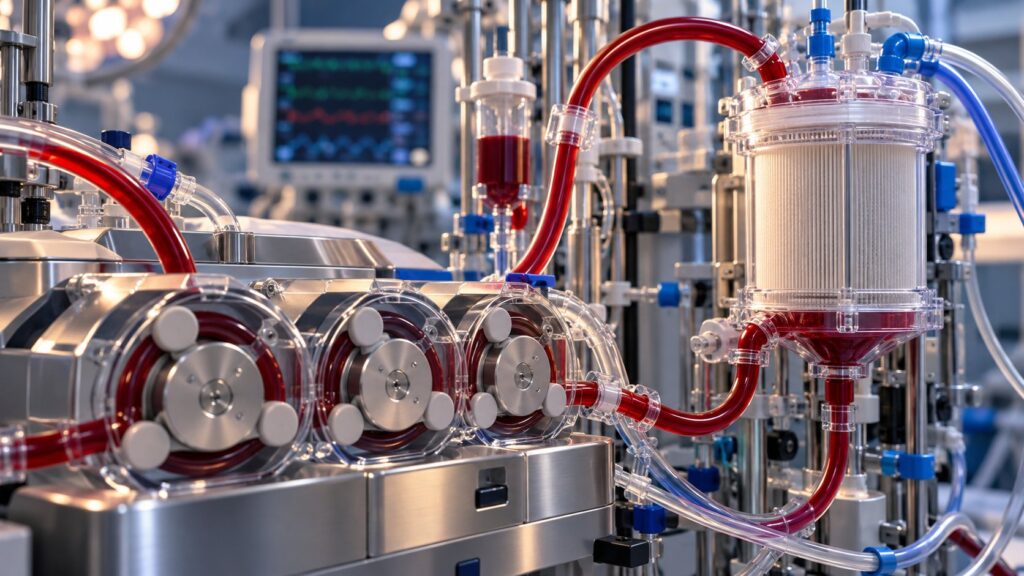
Both groups received roller-pump bypass using a Jostra HL20 or Sorin S5 system, a non-coated custom circuit, and a hollow-fiber membrane oxygenator. The reported indexed-flow target was 2.2–2.4 L/min/m², the mean arterial pressure target was 60–80 mmHg, and systemic temperature was maintained at 34–36°C. These values describe the institutional study protocol rather than treatment targets validated by this comparison.
In the pulsatile group, bypass began in continuous mode and changed to pulsatile mode after native ventricular ejection ceased. Pulsatility continued until spontaneous ejection resumed during separation from bypass. Reported pulse rates were 60–80 per minute for adults and 80–120 per minute for pediatric patients, with a pulse-pressure target above 15 mmHg and active pump time of 50%–55% of each pulse cycle.
Pulse-cycle timing is distinct from the proportion of the entire bypass run spent in pulsatile mode. The paper also uses similar percentage language when discussing overall exposure, leaving that aspect of reporting unclear. The study did not directly measure microcirculatory perfusion or demonstrate how much pulsatile energy reached the tissue bed. A visible arterial pulse pressure alone cannot establish improved regional oxygen delivery.
Operative and Recovery Outcomes
Median bypass duration was 52 minutes in the pulsatile group and 62.5 minutes in the non-pulsatile group; median aortic cross-clamp times were 31 and 47.5 minutes, respectively. Neither difference reached statistical significance. Intraoperative urine output, blood-gas variables, and lactate were also statistically similar. These relatively short bypass exposures are an important part of the clinical context.
| Outcome | Pulsatile, n=39 | Non-pulsatile, n=38 | P value |
|---|---|---|---|
| ICU stay, median days | 2 | 2 | 0.55 |
| Hospital stay, median days | 7 | 8 | 0.14 |
| Ventilator support, median hours | 4 | 4.5 | 0.74 |
| Postoperative creatinine, median mg/dL | 0.86 | 0.80 | 0.30 |
| Postoperative urea, median mg/dL | 14 | 12 | 0.049 |
| Reported mortality | 2 (5.12%) | 2 (5.26%) | 1.00 |
Postoperative liver-function measurements, lactate values, urine output, and drain output did not differ significantly. Duration of the reported vasoactive and inotropic therapies was also similar. However, the investigators did not calculate a vasoactive-inotropic score, so similar treatment duration does not establish equivalent drug-dose exposure or hemodynamic burden.
There were two deaths in each group. Neurological complications were reported in two pulsatile patients and none in the non-pulsatile group, while re-exploration occurred in two and three patients, respectively. These differences were not statistically significant. With so few events, neither the absence of a significant difference nor the direction of a numerical difference provides a reliable estimate of comparative safety.
Interpreting the Renal Findings
Baseline body surface area and serum creatinine were higher in the pulsatile group. Mean baseline creatinine was 0.8 versus 0.6 mg/dL. These imbalances matter when comparing postoperative renal measurements, particularly because no adjusted multivariable analysis was performed. The authors explain that the small sample limited the reliability of such modeling.
The isolated difference in postoperative urea was small and close to the conventional significance threshold. It occurred among numerous comparisons and was not accompanied by a significant difference in creatinine or urine output. The trial therefore does not establish either renal benefit or renal harm from pulsatile perfusion. Routine laboratory measurements also cannot exclude more subtle differences in renal oxygenation or injury.
The authors discuss hemolysis as one possible explanation for biochemical differences, but they did not measure the hemolysis markers required to test that explanation. It would be inappropriate to describe hemolysis as a demonstrated mechanism in this cohort. Direct renal-perfusion assessment, plasma-free hemoglobin, lactate dehydrogenase, haptoglobin, and more sensitive injury markers remain potential components of future research.
Evidence Strength and Practical Relevance
Prospective random allocation and concealed assignment are important strengths. The study also addresses an elective valve and congenital-surgery case mix that differs from many coronary-surgery cohorts. Nevertheless, the single-center design, small sample, post-randomization exclusions, unblinded assessment, baseline imbalances, and limited mechanistic measurements constrain interpretation.
The sample-size calculation used procedural prevalence rather than an anticipated treatment effect for a primary outcome. Consequently, the study does not establish that it could detect clinically meaningful differences in recovery, organ injury, or uncommon adverse events. Its findings are best understood as a failure to demonstrate a measurable clinical advantage from the particular pulsatile strategy used in these selected patients.
For perfusion teams, the useful message is to distinguish the theoretical appeal of pulsatility from documented outcome improvement. This trial does not support a routine change to pulsatile flow solely to improve the measured outcomes in a similar population, but it also does not settle the broader debate. Larger trials with clearly defined pulsatile exposure, effect-size-based sample calculations, and relevant high-risk populations are needed.
Attribution: © 2026 The Authors, published by EDP Sciences. The original article is available under CC BY 4.0. This independently written IPA summary accompanies the source article. Cover artwork is conceptual.
Original Article
Sharma A, Luitel P, Khakural P, Sapkota R. Comparison of clinical outcomes between pulsatile and non-pulsatile perfusion during cardiopulmonary bypass: A prospective randomized study. J Extra Corpor Technol. 2026;58:117–123. Read the original article.