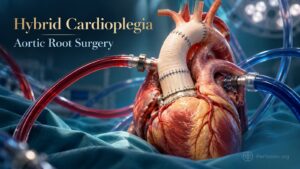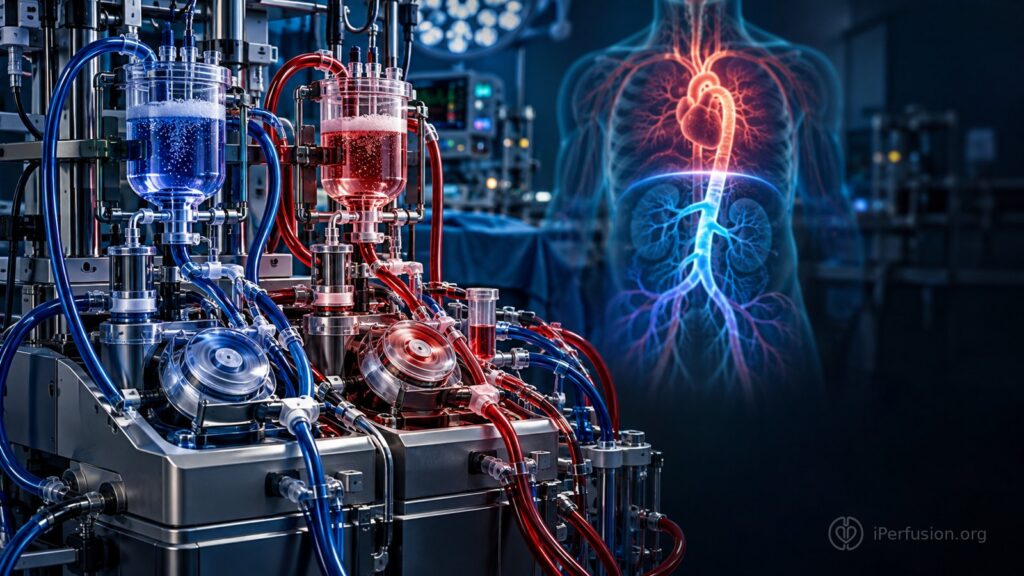
Maintaining regional blood flow during extensive aortic reconstruction is a central challenge in open thoracoabdominal aortic aneurysm (TAAA) repair. Peev and colleagues describe a split-body perfusion strategy that separates upper- and lower-body arterial inflow, combining selective cerebral and visceral perfusion with a distal-first reconstructive sequence. The report illustrates technical feasibility and physiologic rationale; it does not establish better clinical outcomes than conventional approaches.
Why rethink circulatory management?
When aneurysmal disease extends into the proximal descending thoracic aorta or distal arch, obtaining an open proximal anastomosis may require hypothermia and interruption of regional or systemic flow. Organ protection must account for the brain, spinal cord, abdominal viscera, kidneys, and myocardium while providing an adequate surgical field.
The authors organize extracorporeal support around the sequence of reconstruction. Their aim is to maintain active perfusion to critical territories wherever technically feasible, reducing reliance on full-body deep hypothermic circulatory arrest. That aim is distinct from a demonstrated reduction in neurologic injury or other complications.
The clinical setting described
The illustrated index patient was a 56-year-old man who had previously undergone hemiarch repair for acute type A dissection. Subsequent aneurysmal degeneration of the residual chronically dissected thoracoabdominal aorta produced a Crawford extent II aneurysm. The maximum diameter was 57.9 mm in aortic zone 3, and the perivisceral aorta measured 54.3 mm with substantial true-lumen compression.
These anatomic features required proximal descending thoracic reconstruction with an open proximal anastomosis. The article is a surgical technique and video report, rather than a randomized trial or comparative cohort. Although some passages refer to experience across patients, it does not provide a defined series denominator or a quantified aggregate outcomes analysis.
How split-body perfusion fits the operation
Carotid inflow and regional support
A temporary chimney graft on the left common carotid artery provides initial arterial inflow and later selective cerebral perfusion. Femoral venous drainage supports cardiopulmonary bypass. The described approach uses moderate systemic hypothermia, with a target bladder temperature of approximately 28°C, while monitoring ventricular size and preparing for decompression if required.
During distal reconstruction, selective perfusion catheters supply the celiac, superior mesenteric, and renal arteries through a dedicated pump head. Completing the distal anastomosis first creates a side-arm graft that subsequently becomes the lower-body arterial inflow source.
Proximal reconstruction with separate territories
Once the distal inflow is established, cerebral support through the carotid graft and distal systemic support through the reconstructed aorta can be managed independently. The proximal descending thoracic aorta is then reconstructed while these territories remain supported. The authors describe del Nido cardioplegia for myocardial protection during this phase.
After proximal reconstruction, arterial inflow is transferred to the proximal graft side branch, graft continuity is restored, and the temporary configuration is transitioned back toward conventional systemic circulation. This sequence is a description of the published technique, not a universal circuit or dosing protocol.
What matters for the perfusion team
The additional flexibility comes with greater circuit and coordination demands. Changes in clamp position, arterial inflow, and organ territory must be explicitly coordinated among surgery, perfusion, anesthesia, and neuromonitoring personnel.
The report emphasizes deliberate deairing at each transition, attention to carotid graft orientation, and continuous assessment of regional perfusion. Bilateral extremity arterial pressure monitoring, transesophageal echocardiography, electroencephalography, and motor-evoked potentials form part of the described monitoring strategy.
Independent arterial inflow does not itself prove that every organ receives adequate flow. Flow distribution, pressure control, catheter position, and the evolving surgical anatomy remain central considerations. Left ventricular decompression must remain available when ventricular distention develops, even though the authors describe experience without routine venting.
Potential advantages and unresolved questions
The physiologic rationale includes sustained distal inflow during proximal reconstruction and preservation of parts of the collateral network relevant to spinal cord perfusion. Avoiding direct innominate artery instrumentation is another feature of the configuration. Neither a reduction in spinal cord ischemia nor a lower embolic or stroke risk was demonstrated in this report.
Likewise, the title’s emphasis on continuous end-organ flow describes the strategy’s intended architecture. It should not be interpreted as quantified proof of uninterrupted organ oxygen delivery or elimination of ischemic injury.
Limits of the evidence and patient selection
The article provides no comparator, defined cohort size, or statistical outcomes analysis establishing lower mortality, neurologic injury, renal dysfunction, visceral ischemia, or other morbidity. A technical demonstration cannot establish reproducibility across centers or clinical superiority.
The temporary carotid graft also introduces potential bleeding, thrombosis, embolization, carotid injury, kinking, and inadequate cerebral inflow. Carotid or supra-aortic disease, dissection involving the intended inflow vessel, unfavorable cervical anatomy, and the need for separate supra-aortic reconstruction may limit applicability.
The authors position the strategy as an advanced option for selected complex repairs. Larger clinical series and comparative evaluation are needed to define safety, patient selection, reproducibility, and outcomes.
Relevance for perfusion practice
The educational contribution is the integration of circuit design with a distal-first reconstruction plan. For perfusion teams, it illustrates the importance of planning regional flow transitions and monitoring before the operation. It offers a technical concept to evaluate within experienced multidisciplinary programs, with clinical benefit still requiring investigation.
Source: Peev M, Coleman T, Johnson B, Daubenspeck D, Tung A, Salerno C, Pocivavsek L. Rethinking circulatory management in thoracoabdominal aortic repair: split-body perfusion for continuous end-organ flow. Journal of Visualized Surgery. 2026;12:41. Published online September 22, 2026. doi:10.21037/jovs-2026-0039.
Original article and operative video: View the publisher’s article and accompanying video.
Funding and disclosures: The authors report no funding and no conflicts of interest. The original work is distributed under CC BY-NC-ND 4.0. This IPA educational analysis is an original paraphrased summary; the downloadable source PDF is unchanged.