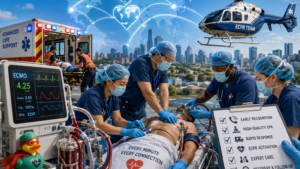
Normothermic regional perfusion (NRP) is an increasingly important organ procurement technique designed to improve the quality and availability of organs recovered after donation following circulatory death (DCD). By restoring warm, oxygenated blood circulation to organs within the donor’s body after death has been declared, NRP can reduce ischemic injury, permit assessment of organ function, and potentially increase the number of organs suitable for transplantation. Despite these clinical benefits, NRP remains ethically debated and operationally inconsistent across the United States. This qualitative study examines how executives from U.S. organ procurement organizations (OPOs) perceive and manage NRP implementation, with particular attention to hospital collaboration, donor-family communication, education, protocols, and outcome monitoring.
The researchers conducted semi-structured interviews with 20 OPO executives, representing a 53% participation rate among the 38 executives approached from OPOs represented at the Organ Donation and Transplantation Alliance’s 2024 National Collaboration Forum on NRP. Interviews occurred between March and April 2024. Participants represented nearly the entire geographic range of the Organ Procurement and Transplantation Network, although OPTN Regions 1 and 9 were not represented. Seventeen interviews occurred in person and three online. Three executives represented OPOs that had not yet implemented NRP but had begun preparing for its introduction.
Researchers analyzed interview transcripts through combined deductive and inductive thematic content analysis. Multiple trained coders reviewed the interviews, reconciled coding differences during 11 meetings, and developed five principal themes. This methodology provided a structured examination of how OPO leaders experience the practical and ethical challenges associated with normothermic regional perfusion.
The first major finding was substantial variation in hospital acceptance of NRP. Comfort differed not only between hospitals but also among clinicians working within the same institution. Some hospitals permitted abdominal NRP (A-NRP) while rejecting thoracic NRP (TA-NRP), and others remained uncomfortable with NRP altogether. Ethical concerns were an important source of resistance, particularly questions involving the dead donor rule, irreversibility of death, restarting cardiac function during TA-NRP, and preventing restored circulation from reaching the brain. Participants reported that concerns raised by nurses, anesthesiologists, physicians, administrators, or other personnel could delay procedures while hospital leadership or ethics committees reviewed proposed NRP cases.
A second important finding involved the lack of standardized NRP protocols. Many participating OPOs did not have consistent operating procedures governing case management or data collection. Differences included authorization processes, equipment and supplies, operating-room staffing requirements, procedural measurements, and post-transplant outcome monitoring. Some organizations collected serial lactate measurements and detailed procedural information, whereas others emphasized the number of organs recovered or post-transplant graft function. The inconsistency can make comparisons among NRP programs difficult and limits the ability to systematically assess outcomes.
This variation also creates practical challenges in the operating room. OPO personnel sometimes follow protocols established by individual recovery teams, which themselves may have limited NRP experience. Consequently, hospital personnel can find themselves learning aspects of the procedure during an active procurement. Participants characterized such experiences as essentially “trial by fire.” Some OPOs were responding by collaborating with hospitals to establish formal protocols, educational resources, and standardized recovery programs before cases occur.
Communication with donor families emerged as a particularly significant ethical issue. OPO approaches ranged from providing detailed descriptions of NRP to offering only general explanations that organs would be perfused within the body rather than after removal. Some OPOs disclosed details such as premortem cannulation, occlusion of vessels, or restoration of cardiac activity during TA-NRP. Others provided limited information unless family members specifically requested additional details. Participants favoring greater disclosure emphasized transparency, whereas those favoring less procedural detail expressed concern about unnecessarily increasing distress during an already traumatic period.
The findings therefore highlight a tension between informed decision-making and avoiding additional burden on grieving families. Importantly, some organizations have begun consulting donor families and patient advisory councils to determine what information families actually want during authorization discussions. The authors suggest that people with firsthand experience of donation conversations should contribute to the development of future communication standards.
Cross-organizational collaboration emerged as one of the strongest practical strategies for facilitating NRP. Participants described pre-procedure “huddles” involving OPOs, donor hospitals, transplant centers, and recovery teams. These meetings clarify procedural plans, organ recovery methods, responsibilities, staffing, and logistical expectations before entering the operating room. Executives considered these discussions particularly important because NRP experience and protocols vary considerably among hospitals and transplant teams. Communication after procurement was also valuable because OPOs could share information about organs recovered, organs transplanted, and recipient graft outcomes.
Proactive education was another recurring theme. Rather than introducing NRP only when a potential donor case arises, OPOs increasingly educate hospital leaders and clinical staff in advance. Educational strategies included grand rounds, webinars, handouts, conferences, on-site meetings, and materials developed jointly with hospitals, bioethics experts, or donor families. Participants believed advance education allowed clinicians to examine ethical and procedural questions without the pressure of an active donation case. However, the authors emphasize that the effectiveness of these educational approaches has not yet been empirically established.
The study has important limitations. Participants were OPO leaders rather than a representative sample of all OPO personnel, and recruitment occurred among executives attending an NRP-focused national forum. This introduces possible selection bias because attendees may have been more interested in or supportive of NRP than other OPO leaders. Findings were also based on self-reported practices rather than independently verified protocols or observations. Finally, interviews were conducted in 2024, and NRP policies and practices continue to evolve rapidly.
Overall, the research portrays U.S. normothermic regional perfusion as a promising transplantation practice operating within an incompletely standardized ethical and procedural environment. Variation exists in hospital acceptance, clinical protocols, outcome tracking, education, and donor-family communication. The study argues that proactive education, standardized data collection, transparent communication, carefully developed protocols, and consistent collaboration between OPOs, donor hospitals, transplant centers, clinicians, and donor families could strengthen NRP implementation. Future empirical research is needed to determine which practices best protect donors and families while maximizing safe, effective organ transplantation.