
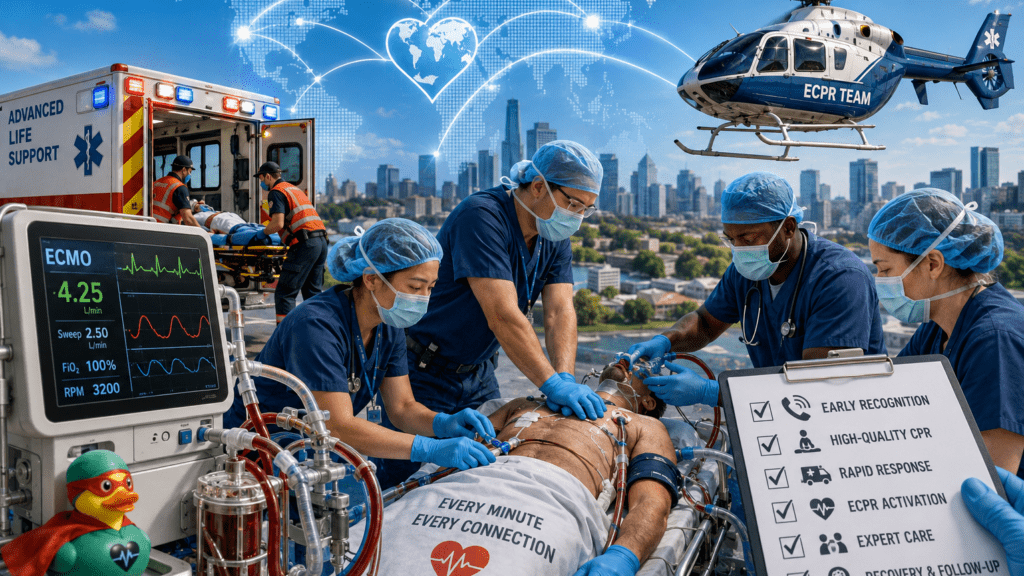
Extracorporeal cardiopulmonary resuscitation (ECPR) is increasingly being incorporated into systems treating refractory out-of-hospital cardiac arrest (OHCA). Although survival rates approaching 30% have been achieved in selected, highly organized programs, the authors emphasize that ECPR should not be viewed simply as an advanced procedure. Instead, it is one component of a complex cardiac arrest system in which early recognition, bystander CPR, professional resuscitation, rapid identification of eligible patients, timely extracorporeal membrane oxygenation (ECMO), and coordinated postresuscitation care must function together.
Before establishing an ECPR program, communities should optimize their existing cardiac arrest systems. This includes rapid dispatch recognition, telephone-assisted CPR, widespread automated external defibrillator availability, high-quality basic and advanced life support, effective airway management, mechanical CPR where appropriate, and robust quality-improvement programs. Importantly, investments made to support ECPR can strengthen conventional OHCA care as well, potentially benefiting the much larger population that never receives extracorporeal support.
Patient selection remains challenging because universally accepted ECPR eligibility criteria do not exist. Common elements include a witnessed arrest, rapid initiation of bystander CPR, appropriate age, an initially shockable rhythm or selected cases of pulseless electrical activity, and acceptable no-flow and low-flow intervals. Physiological factors such as signs of life during CPR, arterial pH, lactate, oxygenation, and cerebral oxygen saturation may provide additional information. Restrictive eligibility improves observed survival but can exclude salvageable patients and reduce procedural volume, while overly broad criteria can lower overall program outcomes.
Time is particularly important. ECMO flow is generally targeted within 60 minutes of cardiac arrest, although the authors caution against treating this as an absolute biological cutoff. No-flow time—the interval between collapse and CPR—is especially harmful, while progressively longer low-flow time during CPR also decreases the probability of neurologically favorable survival. Consequently, successful systems build speed into every phase of care through parallel activation, abbreviated scene times for appropriate candidates, mechanical CPR during transport, rapid handoffs, and streamlined cannulation pathways.
Only approximately 3% to 11% of OHCA patients are likely to meet ECPR eligibility criteria. Program designers therefore need to understand not only how many potential patients exist but where and when arrests occur. The review advocates combining cardiac arrest registries with geographic information system modeling to estimate patient distribution, EMS transport times, hospital locations, and achievable collapse-to-ECMO intervals. These analyses can determine where ECPR teams and centers should be located and should be repeated as populations, infrastructure, eligibility criteria, and EMS systems change.
The review describes three principal ECPR delivery strategies, illustrated in the Figure 1 diagram on page 5: hospital-based ECPR, prehospital ECPR, and a rendezvous model. Hospital-based programs concentrate expertise and resources at specialized centers but have limited geographic reach because patients must arrive quickly enough for timely ECMO initiation. Rendezvous systems send a specialized ECMO team toward the patient while EMS simultaneously transports the patient to a predefined location, potentially expanding the reach of a high-volume team without requiring every hospital to maintain independent ECPR capabilities.
Prehospital ECPR brings ECMO directly to the patient. This strategy can dramatically increase geographic coverage and shorten low-flow time, with observational analyses reporting approximately 25% favorable neurological survival and substantially shorter low-flow intervals than hospital-based ECPR. However, field cannulation requires specialized clinicians, equipment, intensive training, simulation, transportation resources, quality assurance, and considerable financial investment. Evidence supporting prehospital ECPR also remains predominantly observational and comes from highly developed emergency medical systems, limiting certainty about its reproducibility elsewhere.
The article therefore does not identify one universally superior ECPR delivery model. Local geography, population density, EMS capabilities, hospital infrastructure, case volume, and financial resources should determine system design. Regardless of location, experienced teams and sufficient procedural volume are essential. Higher-volume ECPR centers have demonstrated better outcomes, supporting regional concentration of expertise rather than widespread distribution among low-volume institutions.
Intra-arrest transport requires equally careful planning. Most patients who achieve spontaneous circulation do so relatively early during conventional professional resuscitation. ECPR programs must therefore balance high-quality on-scene resuscitation against rapid transport for candidates with persistent refractory arrest. The review suggests that potential transition toward ECPR commonly occurs after approximately 8 to 20 minutes of professional resuscitation. Importantly, changing transport practices for ECPR candidates must not inadvertently reduce CPR quality or outcomes among patients who would benefit from continued conventional resuscitation.
Post-ECPR care is another critical component. Receiving hospitals should function as comprehensive cardiac arrest centers with continuous access to coronary angiography, percutaneous coronary intervention, advanced critical care, ECMO expertise, and multidisciplinary treatment of complications associated with prolonged CPR. Premature neurological prognostication is particularly concerning because patients supported by ECPR may awaken later than conventional cardiac arrest survivors. The authors emphasize allowing adequate time for neurological recovery and avoiding premature withdrawal of life-sustaining therapy.
Economic sustainability ultimately depends on outcomes. Programs achieving approximately 25% to 30% survival are more likely to be cost effective, particularly when survivors achieve good long-term quality of life. Conversely, poorly performing programs may struggle to justify their substantial staffing, equipment, transportation, and infrastructure costs. The review also discusses organ donation as a potential contributor to overall health-system value while emphasizing that donation considerations must remain ethically separate from decisions about initiating or withdrawing ECPR.
Ultimately, the central message is that ECPR success depends more on system design than technology alone. Communities should optimize conventional cardiac arrest care first, analyze their eligible population and geography, select an appropriate delivery strategy, minimize no-flow and low-flow times, concentrate expertise, standardize postresuscitation care, and continuously measure performance. As summarized by the authors, ECPR should be understood as one element of an integrated, data-driven cardiac arrest system rather than an isolated rescue procedure.