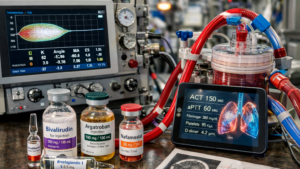

Goal-Directed Perfusion (GDP) represents an evolving paradigm in cardiopulmonary bypass (CPB) management, emphasizing individualized physiological control of oxygen delivery, metabolic demand, and perfusion pressure during cardiac surgery. The article “Mini-Compendium on Goal-Directed Perfusion (GDP) Based on a Narrative Review” synthesizes current physiological principles and clinical evidence to provide a comprehensive framework for modern perfusion management. Rather than relying solely on traditional perfusion targets such as fixed pump flow or mean arterial pressure, GDP integrates multiple hemodynamic and metabolic variables to maintain adequate tissue oxygenation and prevent postoperative organ dysfunction.
Cardiopulmonary bypass places patients in a unique non-physiological state where systemic perfusion is entirely dependent on extracorporeal circulation. In this setting, inadequate oxygen transport may lead to tissue hypoxia, hyperlactatemia, and complications such as acute kidney injury (AKI). Traditional approaches often rely on standardized pump flows (for example, 2.4 L/min/m²) and generalized pressure targets, but these values do not account for patient-specific factors like anemia, metabolic demand, or microcirculatory perfusion. The GDP model addresses this limitation by focusing on the balance between oxygen supply and consumption.
The cornerstone of the GDP approach is indexed oxygen delivery (DO₂i), which represents the amount of oxygen transported to tissues per unit of body surface area. Clinical evidence shows that maintaining DO₂i above approximately 260–280 mL/min/m² during cardiopulmonary bypass is essential to sustain aerobic metabolism and prevent organ injury. When oxygen delivery falls below this threshold, cellular metabolism becomes oxygen-supply dependent, leading to anaerobic metabolism and lactate accumulation.
In addition to oxygen delivery, GDP incorporates metabolic markers that provide early insight into tissue oxygenation status. Oxygen consumption (VO₂i) and carbon dioxide production (VCO₂i) reflect metabolic activity, while the oxygen extraction ratio (O₂ERi) indicates how efficiently tissues utilize available oxygen. By monitoring these variables simultaneously, clinicians can detect early signs of oxygen debt before overt clinical deterioration occurs.
A key innovation discussed in the review is the use of metabolic coupling ratios, particularly the DO₂/VCO₂ ratio and DO₂/O₂ER ratio. These ratios serve as integrative indicators of perfusion adequacy and metabolic efficiency. Under normal aerobic conditions, the DO₂/VCO₂ ratio remains above approximately 5.3, indicating that oxygen delivery sufficiently supports metabolic activity. When the ratio falls below this level, it may signal an early shift toward anaerobic metabolism even before lactate levels increase. Similarly, the DO₂/O₂ER ratio reflects the balance between oxygen supply and tissue extraction; values below approximately 6 suggest limited physiologic reserve and an increased risk of metabolic stress.
Another major advancement highlighted in the article is the introduction of time-dose response models for both oxygen delivery and perfusion pressure. These models quantify the cumulative exposure to suboptimal perfusion rather than relying on single measurements. The Area Under the Curve for oxygen delivery (AUC–DO₂) measures the magnitude and duration of oxygen delivery deficits during bypass. Studies have shown that higher cumulative oxygen deficits strongly correlate with postoperative complications such as acute kidney injury and hyperlactatemia.
Similarly, perfusion pressure is assessed using the Mean Arterial Pressure (MAP) time-dose response model. While MAP is a traditional perfusion parameter, GDP reinterprets it in the context of organ autoregulation and cumulative hypotension exposure. Evidence indicates that MAP values below approximately 65–70 mmHg can impair renal and cerebral autoregulation during CPB. By measuring the cumulative duration and severity of hypotension (AUC–MAP), clinicians can better predict the risk of organ injury and intervene earlier.
The review conceptualizes Goal-Directed Perfusion using four interconnected pillars: Model, Mission, Means, and Monitoring. The model refers to the extracorporeal circulation system in which native regulatory mechanisms are suspended. The mission of GDP is to maintain metabolic equilibrium between oxygen supply and tissue demand rather than simply achieving arbitrary numeric targets. The means include adjustable perfusion variables such as pump flow, hemoglobin concentration, oxygen saturation, temperature, and vascular tone. Monitoring integrates all these elements through continuous measurement of oxygen transport variables, metabolic ratios, and perfusion pressure.
Importantly, the authors emphasize that GDP principles can be implemented even in resource-limited settings. While advanced monitoring systems provide real-time metabolic data, clinicians can still apply GDP by calculating indexed oxygen delivery from standard parameters such as pump flow, hemoglobin concentration, and arterial oxygen saturation. Lactate trends, mixed venous oxygen saturation, and arterial pressure monitoring can serve as practical surrogate markers of perfusion adequacy.
Overall, the mini-compendium positions Goal-Directed Perfusion as a transformative approach to cardiac surgery perfusion management. By integrating hemodynamic, metabolic, and temporal determinants of oxygen delivery, GDP shifts perfusion practice from a static, flow-based technique toward a dynamic and predictive physiological model. This patient-specific approach may reduce complications such as acute kidney injury, hyperlactatemia, and postoperative organ dysfunction.
As perfusion technology advances, the integration of automated monitoring systems and artificial intelligence-driven dashboards may further enhance GDP implementation. These tools could enable real-time decision support, helping perfusionists maintain optimal oxygen delivery and perfusion pressure tailored to each patient’s metabolic needs.
Ultimately, the review establishes GDP as a comprehensive and data-driven framework that bridges physiology, mathematics, and clinical practice, laying the foundation for a standardized model of precision perfusion in contemporary cardiac surgery.