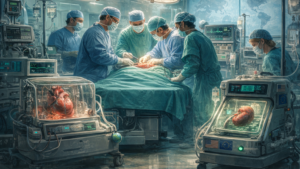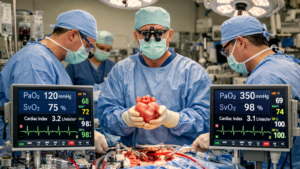
Lung transplantation (LTx) remains the definitive treatment for patients with end-stage pulmonary fibrosis (PF). However, perioperative instability and primary graft dysfunction (PGD) continue to pose major risks. In this retrospective single-center study from Hannover Medical School, investigators examined whether a more liberal, elective intraoperative extracorporeal membrane oxygenation (ECMO) strategy could improve outcomes in PF patients undergoing bilateral lung transplantation.
The study included 422 adult PF patients transplanted between January 2012 and January 2025. Patients were divided into two cohorts: a pre-2020 group (n=273) and a post-2020 group (n=149). In 2020, the institution implemented a revised protocol promoting earlier and more liberal elective veno-arterial (v-a) ECMO use, particularly in patients with secondary pulmonary hypertension. Pre-transplant right-heart catheterization parameters—mean pulmonary artery pressure (PAPmean) >50 mmHg and pulmonary vascular resistance (PVR) >9.4 Wood units—guided decision-making.
Before 2020, elective ECMO was used in 19% of patients, non-elective ECMO in 11%, and 70% underwent transplantation without ECMO. After the protocol change, elective ECMO utilization increased dramatically to 66%, while transplants without ECMO dropped to 26%. The proportion of non-elective ECMO cases remained similar (8%), highlighting that some intraoperative deterioration remains unpredictable.
The primary outcome was PGD grade 3 at 72 hours post-transplant. Results were striking. Among elective ECMO patients, PGD grade 3 incidence decreased from 17% pre-2020 to just 3% post-2020 (p=0.002). Non-elective ECMO patients experienced an even more pronounced improvement, with PGD falling from 38% to 0% (p=0.016). Even patients transplanted without ECMO showed numerical improvement.
PGD represents ischemia-reperfusion injury and remains a major determinant of early morbidity and long-term outcomes, including chronic lung allograft dysfunction (CLAD). By initiating ECMO electively—before hemodynamic collapse—surgeons ensured controlled graft reperfusion and reduced physiologic stress during implantation of the second lung, when full cardiac output flows through the first implanted graft. This controlled environment likely contributed to the reduction in severe PGD.
Secondary outcomes further supported the elective ECMO strategy. Post-2020 elective ECMO patients required shorter invasive mechanical ventilation (median reduction of 6 hours), had significantly fewer new dialysis requirements (23% vs. 4%, p<0.001), and experienced shorter ICU stays. Prolonged postoperative ECMO support was reduced both in frequency and duration.
Importantly, increased ECMO use did not lead to higher major vascular complication rates. While lymphatic fistula became more common after 2020, severe complications such as limb ischemia and retroperitoneal hematoma were more frequent in the earlier percutaneous ECMO era. Refinements in surgical cannulation techniques—including open femoral exposure and later longitudinal incision approaches—likely mitigated risk.
One-year graft survival showed encouraging trends. Elective ECMO patients improved from 88.5% to 95.6%, and non-elective ECMO patients improved from 70% to 91.7%, although these differences did not reach statistical significance, likely due to limited post-2020 follow-up duration. CLAD-free survival at one year was similar between groups.
Risk factor analysis revealed that increased PVR and longer donor ventilation duration predicted the need for non-elective ECMO despite protocol adjustments. This underscores the challenge of perfectly predicting intraoperative instability.
The study’s limitations include its retrospective design, short follow-up in the post-implementation era, and potential confounding inherent to a before-and-after institutional protocol change. Nonetheless, the consistency of PGD reduction across subgroups and the absence of increased major complications provide compelling support for elective ECMO in high-risk PF patients.
In summary, a more liberal elective intraoperative ECMO strategy during bilateral lung transplantation in pulmonary fibrosis significantly reduced severe primary graft dysfunction, shortened ventilation duration, lowered dialysis rates, and demonstrated trends toward improved survival. These findings support proactive hemodynamic stabilization and controlled graft reperfusion as key strategies in modern lung transplant surgery.