A case report describes unexpected red-cell clumping during mitral and tricuspid valve surgery in a patient without a known cold-agglutinin disorder. The team observed temperature-dependent aggregation despite an activated clotting time within range, then changed to normothermic bypass and warm cardioplegia. The patient recovered after transient postoperative findings consistent with hemolysis. The report illustrates a rare perfusion hazard but cannot establish screening or treatment standards.
Unexpected Agglutination During Cardiopulmonary Bypass
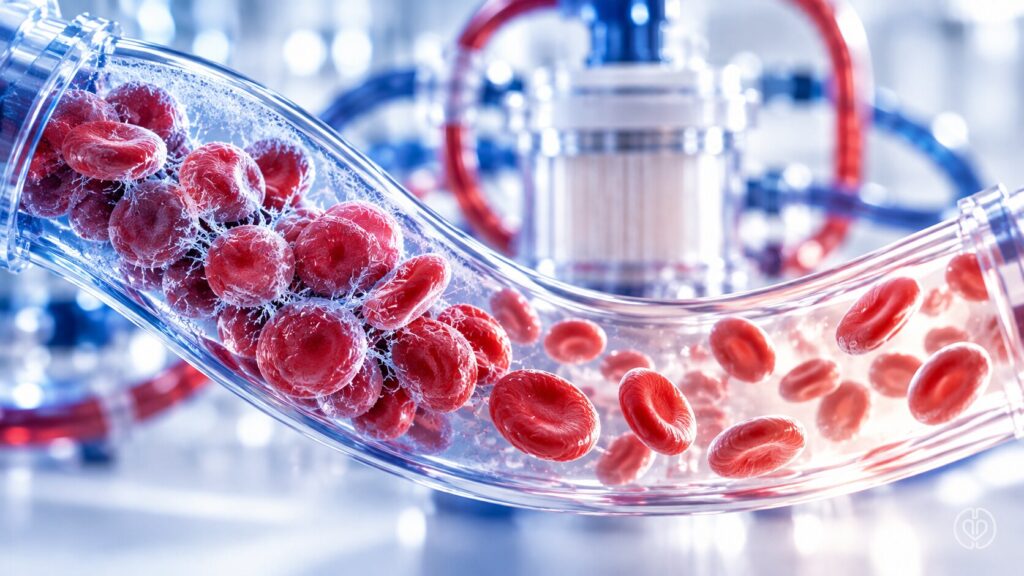
Cold-reactive antibodies can create a particular challenge when cardiac surgery combines systemic cooling with cold blood cardioplegia. In this report, D’Alessio and colleagues describe a 74-year-old man whose previously unrecognized cold-agglutinin problem became apparent only after cardiopulmonary bypass had begun. Visible blood clumps in the left-sided heart chambers prompted the team to reassess the situation, investigate a temperature-dependent process, and modify the operative strategy.
The case is relevant to perfusion practice because the activated clotting time (ACT) remained within the intended range. An adequate ACT addresses heparin anticoagulation; it does not exclude antibody-mediated red-cell aggregation. The report therefore illustrates why visible clumping deserves investigation even when routine anticoagulation monitoring appears satisfactory. Agglutination and conventional coagulation-mediated clot formation should not be treated as interchangeable explanations.
Clinical Background and Operative Findings
The patient was scheduled for repair of severe primary mitral regurgitation and secondary tricuspid regurgitation, with preserved biventricular function. His history included a remote myocardial infarction with coronary stenting, controlled hypertension, and asthma. Preoperative testing showed mild normocytic anemia, with a hemoglobin concentration of 113 g/L. The report describes otherwise reassuring routine investigations and no blood-group antibodies identified before surgery.
After heparin administration, an ACT above 480 seconds was achieved. The team initiated cardiopulmonary bypass using ascending aortic and bicaval cannulation, cooled the patient systemically to 34°C, and delivered antegrade blood cardioplegia at 4°C. When the left atrium was opened for mitral valve assessment, blood clumps were seen in the left atrium and ventricle.
The clinicians confirmed that the ACT remained in range. They then obtained a blood sample from the bypass circuit and observed its behavior with cooling and rewarming. Clumping developed when the sample was exposed to ice and disappeared after it returned to normal temperature. This supported a provisional suspicion of cold-agglutinin activity. Hematology consultation was requested, but additional rapid confirmatory testing was unavailable intraoperatively.
Case at a Glance
| Feature | Reported finding |
|---|---|
| Patient and procedure | 74-year-old man undergoing mitral and tricuspid valve repair |
| Preoperative hemoglobin | 113 g/L |
| Temperature exposure | Systemic cooling to 34°C; blood cardioplegia at 4°C |
| Initial warning sign | Visible clumps in the left atrium and ventricle despite ACT within range |
| Temperature-dependent observation | Sample clumped on cooling and cleared on rewarming |
| Operative response | Rewarming to 37°C, warm cardioplegia, and warm saline washout of the heart chambers |
| Postoperative findings | Blood-stained urine, anemia requiring red-cell transfusion, bilirubin peak of 32 µmol/L, and a positive direct antiglobulin test |
| Reported outcome | Same-day extubation and subsequent discharge in excellent health |
How the Operative Strategy Changed
The team rewarmed the patient to 37°C, delivered subsequent cardioplegia doses warm, and used warm saline to wash out the cardiac chambers. Mitral and tricuspid repair proceeded, followed by warm reperfusion. The patient remained hemodynamically stable and was extubated on the day of surgery.
The postoperative course was favorable overall, but it was not entirely free of hematologic findings. Blood-stained urine developed, anemia required red-cell transfusion, and bilirubin reached 32 µmol/L. The authors describe these as minor postoperative signs of hemolysis. A subsequent direct antiglobulin test was positive and was reported as confirming the suspected diagnosis. The patient ultimately recovered and was discharged in excellent health.
Why Temperature Matters
The paper explains that cold-reactive antibodies, commonly IgM, can bind to red-cell antigens at lower temperatures and promote aggregation. Complement activation can contribute to red-cell destruction. Warming may reverse the visible aggregation, but the disappearance of clumps does not establish that complement-related hemolysis has ceased. This distinction helps explain why postoperative hematologic surveillance remained relevant even after the operative appearance improved.
Thermal amplitude—the temperature range over which an antibody reacts—is an important part of assessing clinical significance. Antibody titer and the duration of cold exposure also matter. The case further draws attention to the difference between systemic temperature and local exposure: cardioplegia at 4°C represented a much colder environment than the measured systemic temperature of 34°C.
Implications for Perfusion Teams
The practical educational message is to recognize a temperature-linked pattern and communicate unexpected findings promptly among surgery, anesthesia, perfusion, and hematology. In this patient, clumping with cooling, reversibility on warming, and an ACT within range directed attention toward an immune-mediated process. The improvised sample observation was a clue used in this case, not a validated replacement for laboratory investigation.
The report discusses the value of hematologic assessment when cold-agglutinin disease is known or suspected before surgery. Relevant evaluation may include evidence of hemolysis, direct antiglobulin testing, antibody titer, and thermal amplitude. However, this single case does not demonstrate the benefit or cost-effectiveness of universal preoperative screening, and it does not establish one temperature strategy for every patient.
Evidence Limits
This publication describes one patient, without a comparison group or a controlled assessment of management options. The favorable outcome cannot establish which intervention was responsible or quantify the risk of embolic, ischemic, or hemolytic complications. Detailed antibody characterization and long-term follow-up are not provided, limiting conclusions about the underlying disorder and the title’s description of it as transient.
Its value is primarily educational: it documents a recognizable intraoperative presentation and the response chosen by one team. The observations support awareness and further investigation, rather than broad claims about treatment effectiveness. The original report should be read in that context when applying its lessons to local perfusion education.
Original Article
D’Alessio A, Ansaripour A, Shahjahan S, Oliver J, Chan C, Srivastava V. Transient Cold Hemagglutinin Disease (CHAD) During Cardiac Surgery: An Unexpected Complication from Hypothermia. Journal of Cardiovascular and Thoracic Research. 2026;18(2):133–135. doi:10.34172/jcvtr.33536. Published June 30, 2026.
This independently written IPA educational summary refers to the original case report, published under the Creative Commons Attribution 4.0 license.