
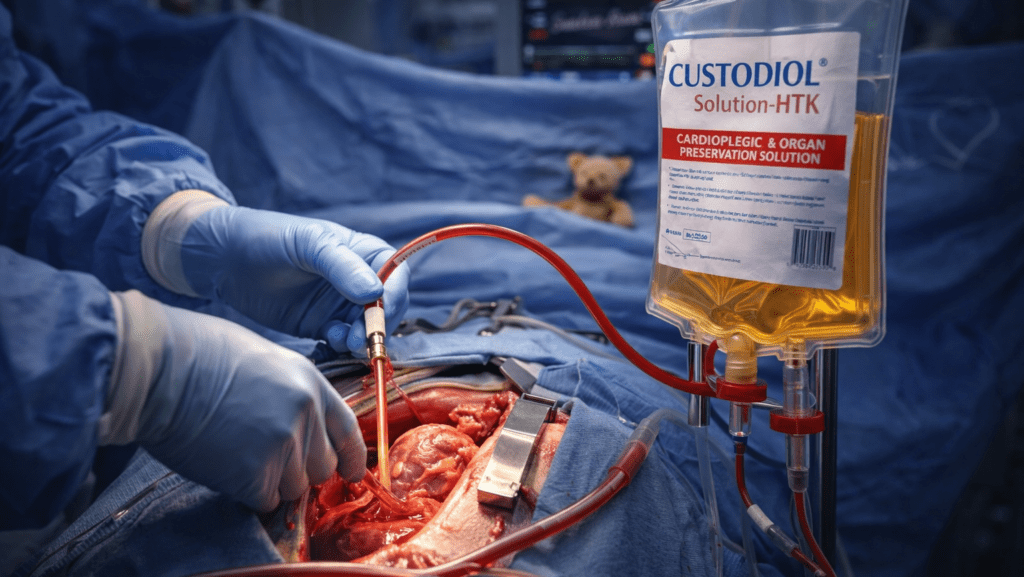
Myocardial protection remains one of the most critical determinants of success in cardiac surgery, particularly during prolonged ischemic periods associated with cardiopulmonary bypass and aortic cross-clamping. The article Custodial-HTK Cardioplegia in Conventional Cardiac Surgery: A Retrospective Analysis From UiTM presents an institutional experience evaluating the clinical performance of Custodial-HTK solution compared with traditional blood cardioplegia in a real-world tertiary cardiac surgery setting in Malaysia.
The study addresses a clinically relevant question: whether Custodial-HTK, a single-dose crystalloid cardioplegia originally developed for organ preservation, can provide myocardial protection comparable to blood cardioplegia in patients undergoing complex or high-risk cardiac procedures. This is especially important for smaller or resource-limited cardiac centers, where prolonged operations and reduced access to advanced mechanical circulatory support systems can increase perioperative risk.
The investigators conducted a retrospective observational cohort study involving 79 elective patients who underwent conventional on-pump, cross-clamp cardiac surgery at Universiti Teknologi MARA (UiTM) between August 2022 and July 2023. Emergency cases, off-pump surgeries, on-pump beating heart procedures, and patients with incomplete records were excluded. Of the included cohort, 10 patients received Custodial-HTK cardioplegia, while 69 received standard blood cardioplegia. The choice of cardioplegia was not randomized but rather determined collaboratively by the surgeon, perfusionist, and anesthesiologist, with Custodial-HTK preferentially selected for patients with impaired left ventricular ejection fraction (LVEF <40%) or those undergoing complex procedures involving multiple concomitant interventions.
Baseline characteristics revealed that patients in the Custodial-HTK group were generally higher risk. They demonstrated significantly lower mean LVEF and a markedly higher proportion of patients with impaired ventricular function. Pre-induction intra-aortic balloon pump (IABP) use was also significantly more common in this group, reflecting poorer baseline hemodynamics. Although the Custodial-HTK cohort had a higher mean EuroSCORE II, this difference did not reach statistical significance. Importantly, other comorbidities such as diabetes, hypertension, renal disease, prior stroke, and smoking history were comparable between groups, suggesting that the principal differences were related to cardiac function and surgical complexity rather than systemic illness burden.
Intraoperative findings aligned with institutional selection practices. Patients receiving Custodial-HTK were far more likely to undergo complex procedures such as combined coronary artery bypass grafting (CABG) with valve surgery or double-valve interventions. Consequently, cardiopulmonary bypass and aortic cross-clamp times were significantly longer in the Custodial-HTK group. These prolonged ischemic durations underscore why a single-dose cardioplegia strategy with extended myocardial protection could be advantageous in this subset of patients.
Despite these clear differences in operative complexity and baseline cardiac risk, postoperative outcomes were notably similar between the two groups. The primary endpoint of 30-day mortality showed no statistically significant difference, with both groups demonstrating comparable early survival rates. Secondary outcomes, including ICU length of stay and total hospital stay, were also similar. Although the Custodial-HTK group exhibited numerically higher rates of postoperative arrhythmias, renal dysfunction, pulmonary complications, transaminitis, and new-onset heart failure, none of these differences achieved statistical significance.
From a mechanistic standpoint, the findings are biologically plausible. Custodial-HTK is an intracellular-type cardioplegic solution characterized by low sodium and calcium concentrations, inducing diastolic arrest through membrane hyperpolarization rather than potassium-mediated depolarization. Its formulation includes histidine for buffering acidosis, tryptophan for membrane stabilization, ketoglutarate as a metabolic substrate to support ATP regeneration, and mannitol to reduce cellular edema and oxidative stress. Collectively, these properties allow prolonged myocardial protection—often up to two hours—with a single dose, minimizing the need for repeated cardioplegia administration and reducing intraoperative interruptions.
The authors appropriately acknowledge several limitations. The small sample size of the Custodial-HTK group limits statistical power and precludes robust subgroup analyses. The retrospective design also restricts causal inference and introduces potential selection bias, as higher-risk patients were more likely to receive Custodial-HTK. Propensity score matching was not feasible due to the imbalance in group sizes and baseline characteristics. Cost considerations were also noted, as Custodial-HTK is substantially more expensive than conventional blood cardioplegia, which may limit its broader adoption in resource-constrained environments.
Nevertheless, the study contributes valuable institutional data supporting the feasibility and safety of Custodial-HTK cardioplegia in complex cardiac surgery. The comparable postoperative outcomes observed—even in patients with poorer baseline ventricular function and longer ischemic times—suggest that Custodial-HTK is a viable myocardial protection strategy when used selectively. The authors rightly call for larger, prospective randomized controlled trials to better define its optimal role and cost-effectiveness in contemporary cardiac surgical practice.
In summary, this analysis reinforces the concept that myocardial protection strategies should be individualized based on patient risk profile and procedural complexity. Within this context, Custodial-HTK emerges as a safe and effective alternative to blood cardioplegia for selected high-risk cardiac surgery patients.