Extracorporeal membrane oxygenation (ECMO) is a life-saving therapy used in severe cardiopulmonary failure, yet it remains one of the most complex technologies in critical care. High-quality training is essential to prevent complications and improve outcomes, but traditional ECMO simulation programs are expensive, labor-intensive, and often inaccessible. In this innovative multicentre study involving 335 patients, researchers developed a high-resolution ECMO digital twin powered by artificial intelligence (AI) and deployed it in a real-time virtual reality (VR) simulation environment .
The study integrated ECMO device logs with electronic health record (EHR) data from two major European centres between 2020 and 2025. Over 250 million data points were collected, including pump speed (RPM), flow, arterial and venous pressures, inlet pressure, oxygen saturation, heart rate, blood pressure, respiratory rate, and end-tidal CO₂. Continuous waveform data sampled at 25 Hz were synchronized and resampled to 30-second intervals to align with ECMO machine data. This high-frequency data integration enabled unprecedented modeling of ECMO–patient mechano-physiological interactions.
The researchers designed a hierarchical two-stage predictive modeling pipeline. Model 1 predicted ECMO circuit outputs—such as blood flow and line pressures—based on machine settings (RPM, sweep gas flow) and cannula sizes. Model 2 then used these predicted circuit outputs along with patient features to forecast vital sign responses, including diastolic blood pressure, heart rate, oxygen saturation, respiratory rate, and end-tidal CO₂ .
Neural networks with three hidden layers (8–16 nodes, ReLU activation) demonstrated superior performance compared to linear regression baselines. For Model 1, inclusion of cannula size improved flow prediction accuracy (RMSE 0.32 LPM, R² 0.57). Model 2 achieved clinically acceptable prediction errors, including RMSE values of 15.23 mmHg for blood pressure, 19.50 BPM for heart rate, 2.94% for oxygen saturation, and 1.42 mmHg for end-tidal CO₂ .
One major challenge addressed in the study was data imbalance across RPM values, as extreme settings occur less frequently in clinical practice. The authors implemented RPM binning, resampling strategies, and targeted synthetic data augmentation at low RPM values to improve performance during rare disaster scenarios such as pump failure. Expert validation confirmed that simulated physiological responses in extreme conditions were clinically plausible.
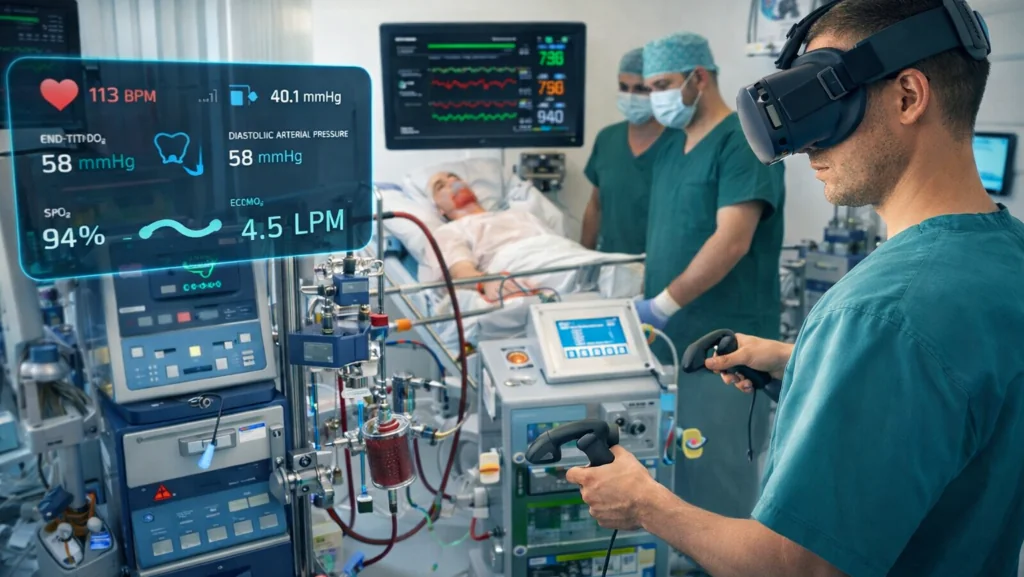
Crucially, the AI models were exported using the Open Neural Network Exchange (ONNX) format and embedded directly into an Unreal Engine–based VR platform. By optimizing model size and computational efficiency, the team achieved real-time inference with latency consistently below 100 milliseconds on Android-based VR headsets. This eliminated the need for external servers and allowed seamless scenario switching during simulation .
Twenty-one ECMO-experienced clinicians—including intensivists, perfusionists, and residents—participated in VR evaluation. The results were encouraging:
- 86% agreed ECMO flow responded realistically to pump speed changes.
- 81% found heart rate and oxygen saturation responses plausible.
- 76% rated arterial blood pressure responses as realistic.
- 81% felt integration of circuit and monitor data supported clinical decision-making .
The study followed TRIPOD+AI reporting standards, and patient-level train-test splitting ensured prevention of data leakage. Cross-validation demonstrated consistent performance across folds, reinforcing model robustness.
Importantly, this digital twin approach differs from traditional mechanistic ECMO models, which rely on lumped-parameter or rule-based physiology simulations. Those models often lack full clinical validation and may struggle to replicate extreme scenarios. By contrast, this AI-driven digital twin learns directly from real-world high-resolution patient data, allowing dynamic adaptation to user input within a VR training environment.
Limitations include lack of direct measures of ventricular ejection fraction, limited external validation beyond two centres, and computational constraints inherent to VR headsets. The authors propose future expansion through federated learning across international ECMO centres, incorporation of continuous waveform data and ventilator parameters, and hybrid physics-AI modeling approaches.
Overall, this study establishes a scalable, reproducible pathway from ICU bedside data to immersive VR ECMO simulation. By combining artificial intelligence, digital twin methodology, and virtual reality, the researchers have created a high-fidelity training ecosystem that may democratize access to advanced ECMO education worldwide. The framework also lays the groundwork for broader critical-care digital twin platforms capable of simulating complex cardiopulmonary support systems.