Platelet-rich plasma (PRP) preparation systems are expected to deliver a predictable concentration of platelets, but cardiac surgical patients do not always resemble healthy blood donors used in device evaluations. A prospective randomized study from Franciscan Health Indianapolis examined whether two commonly used systems could achieve a sixfold increase over baseline under routine cardiac surgery conditions.
The Angel and Magellan systems both exceeded that target on average. Individual results were more variable: 30% of Magellan preparations and 33% of Angel preparations did not reach six times baseline. The distinction between a satisfactory group average and consistent performance in each preparation is the central practical finding.
Study Design and Preparation Protocol
Garrison and colleagues collected data from 60 adult cardiac surgery cases involving three surgeons between May and September 2024. Thirty cases were assigned to the Magellan Autologous Concentration System and 30 to the Angel cPRP System. Device allocation used a coin toss, and laboratory personnel measuring platelet counts were blinded to the preparation system.
Participants were at least 18 years old, weighed more than 50 kg, and underwent coronary bypass, valve surgery, or combined procedures. Emergency cases, pregnancy, and cases with a processing volume below 180 mL were excluded. The investigation therefore evaluates a defined adult surgical workflow rather than all possible applications of these devices.
For each case, three syringes each contained 52 mL of patient blood and 8 mL of anticoagulant citrate dextrose solution-A. The total processing volume was 180 mL, comprising 156 mL of blood and 24 mL of anticoagulant. Baseline platelet counts were measured from this anticoagulated starting material.
The investigators used the Angel 7% hematocrit protocol and the Magellan 6-mL volume protocol to prepare a final 18-mL PRP product targeting six times the starting platelet concentration. Magellan output was pooled from three 6-mL preparations. Angel output was brought to 18 mL with platelet-poor plasma. Samples were mixed before laboratory analysis with a Beckman Coulter DxH 900 analyzer.
Key Results
| Measure | Magellan | Angel |
|---|---|---|
| Preparations evaluated | 30 | 30 |
| Mean concentration multiple ± SD | 6.58 ± 1.33 | 6.31 ± 0.93 |
| Median concentration multiple | 6.74 | 6.11 |
| Observed range | 4.03–9.76 times baseline | 4.42–8.22 times baseline |
| Below the sixfold target | 9/30 (30%) | 10/30 (33%) |
| Starting platelet count below 150,000/µL | 11/30 (36.7%) | 11/30 (36.7%) |
Concentration multiples are dimensionless ratios of post-processing to pre-processing platelet counts. They are not absolute platelet concentrations or percentages of platelet recovery.
Average yield and individual reliability
The mean concentration multiples did not differ significantly between devices (P=.35). Magellan had a numerically wider range and higher standard deviation, but the reported variance comparison was also not statistically significant. These findings do not establish that one system is more accurate or more consistent than the other.
Both group averages were above sixfold, yet 19 of the 60 individual preparations fell below the target. A device can therefore deliver an acceptable average while individual products vary meaningfully. Conversely, exceeding sixfold should not automatically be interpreted as a better clinical product: this study did not test an optimal therapeutic platelet concentration.
Lower starting counts and absolute concentration
Eleven preparations in each arm began with platelet counts below 150,000/µL. Within those subsets, three preparations per device failed to achieve the sixfold target. These small descriptive subgroups do not establish whether a lower starting count independently predicts performance.
The authors also report that 46.7% of all preparations reached an absolute concentration of at least one million platelets per microliter. This illustrates why fold enrichment and absolute concentration answer different questions. A sixfold increase from a relatively low baseline can still produce a lower final concentration than a smaller fold increase from a higher baseline.
What the Study Does—and Does Not—Show
This investigation evaluates platelet concentration in the prepared product. It does not measure platelet function, growth-factor release, total platelet recovery efficiency, or the broader cellular composition of PRP. Nor does it compare sternal wound infection, pain, healing, or other patient outcomes between devices.
Although the paper discusses previous clinical literature on topical PRP, its own results should not be presented as evidence that either device improves wound healing or prevents infection. Similarly, a nonsignificant difference between two small groups is not a formal demonstration of equivalence.
Relevance to Perfusion Practice
For perfusion teams preparing PRP, the study supports attention to the actual product obtained rather than relying solely on a programmed target. The relevant quality measures include starting concentration, final concentration, final volume, and the resulting fold enrichment. Consistent sampling and mixing matter when interpreting those measurements.
The results apply to the specific device settings, input volume, and final-volume preparation described. Different protocols or patient populations may produce different results. The study offers useful local performance data, but it does not establish a universal acceptance threshold for PRP or a preferred device.
Limitations and Evidence Assessment
The randomized allocation and blinded laboratory analysis strengthen this comparison. However, it was a single-center study with only 30 cases per device and one concentration target. There was no patient-outcome assessment and no formal equivalence design. The authors reported no research funding and no conflicts of interest.
The most defensible conclusion is that both systems achieved the sixfold target on average in this adult cardiac surgery workflow, with appreciable preparation-to-preparation variability. Broader testing across centers, settings, and targets would help determine how reliably those findings translate into other perfusion programs.
Source and Attribution
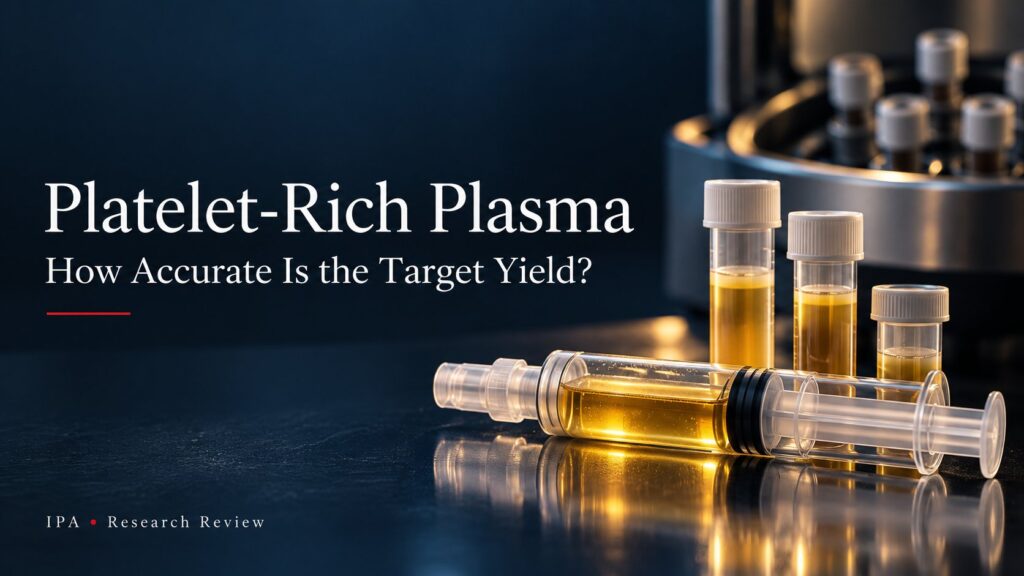
This original IPA educational summary is adapted from the open-access article by Garrison and colleagues under the Creative Commons Attribution 4.0 license. Wording and presentation have been adapted. The cover is a conceptual illustration.
Original Article
Garrison L, Nicks D, Nicks S, Green J, Pham H, Wysocki S. Evaluation of accuracy of platelet rich plasma preparation devices for cardiac surgery: A prospective, randomized, single blinded study. Journal of ExtraCorporeal Technology. 2026;58:124–127. doi:10.1051/ject/2026004.