
Cardiogenic shock remains one of the most dangerous emergencies in cardiovascular medicine because it reflects a state of profound circulatory failure caused by inadequate cardiac function and rapidly leads to end-organ hypoperfusion. In this 2026 mini review, Siopi and colleagues provide a contemporary comparison of the most widely used temporary mechanical circulatory support devices in cardiogenic shock: intra-aortic balloon pump (IABP), Impella, and venoarterial extracorporeal life support (VA-ECLS). The article is designed as a practical, clinician-facing review and focuses not only on the devices themselves, but also on how to choose among them, when to escalate support, when to de-escalate, and how to think about antithrombotic therapy in these highly unstable patients.
The authors begin by framing cardiogenic shock as a heterogeneous syndrome that can arise from left ventricular, right ventricular, or biventricular failure. They note the importance of the Society for Cardiovascular Angiography and Interventions (SCAI) staging system, which helps classify shock severity from early risk through extremis. This staging matters because device selection should not be driven by habit alone; it should match the clinical phenotype, severity, and pace of deterioration. The review highlights the major forms of shock encountered in practice, especially acute myocardial infarction-related cardiogenic shock, heart failure-related cardiogenic shock, and post-cardiotomy shock.
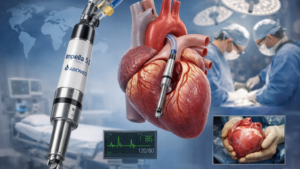
A central focus of the paper is Impella, described as a microaxial catheter-mounted pump that can provide temporary left- or right-sided circulatory support. The review explains that left-sided Impella devices unload the left ventricle, reduce end-diastolic pressure and volume, lessen venous congestion, and increase cardiac output and mean arterial pressure. The authors present Impella as an increasingly important first-line option, especially in infarct-related shock, citing the DanGer Shock trial as a pivotal study supporting survival benefit despite higher rates of bleeding, hemolysis, dialysis, and limb ischemia. The article also discusses contraindications, including valvular disease, anatomical limitations, mechanical valves, severe peripheral vascular disease, and structural defects that may complicate placement or function. Overall, the review portrays Impella as effective and relatively easy to implant, though cost, hemolysis, and shorter support duration remain important drawbacks.
The paper then turns to VA-ECLS, which provides both circulatory and respiratory support and is especially valuable in severe or refractory shock, including patients with cardiorespiratory collapse or biventricular failure. The authors explain that VA-ECLS offers high flow support and can be lifesaving in advanced SCAI stage D or E shock. At the same time, they emphasize one of its most important physiologic limitations: retrograde aortic flow may increase left ventricular afterload, worsen ventricular distention, raise filling pressures, and contribute to pulmonary edema. This is why left ventricular unloading or venting becomes a major issue during VA-ECLS support. The review discusses noninvasive and invasive venting approaches and examines combined strategies such as ECPELLA, where VA-ECLS is paired with Impella for additional unloading. On page 4, the comparative table summarizes VA-ECLS as the highest-flow option with prolonged support potential, but also the most invasive, technically demanding, and complication-prone device of the three.
IABP receives a more cautious appraisal. The review explains that the balloon inflates in diastole and deflates in systole, thereby improving coronary perfusion and reducing afterload. It is simpler, cheaper, and easier to insert and remove than Impella or VA-ECLS. However, the authors stress that randomized trial data, especially from IABP-SHOCK II, have largely discouraged routine IABP use in more severe infarct-related cardiogenic shock. Even so, they identify situations where IABP may still be reasonable, particularly in non-ischemic shock, milder SCAI stage C presentations, acute decompensated chronic heart failure, severe mitral regurgitation, or as a bridge strategy when the goal is to stabilize a patient without moving immediately to more invasive support.
One of the most useful parts of the article is its operational guidance. On pages 4 and 5, the paper includes flowchart-style algorithms for heart failure-related shock, acute myocardial infarction-related shock, post-cardiotomy shock, and right heart failure evolving while on support. These diagrams emphasize that mechanical support is not static. Patients must be reassessed frequently, generally every 6 to 12 hours, with close attention to hemodynamics, filling pressures, pulmonary congestion, metabolic markers, end-organ function, and ongoing need for vasoactive therapy. Escalation is favored when instability persists despite current support, when inotrope or vasopressor needs remain high, or when ventricular failure progresses. De-escalation is considered only after hemodynamic stability is restored, end-organ function improves, and the underlying cause has been adequately treated.
The review also addresses antithrombotic management, an area that remains unsettled in temporary mechanical circulatory support. The authors explain that cardiogenic shock itself alters drug absorption and physiology, while implanted cannulas increase both thrombotic and bleeding risk. For that reason, unfractionated heparin is presented as the default anticoagulant, with bivalirudin or argatroban as alternatives. The discussion is practical and acknowledges how complex these choices become in patients with recent PCI, renal dysfunction, or significant hemorrhagic risk.
In their conclusion, the authors argue that no single device is best for every patient. Instead, success depends on early recognition, timely initiation, careful patient selection, repeated reassessment, and readiness to escalate or de-escalate based on physiology rather than routine. They also identify future priorities, including stronger comparative trials, better shock networks and transfer systems, refined prognostic scoring, and more standardized protocols for anticoagulation, transfusion, and device timing. As a mini review rather than a formal systematic review or original study, the paper’s main strength lies in translating a broad evidence base into practical bedside decision-making. For clinicians managing cardiogenic shock, it offers a concise but highly actionable roadmap.