A one-day ECMO workshop can bring clinicians together to practise circuit troubleshooting, rehearse emergencies, and develop a shared approach to bedside care. A retrospective service evaluation from St Vincent’s Hospital Sydney examined how participants rated their own knowledge, confidence, and skills before and immediately after this type of interdisciplinary training.
Across 20 workshops, 275 matched evaluations showed improvements in all five assessed domains. The largest gains involved confidence during ECMO emergencies and self-rated circuit-management skills. These are encouraging educational findings, but they measure participants’ perceptions—not independently assessed competence, retained learning, or patient outcomes.
Study Design and Participants
Whittam and colleagues analysed routinely collected evaluation data from workshops delivered between 2014 and 2019 at an adult quaternary hospital in Australia. Although the paper was published in 2026, the training and survey data predate the COVID-19 pandemic.
The analysis included 184 registered nurses, 85 medical officers, three perfusionists, and three physiotherapists. Approximately 65% classified themselves at the lowest baseline ECMO proficiency level. The reported survey response rate was 99%, providing a substantial set of paired responses from a predominantly novice cohort.
Participants rated five domains on nine-point scales, with one representing the lowest and nine the highest level. Surveys were completed immediately before and after the workshop. There was no control group, and the evaluation did not include an objective examination or a blinded assessment of simulated performance.
What the Workshop Included
The eight-hour programme combined theory, hands-on circuit work, and realistic team scenarios. An eight-member interdisciplinary faculty included ICU clinicians and educators, perfusionists, and simulation staff. A typical group of 14 participants divided into two smaller groups for circuit practice.
From principles to practical circuit work
Initial teaching covered VV- and VA-ECMO principles, patient selection, configurations, anticoagulation, monitoring, weaning, and complications. Participants then handled training circuits, traced flow pathways, and practised troubleshooting under faculty supervision. Examples included access or volume insufficiency, air management, and hand-cranking.
A dedicated cannulation session used a mannequin and a primed training circuit to rehearse urgent VA-ECMO cannulation and team roles. The workshop also included extended scenarios addressing problems such as hypoxaemia on VV-ECMO, severe access insufficiency, and pump failure.
Debriefing and teamwork
Structured debriefing explored both technical decisions and communication, leadership, and situational awareness. Participants could learn by observing as well as directly taking part. This design made the workshop more than an equipment demonstration: it provided opportunities to discuss how different professional groups interpret and respond to the same event.
Immediate Self-Reported Results
| Domain | Before | After | Mean change (95% CI) |
|---|---|---|---|
| VV-ECMO knowledge | 3.63 | 6.59 | +2.95 (2.78–3.12) |
| VA-ECMO knowledge | 3.44 | 6.41 | +2.97 (2.80–3.14) |
| Confidence in routine ECMO care | 3.24 | 6.31 | +3.07 (2.88–3.25) |
| Confidence in ECMO emergencies | 2.42 | 6.09 | +3.68 (3.49–3.87) |
| Self-rated circuit-management skills | 2.41 | 6.10 | +3.69 (3.50–3.89) |
Mean self-ratings on a 1–9 scale; n=275 paired evaluations per domain. All within-group changes had P<.001. Changes are reproduced as reported and may differ slightly from subtraction of the rounded means.
Registered nurses generally reported the largest improvements across most domains. However, differences in prior experience and professional responsibilities were not measured sufficiently to explain those findings. With only three perfusionists and three physiotherapists, estimates for those professions are too imprecise to support broad conclusions about comparative benefit.
Free-text feedback reinforced the value of hands-on practice, realistic scenarios, supportive interdisciplinary faculty, and the workshop’s overall structure. These comments support acceptability and perceived usefulness, while remaining participant-reported observations.
Relevance to Perfusion and ECMO Education
The workshop offers a practical example of how perfusion expertise can be integrated into team education. Perfusionists helped with circuit training, simulation delivery, and troubleshooting. Those contributions are relevant even though very few perfusionists were included as learners in the evaluation.
For education leaders, the model links three complementary activities: explaining principles, practising equipment tasks, and rehearsing coordinated responses. Debriefing allows teams to discuss why an action was taken and how responsibilities should be shared. The authors support including such workshops within local credentialing and continuing education pathways alongside supervised clinical practice.
The study does not show that one workshop is sufficient for independent ECMO practice. It also cannot identify which component caused the reported improvement, because all participants experienced the combined programme. Objective assessments and later follow-up would be needed to establish skill acquisition, retention, and transfer to clinical care.
Limitations and Evidence Assessment
The evaluation’s strengths include its 275 paired responses, consistent programme structure, and experience across multiple workshops. Its central limitation is reliance on self-report. Enthusiasm after training, social desirability, and the evaluation setting may influence responses. A high response rate reduces missing feedback but does not remove those biases.
The single-group design cannot separate workshop effects from prior ECMO exposure, other learning, or repeated attendance. Demographic information was limited, no longer-term reassessment was performed, and no patient-centred outcomes were measured. Findings from a well-resourced adult quaternary centre may not transfer directly to other services.
The results support the workshop’s perceived educational value and provide a useful programme example. They should be described as immediate gains in self-rated readiness rather than proof of clinical mastery or improved patient safety.
Source
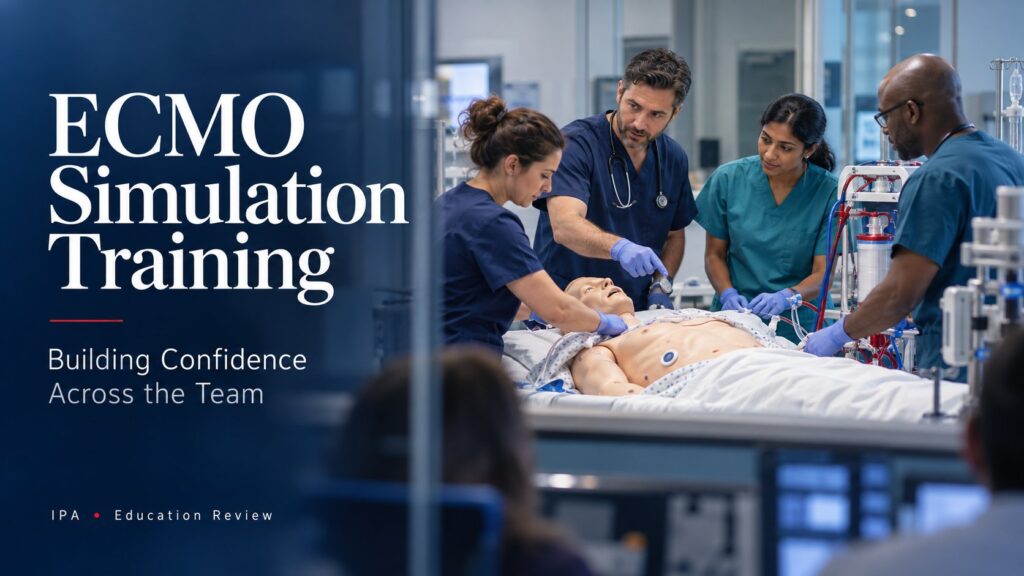
This IPA article is an original educational summary of the service evaluation by Whittam and colleagues. The cover is a conceptual simulation-training illustration. The original paper provides the full methodology, analyses, and supporting discussion.
Original Article
Whittam S, Breeding J, Causby B, et al. Clinicians’ Knowledge, Confidence and Skills: A Retrospective Evaluation of an Interdisciplinary Extracorporeal Membrane Oxygenation Simulation Workshop. Nursing in Critical Care. 2026;31:e70578. doi:10.1111/nicc.70578.