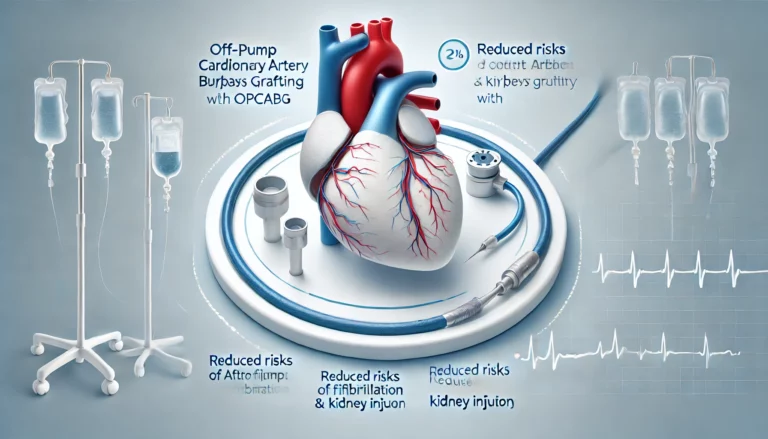

Off Pump CABG

The Value of Off-Pump Coronary Artery Bypass Grafting in Surgery for Combined Valvular and Coronary Heart Disease

This study explores the benefits of off-pump coronary artery bypass grafting (OPCABG) in surgeries combining valve and coronary interventions. Among 884 patients, the OPCABG group showed reduced incidences of postoperative atrial fibrillation (29.5% vs. 39.5%) and acute kidney injury (14.5% vs. 21.2%) compared to on-pump CABG. No differences in mortality or stroke rates were observed. The results suggest OPCABG is a safe and effective approach for improved short-term outcomes in complex cardiac surgeries.

Read More »
Cardioplegia 2024

Gradual Reperfusion in Cardioplegia-Induced Cardiac Arrest

This study explores the potential benefits of gradual reperfusion in cardiac surgery patients experiencing cardioplegia-induced cardiac arrest, aiming to reduce ischemia-reperfusion injury. Fifty elective cardiac surgery patients were randomized into two groups: a hyperoxemic control group with conventional reoxygenation and a normoxemic study group with gradual reoxygenation. Results showed that gradual reperfusion was safe but did not significantly reduce ischemia-reperfusion injury compared to standard methods, although potassium levels were lower in the normoxemic group.

Read More »
CABG A-FIB

Risk Factors of Postoperative Atrial Fibrillation After Isolated Coronary Artery Bypass Grafting Surgery in the Recent 10 Years: Clinical Analysis of 6229 Patients

This retrospective study analyzed 6,229 patients who underwent isolated coronary artery bypass grafting (CABG) from 2015 to 2023 to determine the risk factors for postoperative atrial fibrillation (POAF). The incidence of POAF was 30.94%. Univariate analysis revealed factors such as age, hypertension, smoking, CPB time, and ejection fraction (EF) as significant. Multivariate analysis identified older age and low EF as independent risk factors for POAF.

Read More »
AKI 2024

Factors Associated with Acute Kidney Injury After On-Pump Coronary Artery Bypass Grafting

Acute kidney injury (AKI) is a common complication following cardiac surgeries like coronary artery bypass grafting (CABG). This study analyzed 120 patients to identify risk factors for AKI, which occurred in 26% of the cases. Findings showed that patients with higher EuroSCORE II values, elevated creatinine and urea levels, lower hemoglobin, and reduced oxygen delivery during cardiopulmonary bypass (CPB) were more likely to develop AKI. AKI was also linked to longer hospital stays.

Read More »
OPCABG 2024

On-Pump or Off-Pump Impact of Diabetic Patients Undergoing Coronary Artery Bypass Grafting: 5-Year Clinical Outcomes

This study evaluates the long-term outcomes of on-pump vs. off-pump coronary artery bypass grafting (CABG) in diabetic patients. A retrospective review of 1,269 patients found that off-pump CABG was associated with a lower 5-year all-cause death rate (4.23% vs. 5.95%) and reduced risks of postoperative stroke and atrial fibrillation. These results suggest potential advantages for diabetic patients undergoing off-pump CABG procedures.

Read More »
CABG Block

In-Hospital Graft Occlusion in Post-Coronary Artery Bypass Grafting Patients in the Early Postoperative Period: A Systematic Review and Meta-Analysis

This study evaluates the incidence and risk factors of early in-hospital graft occlusion in post-coronary artery bypass grafting (CABG) patients. The meta-analysis, including 22 studies with 35,798 patients, found a 5% occlusion rate. The rate varied based on symptom-driven or systematic graft patency assessments. Vein graft presence, female gender, and other factors like composite grafts may increase the risk of early occlusion.

Read More »
Surgery in Progress

New Approach to the Mitral Valve Through the Left Anterior Minithoracotomy for Combined Valve and Coronary Surgical Procedures

A new technique for accessing the mitral valve via the left anterior minithoracotomy has been developed for patients requiring both mitral valve surgery and coronary artery bypass grafting. From October 2020 to September 2022, 24 patients underwent this procedure, which involved specialized exposure maneuvers and conventional surgical techniques. The approach proved successful with no need for conversion to sternotomy, no major complications, and no mortality within 30 days post-procedure.

Read More »
Myocardial Injury

Hybrid Feature Selection in a Machine Learning Predictive Model for Perioperative Myocardial Injury in Noncoronary Cardiac Surgery with Cardiopulmonary Bypass

This study developed a predictive model for perioperative myocardial injury (PMI) using hybrid feature selection (FS) methods in patients undergoing noncoronary cardiac surgery with cardiopulmonary bypass (CPB). Conducted at Fuwai Hospital, China, the retrospective study included 1130 patients, with an overall PMI incidence of 20.3%. Various machine learning models were evaluated, with the Naïve Bayes model achieving the highest AUC. The study highlighted the importance of factors like prolonged CPB, aortic clamp time, and preoperative low platelet count in predicting PMI risk.

Read More »
Revasculatization

Hybrid Total Arterial Minimally Invasive Off-Pump Coronary Revascularization and Percutaneous Coronary Intervention Strategy for Multivessel Coronary Artery Disease: A Cohort Study with a Median 11-Year Follow-Up

This study examines hybrid coronary revascularization (HCR), a treatment combining minimally invasive coronary artery bypass grafting (CABG) with percutaneous coronary intervention (PCI) for multivessel coronary artery disease (MV CAD). It involved 138 patients who underwent either MIDCAB or MICS-CABG, with a median follow-up of 11 years. Results showed a 36.7% incidence of major adverse cardiac and cerebral events (MACCE) and a higher mean survival rate for those completing hybrid treatment. The study supports HCR as a safe and effective option, highlighting the need for organized PCI steps post-surgery.

Read More »