
Southpark Kenny

Leveraging the Perfusionist-Surgeon Dyad to Improve the Culture of Safety

This article describes how a cardiac surgery program at Massachusetts General Hospital transformed its operating room culture by leveraging the unique perfusionist-surgeon relationship. By promoting psychological safety, challenging hierarchical assumptions, and implementing structured guidelines, checklists, and multidisciplinary briefings, the team improved communication, recruitment, teamwork, and resilience. The initiative demonstrates how deliberate cultural change enhances safety and performance.

Read More »
Advanced Heart Failure Care Settings

Outcomes of Heart Failure Hospitalizations at Urban Teaching vs. Non-Teaching Hospitals: A Nationwide Propensity Score Matched Analysis in the United States

This nationwide propensity-matched study of 7.5 million U.S. heart failure hospitalizations (2016–2022) found that urban teaching hospitals had higher inpatient mortality, complication rates, length of stay, costs, and palliative care consultations compared with urban non-teaching hospitals. Despite worse in-hospital outcomes, 30- and 90-day readmission rates were similar. Findings likely reflect referral bias and greater illness severity at teaching centers rather than differences in care quality.

Read More »
National Matching Service for Perfusion Education Program Applicants

The Feasibility of a National Matching Service for Perfusion Education Program Applicants

As the demand for perfusion education programs (PEPs) grows, many qualified applicants struggle to secure spots due to inconsistent admission processes. This study examines the potential benefits of implementing a national matching service (NMS) for PEP applicants, similar to medical residency matches. By standardizing timelines, eliminating unfair practices, and ensuring efficient applicant-program matching, an NMS could enhance the recruitment process and support the growing need for perfusionists.

Read More »
Development and Validation of a Checklist for Cardiopulmonary Bypass

Development and Validation of a Checklist for Cardiopulmonary Bypass

This study focuses on developing and validating a checklist for cardiopulmonary bypass (CPB) to enhance patient safety and reduce adverse events. Using the Delphi method, five expert perfusionists refined an initial 42-item checklist down to 41 crucial elements. The final checklist standardizes CPB procedures, ensuring systematic verification of equipment and protocols. The study highlights the importance of structured guidelines in improving surgical outcomes and preventing errors.

Read More »
Outcomes in Children Who Undergo Postcardiotomy Extracorporeal Membrane Oxygenation

Outcomes in Children Who Undergo Postcardiotomy Extracorporeal Membrane Oxygenation: A Report From the STS-CHSD

This study evaluates survival outcomes in children who undergo postcardiotomy extracorporeal membrane oxygenation (ECMO) following congenital heart surgery. Using data from the Society of Thoracic Surgeons Congenital Heart Surgery Database (STS-CHSD), the study found that ECMO initiation over 48 hours post-surgery correlated with the poorest outcomes. Postoperative septicemia, cardiac arrest, and neurological injury were strongly linked to mortality, while reintubation and unplanned noncardiac reoperation improved survival.

Read More »
Surgery vs. PCI

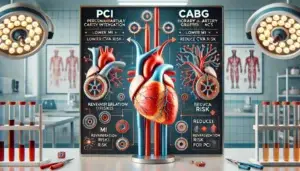
Comparing Percutaneous Coronary Intervention and Coronary Artery Bypass Grafting in Non-ST-Segment Elevation Acute Coronary Syndromes: A Systematic Review and Meta-Analysis

This systematic review and meta-analysis compared percutaneous coronary intervention (PCI) and coronary artery bypass grafting (CABG) for treating non-ST-segment elevation acute coronary syndromes (NSTE-ACS). Analyzing data from 15 studies with 48,891 patients, results showed no significant mortality difference between PCI and CABG. However, CABG reduced the risk of myocardial infarction (RR = 0.56) and repeat revascularization (RR = 2.94), while PCI was associated with a lower risk of cerebrovascular accidents (RR = 0.58). These findings emphasize individualized treatment strategies based on patient-specific risk profiles.

Read More »
VA ECMO

A Comparative Study of Femoral Artery and Combined Femoral and Axillary Artery Cannulation in Veno-Arterial Extracorporeal Membrane Oxygenation Patients

This study investigates the clinical outcomes of two cannulation strategies—femoral artery (FA) cannulation and combined femoral and axillary artery (FA+AA) cannulation—in patients receiving veno-arterial extracorporeal membrane oxygenation (VA-ECMO) after cardiac surgery. The FA+AA group showed significant benefits in reducing chronic renal failure, platelet drop, and creatinine levels. Despite similar 30-day mortality rates, the combined approach led to fewer complications and faster recovery.

Read More »
Perform Report

Perfusion Measures and Outcomes (PERForm) Registry: First Annual Report

The first annual report of the Perfusion Measures and Outcomes (PERForm) registry details patient characteristics and cardiopulmonary bypass (CPB) practices from 2019 to 2022 across 42 hospitals. Covering data from 40,777 adult patients, the report highlights trends in myocardial protection, glucose, anticoagulation, temperature, anemia, and fluid management. Key findings include the stability of hematocrit levels and increased pump sucker termination before protamine administration, indicating improved compliance with evidence-based guidelines but identifying areas for enhanced patient safety.

Read More »
Perfusion Learning

Adapting and Applying Student-Centered Learning in a Perfusion Clinical Rotation

This study outlines the transformation of perfusion clinical education from a teacher-centered to a student-centered model. By incorporating reflective practice, self-evaluation, and problem-based learning, the Mayo Clinic’s Perfusion Work Group aims to enhance the clinical training of student perfusionists. Changes include reversing student preceptor evaluations, biweekly student-led educational sessions, and establishing clear skill levels. These methods foster reflective practice, self-assessment, and evidence-based learning, ultimately promoting lifelong reflective perfusionists.

Read More »
Easy Flow Simulation

Easy Flow: An Eclectic Cardiopulmonary Bypass Simulation Model

The “Easy Flow Cardiopulmonary Bypass Simulation Model” offers a cost-effective, innovative approach to perfusion training using standard CPB equipment found in operating rooms. Unique features include double reservoirs and two pumps, enhancing skill development, team management, communication, and disaster response training. This model, requiring an instructor, turns theoretical knowledge into practical competence, making it accessible and beneficial for global healthcare education.

Read More »