
Comparing Myocardial Protection Strategies in Heart Transplantation

Long-Term Outcome of Myocardial Protection in Heart Transplantation: Comparison Among 3 Different Solutions 

This 20-year single-center study of 528 heart transplant recipients compared three preservation solutions: Celsior, HTK-Custodiol, and St Thomas. HTK-Custodiol was associated with a significantly higher rate of severe primary graft dysfunction (10.2% vs 4.5%), but long-term survival and rejection rates were similar across groups. Severe PGD, ischemic time, and donor/recipient age predicted late mortality. Authors advise caution with HTK-Custodiol.

Read More »
Emergency Repair of a Rupturing Ascending Aorta

Circulatory Arrest Time Above 30 Minutes Has Significantly Detrimental Effects on the Outcomes of Type A Aortic Dissection Repair

This retrospective study of 109 patients undergoing emergent type A aortic dissection repair found that deep hypothermic circulatory arrest (DHCA) times exceeding 30 minutes were associated with significantly higher 30-day mortality, 12-month mortality, and postoperative stroke rates. Cerebral perfusion strategy did not alter stroke risk. The findings suggest that limiting circulatory arrest to under 30 minutes may improve survival and neurological outcomes. 

Read More »
Heart Transplantation Graft Survival Following Donation

Heart Transplantation Graft Survival Following Donation After Circulatory Death via Thoracoabdominal Normothermic Regional Perfusion

This national cohort study analyzed adult heart transplants in the United States from 2020–2024 to compare graft survival among donation after circulatory death (DCD) using thoracoabdominal normothermic regional perfusion (TA-NRP), DCD with direct procurement and perfusion (DPP), and donation after brain death (DBD). Two-year graft and patient survival were comparable across groups, supporting broader use of TA-NRP in heart transplantation.

Read More »
Preoperative Anemia Management and Its Economic Impact on Red Blood Cell Transfusion in Cardiac Surgery

Predictors and Economic Impact of Red Blood Cell Transfusion in Cardiac Surgery: A Simulated Cost Reduction Model for Preoperative Anemia Management

This retrospective cohort study of 661 elective cardiac surgery patients identified preoperative anemia as the strongest independent predictor of red blood cell (RBC) transfusion (OR 3.67). Transfusion was associated with longer hospital stay, higher infection rates, prolonged ventilation, and a median cost increase of €2264 per patient. A simulation model estimated that eliminating preoperative anemia could prevent 47 transfusions and save €106 429 over 13 months.

Read More »
Intravenous Lidocaine Infusion During Cardiopulmonary Bypass Cardiac Surgery

Evaluation of the Effect of Intravenous Lidocaine on the Systemic Inflammatory Response Associated With Cardiopulmonary Bypass in Valvular and/or Coronary Cardiac Surgery: Protocol for a Double-Blind Randomized Clinical Trial

This single-center, double-blind randomized clinical trial (LEONARD Trial) evaluates whether intravenous lidocaine reduces systemic inflammation triggered by cardiopulmonary bypass in elective valvular and/or coronary cardiac surgery. Ninety patients will receive lidocaine or placebo, with IL-6 at 6 hours postoperatively as the primary endpoint. Secondary outcomes include inflammatory biomarkers, organ dysfunction, atrial fibrillation, ICU stay, opioid use, and 30-day mortality.

Read More »
Heparin CPB

Optimising Protamine Dosing for Heparin Reversal After Cardiopulmonary Bypass: A Population Pharmacokinetic—Pharmacodynamic Study

This prospective study of 68 cardiac surgery patients used pharmacometric modeling to determine optimal protamine dosing for reversing unfractionated heparin after cardiopulmonary bypass. Researchers found that a protamine-to-heparin ratio of 0.625:1 achieved complete reversal in 95% of patients, lower than the commonly used 1:1 ratio. The study also revealed that activated clotting time (ACT) unreliably reflects residual heparin, suggesting fixed low-ratio dosing may be a practical alternative requiring validation.

Read More »
Ultrafiltration 2024

Zero-Balance Ultrafiltration Reduces Postoperative Delirium After Cardiac Surgery with Cardiopulmonary Bypass: A Randomized Controlled Trial

This single-center randomized controlled trial evaluated whether adding zero-balance ultrafiltration (Z-BUF) to conventional ultrafiltration during cardiopulmonary bypass reduces postoperative delirium after cardiac surgery. Among 106 analyzed patients, Z-BUF significantly lowered delirium incidence within 7 postoperative days compared with conventional ultrafiltration alone, while no significant differences were observed in longer-term cognitive outcomes at 1 or 3 months.

Read More »
Precision and Protection: Advanced Myocardial Preservation in Complex Cardiac Surgery

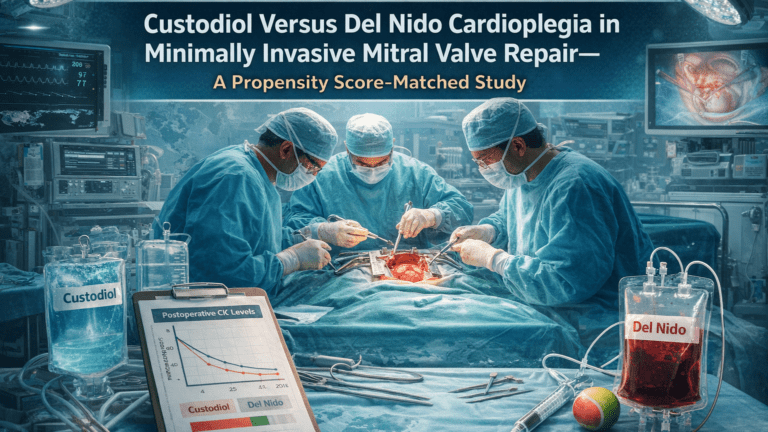
Custodial-HTK Cardioplegia in Conventional Cardiac Surgery: A Retrospective Analysis From UiTM

This retrospective cohort study from a Malaysian tertiary cardiac center compares Custodial-HTK cardioplegia with conventional blood cardioplegia in elective on-pump cardiac surgery. Although Custodial-HTK was preferentially used in higher-risk and more complex cases with lower baseline LVEF and longer bypass times, postoperative outcomes, ICU stay, hospital stay, and 30-day mortality were comparable, supporting its safety and effectiveness.

Read More »
Global Teamwork in Modern Myocardial Protection: Alternative Base Solutions for del Nido Cardioplegia

Alternative Base Solutions for del Nido Cardioplegia: Composition, Rationale, and Clinical Evidence

This comprehensive review examines alternative crystalloid and whole-blood base solutions for del Nido cardioplegia, including normal saline, lactated Ringer’s, plain Ringer’s, Isolyte S, Ionosteril, and whole blood. Drawing on experimental models, randomized trials, and clinical studies, the article demonstrates that these alternatives provide myocardial protection and postoperative outcomes comparable to Plasma-Lyte A when appropriately buffered, supporting cost-effective and globally accessible cardiac surgery practice.

Read More »
Active Myocardial Protection During Cardioplegic Arrest

Molecular and Cellular Mechanisms of Cardioplegic Protection in Surgical Myocardial Revascularization

This comprehensive review explores how cardioplegia actively protects the myocardium during coronary artery bypass grafting. Beyond inducing cardiac arrest, cardioplegic solutions modulate calcium homeostasis, mitochondrial function, oxidative stress, inflammation, and apoptosis. By suppressing electromechanical activity and metabolic demand, cardioplegia prolongs ischemic tolerance and mitigates reperfusion injury, offering critical insights for optimizing myocardial protection strategies in modern cardiac surgery.

Read More »